
Search engine volatility has been at an all time high since August’s Google Core Update and we’re currently in the longest period of high search volatility ever recorded. We decided to take this opportunity to explain what search volatility is and why it can be a good (or bad) thing. So what is search engine volatility?
Search engine volatility is measured by how much websites are fluctuating up and down search rankings in a given period. As a website owner, this means that your site might jump up and down the rankings while volatility is high before settling back into its ‘final position’ once volatility settles back down to normal levels.
Read on to find out more about search engine volatility, how to track it, and if it’s a good or bad thing.
What Is Search Volatility?
Search engine volatility refers to the amount of fluctuation across the rankings on search engine results pages (SERPs). This means that during periods of high volatility, the websites that are ranking for a search term are more likely to move up or down compared to periods of lower volatility.
As with the currently high levels of search volatility, this is often caused by Google algorithm updates. When an update happens, the Google algorithm goes into a testing phase and begins the process of trying out websites at different ranks to see what works best for the new algorithm.
Is Volatility Good or Bad?
This depends on how you look at it. In the short term, ranking fluctuations can lead to lower visibility and reduced traffic. This can impact your revenue while the algorithm works itself out.
Longer term, ranking volatility can be a positive, if your SEO is optimised correctly. By correctly optimising your site you can avoid any negative impacts and ensure that you don’t get on the wrong side of the new algorithm. This means that when the volatility settles down, you might even be a few positions higher than you started as other sites drop.
Volatility Since Google’s August Core Update
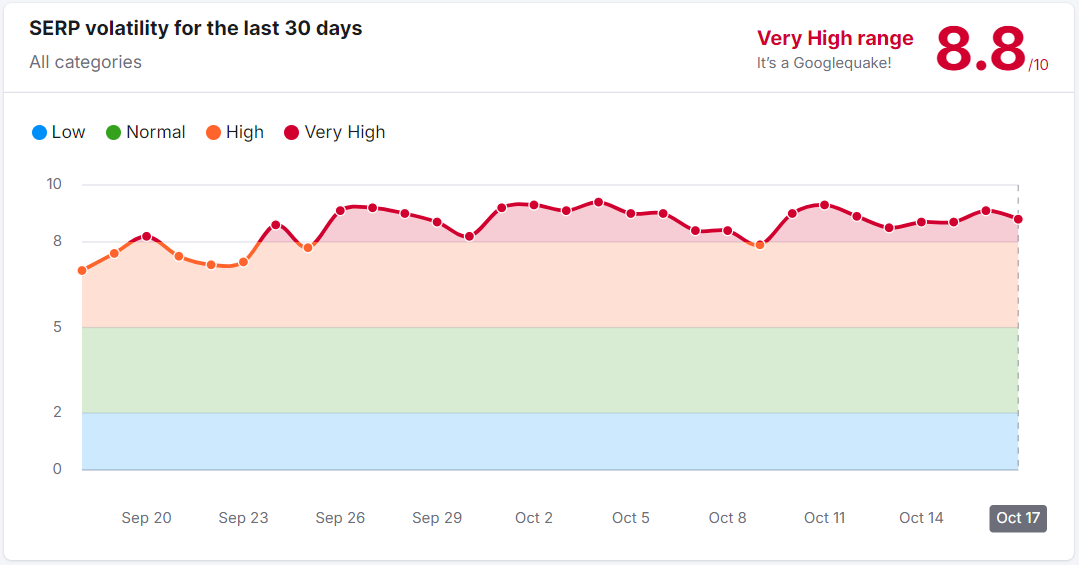
At the time of writing this blog, we’re still experiencing the longest period of high volatility ever recorded. Over the last 30 days, we haven’t dropped below a 7 out of 10 on SEMrush’s volatility sensor, with below a 5 considered normal levels. Only 7 days of this have been considered ‘high’ levels, with the rest of the 30 days being above an 8 out of 10 and considered ‘very high’.
The volatility peaked at 9.4/10 on the 4th of October, but it hasn’t started slowing down just yet, with a 9.3 on 11th October and a 9.1 on the 16th.
It has now been over two months since the August Core Update began on the 15th August and over 1.5 months since it finished rolling out on the 3rd September. With a normal update, we usually expect volatility for 2-4 weeks after it has finished rolling out. However, this has been much longer than a normal update, reaching higher levels than we’ve seen before.
How Do You Check Volatility?
There are a lot of different ways to check search engine volatility, but all of them essentially do the same thing. You can choose the one you like best (or the one you already have a subscription for) and stick with that.
Here are a few options for search volatility trackers:
There are many more options across the web, but these are some of the most popular options out there. Some, such as SEMrush, will provide you with a guide to explain what is considered high volatility and what is normal, so this is a great place to look if you’re just getting started.

Avoid Google Update Impacts With an Experienced SEO Team
To avoid being negatively impacted by the next Google Core Update, you need to make sure that your site is effectively optimised to avoid any pitfalls. This not only involves a deeper understanding of what Google wants to see on your site right now, but also knowledge of what they’re aiming for in the future.
Here at Wildcat Digital, we have an expert team that can optimise your site the ‘right way’, avoiding any black hat techniques or quick trick workarounds that might get penalised in future updates. To discuss how we can help you thrive through search volatility, get in touch with a member of our team or visit our SEO page for more information. For regular updates on everything SEO, you can also read our monthly SEO roundups!

Jamie Stowe
Senior SEO Account Manager