Quick answer: Most SEO and PPC campaigns sit somewhere between £500–£5,000+ per month depending on competition, growth goals, the work required, and the channels involved. Digital PR retainers start from £1,500/month. We don’t charge separately for “AI SEO”. It’s already built into how we run SEO campaigns.
Want a rough figure for your business? Use our free SEO, PPC and digital marketing cost calculator.
Understanding SEO, PPC and Digital PR pricing
Trying to figure out what SEO, PPC or Digital PR should actually cost can be frustrating. One agency quotes £500 per month and another quotes £5,000 for what appears to be the same service.
The problem is that “digital marketing” can mean completely different things depending on the agency. One campaign might be fairly light local SEO. Another could involve technical SEO, CRO, Digital PR, content production and wider digital marketing strategy.
That’s why digital marketing prices vary so much.
A local business wanting more enquiries in one city needs something completely different to a national business competing across multiple services and locations. The amount of work behind the campaign changes massively depending on the competition, growth goals, website quality and how aggressive the strategy needs to be.
To help make sense of it, we’ve broken down the main factors that influence digital marketing costs and what businesses can realistically expect to invest.
This page covers:
- Why digital marketing pricing varies so much
- How much SEO costs
- How much PPC management costs
- How much Digital PR costs
- What actually affects pricing
- And where businesses often waste budget
By the end, you should have a much clearer idea of what a realistic budget looks like for your business and the factors that will influence it.
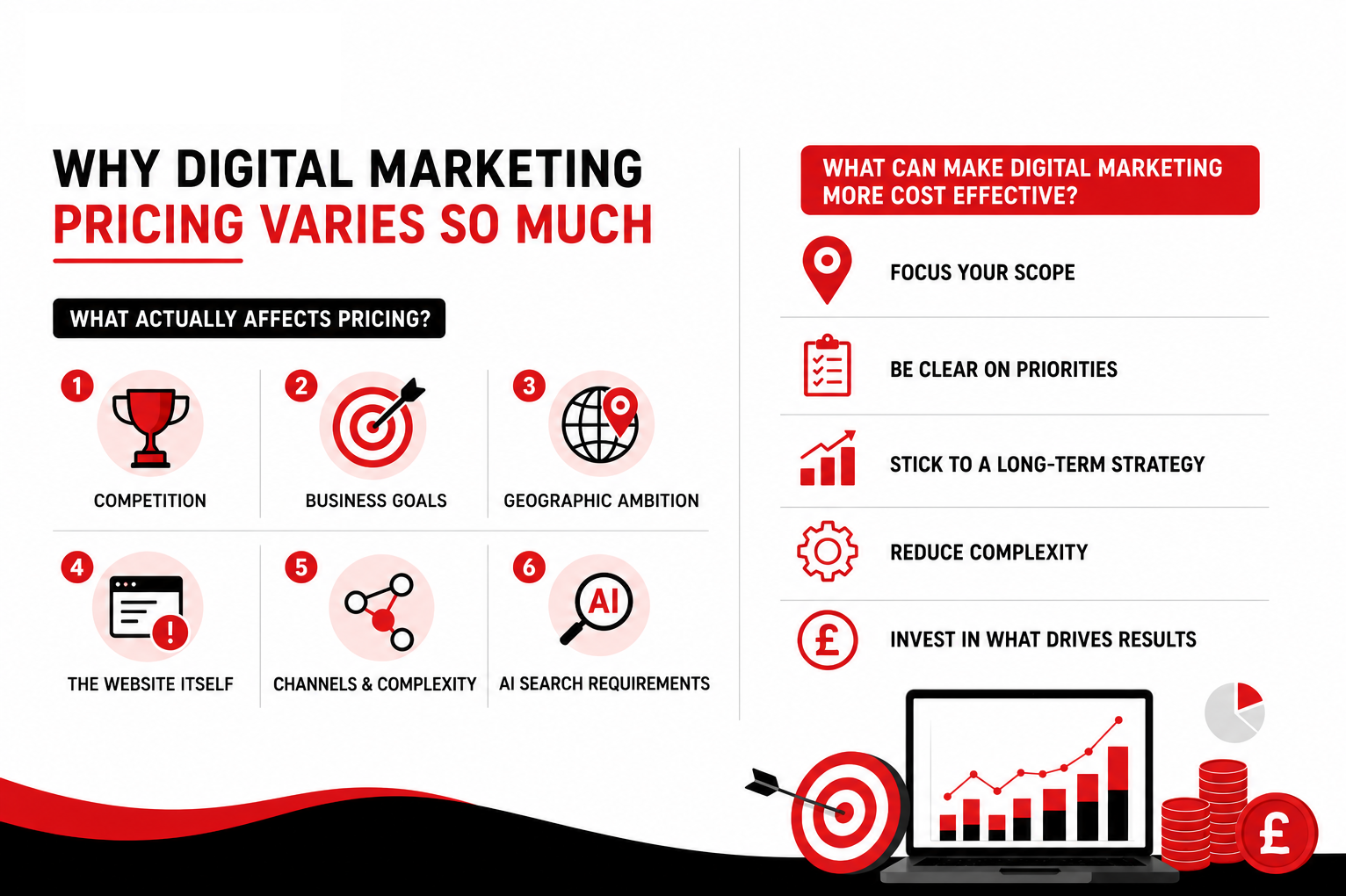
Why digital marketing pricing varies so much
UK digital marketing pricing has risen significantly over the last couple of years, mostly driven by higher content standards, more complex SEO requirements and increasing demand for experienced specialists. According to Whitehat SEO’s 2026 UK agency benchmarking data, that increase reflects expanded scope of work, not just inflation.
What actually affects pricing?
-
Competition: Competition is usually the biggest pricing factor because more competitive markets require more work to achieve meaningful results.
In SEO, that often means producing more content, improving more landing pages, earning stronger backlinks, carrying out more technical optimisation and investing more time in strategy and analysis. In PPC, competition typically drives up cost-per-click (CPC), meaning a larger advertising budget is needed to generate the same number of leads or sales.
Trying to rank for “plumber in Sheffield” requires a very different level of investment compared to competing nationally for “cyber security company UK”, and campaign costs reflect the additional work required.
-
Business Goals: The level of growth you’re trying to achieve will also influence the investment required.
For example, maintaining existing visibility in search results is usually less resource-intensive than doubling lead volume or aggressively growing market share.
More ambitious objectives typically require faster execution, broader activity and a greater level of ongoing optimisation.The bigger the goal, the more resource is generally needed to achieve it within a realistic timeframe.
- Geographic ambition: The larger the area you want to target, the more resource is usually required.
A local campaign may only need a handful of location pages and a focused keyword strategy. A national campaign often requires significantly more content, broader keyword coverage, stronger authority signals and more extensive optimisation across the website. International campaigns add further complexity through localisation, translation, technical implementation and market-specific research.
As the scope of a campaign increases, so does the amount of work needed to compete effectively.
- The website itself: The condition of your website can have a significant impact on pricing. If a website already has strong foundations, campaigns can focus on growth activities much sooner. However, websites with technical issues, weak content, poor user experience or unclear messaging often require additional work before meaningful progress can be made.
The more issues that need addressing at the start of a campaign, the more time and resource will be required.
- Channels and complexity: The number of channels involved will also influence pricing. Managing SEO, PPC and Digital PR together requires more specialist expertise, coordination and reporting than running a single channel. Each channel has its own strategy, implementation and optimisation requirements.
While this typically increases investment, it can also create stronger overall results because the channels support and reinforce one another.
- AI search requirements: Modern SEO now includes optimisation for AI-powered search experiences such as Google AI Overviews, ChatGPT and Perplexity.
This doesn’t usually mean paying for an additional service, but it does affect the way SEO campaigns are delivered. Content, website structure, authority signals and technical optimisation all need to be approached differently to maximise visibility within AI-generated results. As search evolves, the work required to remain competitive evolves with it.
What can make digital marketing more cost effective?
While some factors naturally increase the amount of work required, others can make campaigns significantly more efficient and improve the return you get from your marketing budget.
Smaller geographic targets, lower-competition markets and websites with strong existing foundations generally require less work, allowing more of the budget to be focused on growth rather than overcoming barriers.
Clear priorities also help. When a business knows which products, services or locations matter most, campaigns can concentrate resources where they are most likely to generate commercial results.
A consistent, long-term strategy can improve efficiency too. Frequent changes in direction often slow progress and create additional work, whereas a focused approach allows momentum to build over time.
In most cases, maximising value comes from reducing complexity, improving focus and investing in the activities most likely to drive results.
The right budget depends on what a customer is worth
Two businesses can require exactly the same amount of work but justify very different levels of marketing investment.
For example, a company generating £10,000 in profit from a new customer can usually justify a much larger SEO or PPC budget than a company generating £200.
That’s why we spend time understanding your commercial objectives, customer value and growth targets before recommending a budget. The right investment isn’t determined by industry averages alone. It’s determined by whether the campaign is likely to generate a positive return.
How much does SEO cost per month in the UK?
SEO pricing varies significantly depending on your market, competition, website and objectives. As a broad guide, most UK SMEs invest between £1,200 and £2,500 per month for ongoing SEO. Local campaigns often start from around £500 per month, while competitive national campaigns can exceed £3,000 per month.
The figures below reflect typical industry pricing rather than Wildcat Digital’s pricing specifically. If you’d like a more tailored estimate based on your business, use our digital marketing cost calculator.
According to a 260-agency UK survey by SE Ranking, 78% of SEO providers work on a monthly retainer model. That’s because SEO builds over time. The work done in the early months continues contributing long after it’s implemented, which is why constantly stopping, restarting or switching direction usually slows progress down.
| SEO campaign type | Typical monthly investment |
|---|---|
| Local SEO | £500 – £1,500 |
| Regional SEO | £1,500 – £3,000 |
| National SEO | £3,000 – £10,000+ |
| eCommerce SEO | £2,000 – £10,000+ |
That range is wide but the difference between campaigns is equally wide. A local electrician targeting one city and a national SaaS company competing across hundreds of commercial keywords need completely different levels of work. The content requirements, technical depth, authority building and reporting are nowhere near comparable.
Affordable SEO for small businesses – £500 to £1,500 per month
Usually suited to businesses targeting a single city or region. The focus is normally local keyword targeting, on-page optimisation, Google Business Profile work and improving local visibility overall.
In most cases, this is the realistic starting point for small business SEO if you want enough resource behind the campaign to properly move things forward.
One thing worth knowing: Campaigns below £500/month rarely involve enough genuine strategic work to move the needle. That budget typically covers automated tools, templated reporting, and minimal human input. It’s not always worthless, but expectations need to match reality.
SEO for growing businesses – £1,500 to £3,000 per month
This is where most growing SMEs tend to sit, especially if they’re competing regionally or nationally. Usually enough resource for technical SEO, content creation, Digital PR, ongoing optimisation and proper strategic support rather than just covering the basics.
In most cases, this is where SEO normally starts having a much bigger commercial impact because there’s enough activity behind the campaign to properly build momentum over time.
A common situation we see: Businesses that have spent 12 months paying a lower-cost agency, seen minimal movement, and come to us wondering what went wrong. Usually it’s not that SEO doesn’t work for their sector, it’s that there simply wasn’t enough activity behind the campaign to compete properly.
Enterprise SEO pricing – £3,000 per month and above
Usually suited to larger businesses, highly competitive sectors, large e-commerce sites and multi-location brands.
These campaigns normally involve significantly more technical SEO, content production, Digital PR and strategic support throughout. Competing nationally in difficult markets simply requires more resource behind the campaign.
Why fixed SEO packages often become limiting
A lot of agencies structure SEO around fixed monthly deliverables such as a set number of blogs, backlinks, or keyword targets. The problem is campaigns rarely need the same thing every month.
One month might need technical fixes, landing page improvements, and CRO work. The next might need content production, authority building, and expansion into new services or locations. Campaigns built around a rigid deliverables list tend to hit a ceiling where they’re completing tasks rather than solving problems.
What’s included in a Wildcat SEO retainer?
Most SEO retainers with Wildcat Digital include technical SEO, content creation, on-page optimisation, link building, reporting, strategy and ongoing account management as standard.
We also build AI search visibility into every campaign as standard. Structured data, content structure and wider authority signals are now just part of how we approach SEO rather than a separate add-on service.
If we uncover technical issues during the campaign, straightforward fixes are normally handled within the retainer. More complex development work or larger site changes are scoped separately and discussed upfront first.
How much does PPC management cost in the UK?
PPC pricing is normally split into two parts, which is the management fee paid to the agency and the advertising budget paid directly to platforms such as Google, Microsoft or Meta.
As a broad guide, most UK SMEs pay between £500 and £1,500 per month in management fees, with ad spend sitting separately on top.
The figures below reflect typical industry pricing rather than Wildcat Digital’s pricing specifically. If you’d like a more tailored estimate based on your business, Use our free digital marketing cost calculator to see what a realistic budget might look like based on your competition, growth goals and the channels you’re investing in.
PPC management costs are influenced by factors such as ad spend, campaign complexity, the number of platforms involved, landing page support and the level of growth you’re aiming to achieve.
| PPC campaign type | Typical monthly management fee |
|---|---|
| Small business PPC | £500 – £1,500 |
| Regional campaigns | £1,500 – £3,000 |
| National campaigns | £3,000+ |
| Multi-channel paid media | £5,000+ |
These ranges should be viewed as a benchmark rather than a quote. A local service business running a small number of campaigns requires a very different level of management to a national brand operating across multiple products, locations, audiences and advertising platforms.
It’s also worth remembering that a lower management fee doesn’t always mean lower overall marketing costs. Well-managed campaigns often reduce wasted ad spend, improve conversion rates and generate a better return on investment, making the total cost per lead or sale lower over time.
Some agencies charge a flat fee. Others charge a percentage of ad spend, while some use a hybrid model. The pricing structure matters less than whether the campaigns are generating a genuine commercial return, not just clicks and traffic.
How much should PPC ad spend be?
PPC ad spend goes directly to platforms like Google, Microsoft and Meta and sits separately from the management fee. A workable starting ad budget is usually around £500–£1,000/month for local or tightly focused campaigns, rising to £2,000–£5,000+/month for more competitive national activity.
One of the most common PPC mistakes is trying to run campaigns on budgets that simply aren’t high enough to compete meaningfully in the market. In more competitive sectors, a £300/month budget might generate very little visibility. Not because PPC doesn’t work, but because the budget isn’t large enough to compete consistently in the auction.
Before launching PPC, it’s worth understanding what realistic ad spend looks like for your sector and growth goals.
Wildcat Digital’s management fees are charged separately from your advertising budget. Your ad spend is paid directly to the advertising platform, while management fees cover campaign strategy, optimisation, reporting and ongoing account management.
Use our free PPC cost calculator for a rough estimate.
What does PPC management include?
At Wildcat Digital, PPC management includes campaign strategy, keyword research, ad copywriting, conversion tracking, landing page support, reporting and ongoing optimisation.
A lot of the performance gains in PPC come after campaigns go live. Ongoing optimisation, testing, search term reviews and refinement are usually what improve lead quality and efficiency over time.
How much does Digital PR cost in the UK?
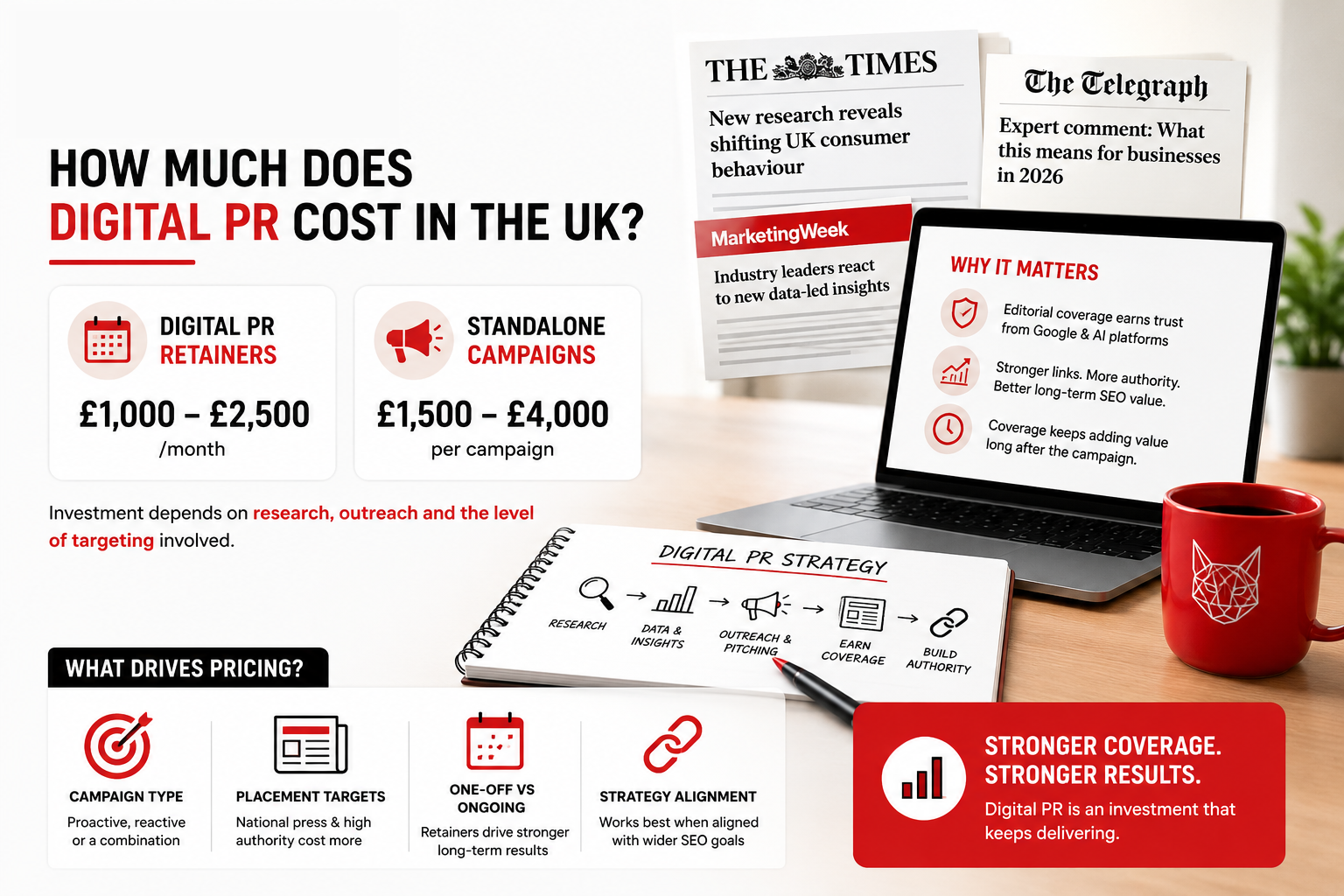
Digital PR retainers in the UK typically range from £1,000–£2,500/month. Standalone campaigns usually sit between £1,500–£4,000 depending on the level of research, outreach and targeting involved.
It’s become one of the most important parts of modern SEO, especially for competitive industries and AI visibility.
What is Digital PR and why does it affect pricing?
Digital PR helps businesses earn coverage and links from trusted publications such as national press, trade websites and industry platforms. Unlike bulk link building, the placements are editorial. A journalist or editor has actively chosen to reference your brand, campaign or research. That matters because Google and AI search platforms both place far more trust in credible editorial coverage than low-quality link building.
It’s also why Digital PR usually costs more than bulk link building. The coverage takes more work to earn, but the long-term SEO value is significantly stronger. Strong editorial coverage can continue adding SEO value long after the campaign itself.
What drives Digital PR pricing up or down?
Campaign type has a big impact on pricing. Proactive Digital PR campaigns normally involve original research, data studies or creative campaign work designed to earn media coverage, so they usually require significantly more time and resource behind them. Reactive PR is normally quicker and focused on responding to relevant journalist opportunities as they come through. In most cases, the strongest strategies combine both.
Placement targets also affect pricing. Earning coverage in national press and high-authority trade publications normally requires significantly more planning, targeting and outreach work than targeting smaller or lower-authority sites. Fifty low-quality links rarely have the same impact as the way five strong editorial placements do.
One-off campaigns and ongoing retainers are priced differently too. A standalone campaign usually generates a short burst of coverage, whereas consistent monthly activity is normally what drives the strongest long-term SEO growth and brand visibility. Strong coverage can continue adding value years after the original campaign.
Digital PR also becomes more effective when it’s aligned with the wider SEO strategy. The targeting, research and content work all support the same visibility goals, which usually makes the overall campaign much more effective.
Digital PR pricing breakdown
Campaign-based Digital PR – £1,500 to £4,000 per campaign
Usually suited to businesses wanting to test Digital PR before committing to ongoing monthly activity.
A campaign will normally focus on a specific piece of research, data-led content, expert commentary or news-focused outreach designed to earn coverage and links across relevant publications.
Digital PR retainers – £1,000 to £2,500 per month
Ongoing monthly activity combining proactive campaigns with reactive PR opportunities.
This is normally where stronger long-term SEO and authority growth starts becoming much more noticeable because coverage, links and brand visibility continue growing over time rather than relying on one-off campaigns.
Digital PR within SEO retainers
In many cases, Digital PR is built into wider SEO retainers rather than treated as a completely separate service.
When SEO and Digital PR are aligned properly, the content, targeting and authority-building work usually performs much more effectively overall.
Digital PR tends to become most valuable when a business already has strong foundations in place and needs additional authority to compete in more competitive search results. In many cases, it’s the difference between reaching page one and becoming one of the most visible brands in the market.
Website quality matters more than most businesses realise
A lot of businesses assume more traffic will fix performance issues. Sometimes it helps. But if the website itself isn’t converting properly yet, sending more traffic to it rarely changes the outcome.
Improving a landing page conversion rate from 2% to 4% can completely change campaign performance without increasing traffic spend at all.
It’s also one reason some agencies cost more than others. The work often extends beyond traffic generation into landing page improvements, conversion optimisation and proper attribution.
A business spending £2,000/month on PPC with a 0.5% conversion rate is probably getting a worse return than one spending the same amount with a 3% conversion rate. More traffic doesn’t fix a website that isn’t converting properly.
Why cheap digital marketing isn’t always cheaper
This is where businesses sometimes get caught out. A lower monthly cost can still become expensive if it produces very little commercial impact.
| Campaign | Monthly cost | Leads generated | Approx. cost per lead |
|---|---|---|---|
| Lower-cost SEO campaign | £500 | 5 | £100 |
| Stronger SEO campaign | £2,000 | 40 | £50 |
The second campaign costs more overall but generates leads far more efficiently. That’s why digital marketing costs are usually better judged against lead quality, conversion rates, sales value and customer lifetime value rather than just the monthly fee.
Why are some SEO agencies so cheap?
Some SEO agencies are cheaper because the level of resource, strategic input and support behind the campaign is different.
High client numbers, templated reporting, junior-only delivery and minimal proactive work are all common reasons some agencies are able to charge less.
None of those things are automatically bad either. Some businesses genuinely only need lighter support.
But it’s important to understand that “SEO management” can mean very different things depending on the agency. The level of strategy, implementation, reporting and proactive support behind a £400/month retainer is rarely the same as a £1,500/month campaign.
Why are some SEO agencies expensive?
Some SEO agencies are more expensive because there’s more specialist support and resource involved behind the campaign.
Senior strategic input, technical specialists, CRO support, content production and multi-channel management all increase the level of resource behind the campaign.
Some agencies also position themselves at the premium end of the market regardless of delivery model.
The bigger question is whether the investment makes commercial sense for the growth opportunity, not just whether the monthly number feels high in isolation.
What a digital marketing setup month actually involves
We charge separately for setup because it’s where much of the research, planning and tracking work happens. Rolling this work into monthly retainers often makes pricing less transparent and can result in businesses paying for setup over a much longer period than necessary. This is a one-off cost agreed upfront in your proposal before delivery begins.
For SEO and PPC, setup is typically between £1,000–£1,500 depending on the scope of the campaign. Digital PR setup varies more depending on the amount of research, targeting and campaign planning involved, but your proposal will always include a clear figure.
The setup stage is where the strategic groundwork for the campaign gets done properly. It’s the research, planning and tracking work that shapes everything that happens afterwards.
For SEO, that includes a kick-off session with our Head of Growth and your dedicated account manager so we can properly understand the business, goals and commercial priorities, not just the initial brief. From there, setup normally includes a full site audit, keyword and competitor research, strategy creation and a tracking review so performance can be measured properly from day one.
For PPC, setup includes the same initial kick-off process alongside account structure planning, campaign builds, ad copy creation and conversion tracking setup. The goal is to launch campaigns with the right structure, tracking and data in place from the start.
For Digital PR, setup includes the initial strategy session, audience and publication research, campaign planning and ideation work needed to make outreach genuinely targeted and relevant from the start.
What actually slows campaigns down
Even well-funded campaigns can struggle if the foundations aren’t in place. In many cases, the biggest barriers to performance aren’t the strategy itself, but the practical challenges that prevent it from being implemented effectively.
Poor tracking is one of the biggest issues. If conversion tracking isn’t set up properly, it becomes very difficult to understand what’s genuinely driving leads and revenue. Campaigns can appear to perform well on paper while generating very little commercial return underneath.
Campaigns also regularly stall because content approvals take too long, landing pages never go live or development work keeps getting pushed back internally. The businesses that normally grow fastest are usually the ones able to implement changes quickly and consistently.
A lot of digital marketing performance issues are operational rather than strategic. Sometimes the issue isn’t the campaign itself. It’s that the work needed to support the campaign never fully gets implemented.
How Wildcat structures its pricing
Most campaigns run on an initial six-month agreement.
SEO, PPC and Digital PR all require enough time to implement the work, gather meaningful data and assess performance properly. Judging results too early often leads to poor decisions and stop-start campaigns.
Six months provides enough runway to build momentum and make informed decisions based on real performance data.
After the initial period, agreements renew every six months rather than locking businesses into long annual contracts.
Is digital marketing actually worth the cost?
It tends to work well when…
- There’s genuine search demand for what you sell
- You’re willing to invest consistently over six months or more
- Your website is already in a reasonable position to convert traffic
- You have a clear understanding of what a customer is worth to the business
- There’s buy-in on both sides rather than treating it as a purely outsourced service
Be cautious if…
- Your business model is still being validated. Sort that first.
- You need immediate revenue with zero tolerance for a ramp-up period
- Your website can’t convert the traffic being sent to it
- Your tracking is broken and there’s no reliable baseline to measure from
- Your budget is so tight that one difficult month would end the campaign before it has a chance to generate momentum
If any of the above is true, we’ll tell you in the consultation. We’d rather have that conversation upfront.
Should you invest in SEO, PPC or Digital PR?
The right channel depends on your goals, timeframe and the level of competition you’re facing. In many cases, the strongest results come from combining channels rather than treating them separately.
SEO
SEO is usually the best fit for businesses looking to generate consistent long-term visibility and reduce reliance on paid advertising over time.
It tends to work particularly well when there is clear search demand for your services, you’re willing to invest consistently and you want to build a sustainable source of enquiries or sales.
PPC
PPC is often the quickest way to generate visibility and leads because campaigns can start driving traffic as soon as they go live.
It’s typically most effective for businesses that want faster results, need to target specific services or audiences, or want more control over lead generation and budget allocation.
Digital PR
Digital PR is often most valuable when a business is already investing in SEO and wants to strengthen its authority, improve visibility in competitive markets and earn coverage from trusted publications.
For many businesses, Digital PR becomes increasingly important as competition grows and stronger authority signals are needed to outperform competitors.
Combining channels
SEO, PPC and Digital PR are often strongest when they work together.
PPC can generate immediate visibility while SEO builds long-term growth. Digital PR can strengthen authority and support both organic rankings and AI search visibility. When the channels are aligned, each one tends to make the others more effective.
How to choose the right digital marketing agency
The right agency isn’t the cheapest or the most expensive. It’s the one that understands your commercial goals, communicates honestly about what’s working and what isn’t, and gives you a realistic picture of what competing in your market actually requires.
Good SEO, PPC and Digital PR management should feel commercially grounded. You should always understand what’s being prioritised, why it matters, what impact it should have and what happens next, not just what tasks were completed that month.

Why businesses choose Wildcat Digital
There are plenty of agencies offering SEO, PPC and Digital PR. The difference is often less about the services themselves and more about how they’re delivered.
At Wildcat Digital, we focus on helping businesses understand what is driving performance, where opportunities exist and what needs to happen next. That means clear communication, commercially focused strategy and honest conversations about what’s working and what isn’t.
Some of the reasons businesses choose to work with us include:
- SEO, PPC and Digital PR managed under one roof
- AI search visibility built into our SEO approach as standard
- Dedicated account management and strategic support
- Transparent setup fees and clear pricing
- Flexible strategies rather than rigid package deliverables
- Reporting focused on commercial outcomes, not just rankings and traffic
- Straightforward advice, even when that means recommending a smaller budget or a different approach
Digital marketing works best when both sides understand the objectives, the strategy and the expected outcomes. Our goal is to make that process as clear and transparent as possible.
Typical digital marketing budgets
The figures below are realistic starting points based on the level of competition, campaign scope and amount of work involved.
| Your situation | Estimated monthly retainer |
|---|---|
| Local SEO, low competition | £500 – £1,000/month |
| Local SEO with Digital PR | £1,000 – £1,800/month |
| Regional SEO, medium competition | £1,500 – £3,000/month |
| National SEO, medium competition | £2,000 – £4,000/month |
| National SEO, high competition | £4,000 – £8,000+/month |
| Enterprise SEO | £5,000 – £10,000+/month |
| PPC, small business / local | £500 – £1,500/month + ad spend |
| PPC, national / competitive | £1,500 – £3,000+/month + ad spend |
| Digital PR retainer | £1,000 – £2,500/month |
| Digital PR campaign | £1,500 – £4,000 per campaign |
| SEO + PPC | £2,000 – £5,000+/month + ad spend |
| SEO + Digital PR | £2,000 – £5,000+/month |
| Full multi-channel retainer | From £3,000/month |
Agency fees only. PPC ad spend is separate. Setup fees apply to all new campaigns and web design/development work is not included within the estimator.
Digital marketing pricing FAQs
How much does digital marketing cost in the UK?
It depends on the services involved and the scale of activity. A focused local SEO campaign might start from around £500/month, while a national multi-channel programme covering SEO, PPC and Digital PR will usually sit between £3,000 and £8,000+/month.
The right investment depends on your competition, growth targets and what a customer is worth to your business.
How much does SEO cost in the UK?
SEO pricing in the UK ranges from around £500/month for smaller local campaigns through to £10,000+/month for highly competitive or enterprise-level campaigns.
For most UK SMEs, meaningful investment normally sits between £1,500 and £3,000/month. This is usually where there are enough hours in the campaign to support proper strategy, implementation and ongoing optimisation rather than just ticking boxes.
How much does PPC cost in the UK?
PPC management fees typically range from £500 to £3,000+/month depending on campaign scale, complexity and the level of ongoing optimisation involved.
Ad spend sits separately on top of that. Some agencies charge a fixed monthly management fee, while others charge a percentage of ad spend. Wildcat Digital uses both approaches depending on the size and complexity of the account. Your advertising budget is always paid directly to the platform and remains fully visible to you.
How much does Digital PR cost in the UK?
Digital PR retainers typically sit between £1,000 and £2,500/month, while standalone campaigns usually range from £1,500 to £4,000 depending on the level of research, outreach and placement targeting involved.
National press outreach and more competitive campaigns generally require more resource behind them.
How much does AI SEO cost in the UK?
At Wildcat Digital, AI visibility isn’t treated as a separate service. It’s already built into how we approach SEO.
Things like structured data, content structure, brand authority and visibility across platforms like ChatGPT and Google AI Overviews are now just part of modern SEO rather than a standalone add-on.
What is the difference between SEO and GEO?
SEO focuses on improving visibility in traditional search results.
GEO (Generative Engine Optimisation) focuses more on improving visibility across AI-generated answers and AI search platforms like ChatGPT, Gemini and Perplexity.
In reality, the two now overlap heavily. Strong SEO foundations also support visibility across AI search platforms.
Do you charge by the hour?
Most of our work is structured around monthly retainers rather than hourly billing.
The more important question is usually what the campaign delivers commercially rather than how many hours sit behind it.
That said, hourly rates can apply for additional work outside the agreed scope.
Should I use an SEO freelancer or an agency?
It depends on the type of support you need.
A freelancer can work well for specific projects such as technical audits, content support or one-off strategy work.
Agencies are usually better suited to ongoing campaigns involving technical SEO, content, Digital PR, PPC and CRO working together consistently.
The other consideration is continuity. If a freelancer becomes unavailable, campaigns can sometimes lose momentum quickly.
Do you charge setup fees?
Yes. Every campaign starts with a one-off setup phase before the monthly retainer begins.
For SEO and PPC, setup is typically between £1,000 and £1,500 depending on scope.
Digital PR setup varies more depending on the amount of research, targeting and campaign planning involved.
Everything is confirmed clearly in your proposal before work begins.
How flexible are retainers?
Wildcat Digital works on six-month agreements that renew every six months rather than long annual contracts.
Campaign scope can still evolve within that period depending on priorities, performance and growth goals.
Some businesses increase activity as results build, while others scale back or shift focus into different channels over time.
If a business wants to move more quickly, increase delivery temporarily or bring additional work into the campaign as a one-off, we can usually accommodate that too.
The initial six-month term exists because SEO, PPC and Digital PR all need enough time to properly implement the work, gather meaningful data and assess performance fairly.
Can I run SEO and PPC at the same time?
Yes, and for many businesses it makes sense to.
PPC delivers immediate visibility while SEO builds longer-term organic authority.
Running both together also creates useful data that can improve performance across both channels over time.
For example, PPC search term data often helps shape SEO content strategy, while organic search performance can help refine paid targeting.
Can I scale my budget up or down?
Yes. Campaign scope can be adjusted over time depending on priorities, performance and budget changes.
In many cases, it makes more sense to adapt the strategy than stop activity completely.
Do you work with businesses outside Sheffield?
Yes. Wildcat Digital is based in Sheffield but works with businesses across the UK and internationally.
Most campaigns are managed remotely.
Free Digital Marketing Cost Calculator
Use our free SEO, PPC and Digital PR pricing calculator to get a rough idea of what realistic investment could look like for your business.
It won’t replace a proper strategy discussion, but it will help benchmark realistic budgets based on your services, competition and growth goals. It takes less than a minute to complete.
You can use this as:
- SEO cost calculator
- PPC budget calculator
- Digital PR pricing calculator
- General digital marketing budget calculator
Once you’ve got your figure, the next step is a free consultation with our Head of Growth, Rich. He’ll talk through your goals, answer any questions and give you a realistic view of what level of investment makes sense for the market you’re competing in.
If we think there’s a better approach, a smaller starting point or that now simply isn’t the right time to invest more heavily, we’ll say that too.