
Breadcrumbs are a small but powerful element of technical SEO that can help users and search engine crawlers to navigate, understand, and in the case of users, stay on your website. So, how are they important to SEO?
Breadcrumbs are important for SEO as they can help search engines like Google understand your website better and how your URLs are linked to each other. They can help with user engagement as they make it easier for users to find pages of your website, understand the category they are in and ultimately, spend more time on your site.
Read on to learn more about breadcrumbs and how they help SEO.

What are Breadcrumbs?
Breadcrumbs on a website are a form of navigation that shows the user the steps they made to get to their current page, and usually allows them to click back to a previous step or homepage easily. The term comes from the well known phrase to ‘leave a trail of breadcrumbs’. Essentially, leaving yourself a way back to where you started.
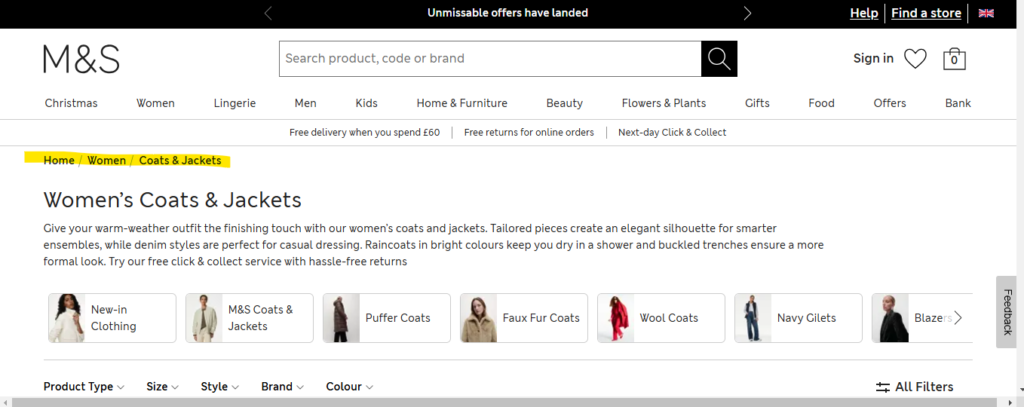
Breadcrumbs typically appear at the top of a website page, under the main navigation. They are a lot smaller so as not to confuse users and may be underlined. They show the steps users have taken with a “>” or “/” symbol representing the path taken.
Why Are Breadcrumbs Important?
Breadcrumbs are important for a number of reasons:
- They help users to navigate your website easily, showing clearly your website hierarchy. This can be especially useful when a user has landed on your website from an external link, giving a backwards path to other potentially useful pages.
- They help website crawlers to understand your site structure and website hierarchy.
- If they are available, Google uses them in the search results which can help to attract users to your website.
- They are helpful for accessibility – They can be helpful for users with disabilities to easily navigate the website and can also be read by screen readers for the visually impaired.
- They can be particularly useful on ecommerce websites to show users the category products belong in.
What Impact Do Breadcrumbs Have on SEO?
Breadcrumbs can help with your SEO efforts in a number of ways. They can:
- Help with user engagement – Giving users an easy way to navigate around your website means they are more likely to stick around and browse, as opposed to bouncing straight off the website. Although bounce rates are not a ranking factor (engagement rate is important to Google), sending positive signals could help to improve your overall SEO efforts.
- Help search engine crawlers understand your website better. Your breadcrumbs are essentially internal links that help crawlers understand your website hierarchy and how URLs are linked to each other. The easier a website is to crawl, the less time it takes to crawl and index more pages.
- Impact user experience. We all want to visit websites that are easy to navigate and have things in logical order. If a website is too difficult to use, we are less likely to convert.

How to Optimise Breadcrumbs for SEO
To ensure that the breadcrumbs used on your website are adding value and meet SEO best practices you should consider:
- Whether you have incorporated a keyword – where relevant it is good for both users and search engines.
- The size of your breadcrumbs. If you make the links too big they may disrupt the user experience and compete with your main navigation bar.
- Are they actual links? Some websites add the breadcrumbs but they aren’t clickable so don’t hold value.
- Are they relevant for your website? If you only have a small website with a very simple structure then breadcrumbs may not be necessary and shouldn’t be added for the sake of it. They are most beneficial on websites with larger more complex structures, and are great for ecommerce websites.
Implementing Breadcrumbs on Your Website
There are 3 main types of breadcrumbs that can be implemented on your website.
Location-based breadcrumbs. These tell users which section of the website hierarchy they are.
Attribute-based breadcrumbs. These breadcrumbs tell you which category or tag you are under on a website. Commonly seen in blogs that have categories or filters.
History-based breadcrumbs. These detail the user journey and will show each page in order from the homepage to your current page.
Breadcrumbs can be implemented through the HTML & CSS of your website, through schema markup or through a relevant plugin, such as Yoast.

Kickstart Your SEO With Wildcat Digital
If you’re looking to boost your website visibility and enhance your position on the search engine results pages, we can help. We are a team dedicated to SEO and PPC, from local strategies to technical SEO we work alongside you to deliver results. Get in touch with a member of our team today to discuss your goals.

Thea Chapman
SEO Account Manager