Since search engines are continuously evolving, they can sometimes throw you a curveball. When your business relies on search engines for traffic and income, it can be quite frustrating and difficult to know what the current best practices are. So, if you suspect you’ve been given a Google penalty – what do you do? In this article, we explain what Google penalties are and how to fix them.
So, what is a Google penalty? A Google penalty is essentially a punishment that Google gives to websites that do things it doesn’t like, such as using Black hat SEO tactics to improve their rankings. These penalties can make a website’s ranking in Google SERPs (search engine result pages) drop significantly.
Continue reading to learn more about what a Google penalty is and how you can recover from it.
What Actually is a Google Penalty?
In essence, a Google penalty is a punishment for a website that violates the marketing practices that Google recommends. A Google algorithm update or a manual review may result in this penalty if a website is found to be using unethical SEO tactics such as keyword stuffing or hiding content.
Check out our blog for more information on unethical SEO tactics, also called ‘Black Hat SEO’.
What is the Purpose of a Google Penalty?
While Google penalties can be annoying if you get one unfairly, they are part of Google’s mission to fight spam or websites that try to manipulate its algorithms. As a result, those who put in the effort and practise the right SEO methods such as publishing high-quality content and optimising your site’s loading speed, will have a better chance of ranking.
5 Things You Should Know About Google Penalties
If you receive a Google penalty, here are 5 things you need to know.
1. Once You Receive a Google Penalty, Your Site is No Longer Listed on SERPS
A Google penalty means your website is either not showing up in Google SERPs (search engine results pages) anymore or it’s way down the list. When this happens, your target audience cannot find you. This ultimately results in a decrease in organic traffic to your site. Fewer visitors mean fewer conversions.
Keep in mind that this can happen to any website. However, once Google penalises your site, you’ll need to invest significant effort into regaining a favourable position and establishing trust with Google. You can do this by maintaining high-quality content on your website.
2. There are Several Types of Google Penalties
There are different types of Google penalties for different reasons. Here are the 6 types of penalties and what they mean.
- Manual action penalty: This is the process where individuals tasked with assessing website content impose penalties. Making it the only penalty not automated by AI , instead administered by humans.
- Unnatural links: Google has two types of penalties for “unnatural links.” The first is when your website contains fake or misleading links going to other websites. The second is when your website gets fake or misleading links from other sites pointing to it.
- User-generated spam: A user-generated spam penalty doesn’t mean your website is considered spam, but the users coming to your website are.
- Hacked site: This penalty essentially reflects a situation where nothing is in your control. Despite your perfect compliance to Google’s rules, your website gets hacked. Ensuring your plugins are updated and that you’re using a secure hosting service are two of the most important factors to avoiding this.
- Cloaking: This is where you expose different types of content to Google and visitors. It’s like telling Google one story and your customers another. For example, search engines might see a page about destinations for holidays while users might see a page about cheap shoes. This is accomplished by adding text to a page when a search engine, rather than a person, requests it.
- Thin content: Content that Google sees as unoriginal or duplicated from elsewhere. To find out more about thin content, check out our blog here.
3. A Google Penalty is not the Same as an Algorithm Impact
A Google algorithm update is usually responsible for a sudden decrease in your website’s search ranking. This suggests that your site isn’t meeting Google’s latest quality standards.
On the other hand, a Google penalty happens when your website breaks Google’s rules for website owners, called Webmaster Guidelines. So, if there hasn’t been any news of an algorithm update, your website may have been penalised.
4. Google Penalties Last Until You Fix Them
You are responsible for fixing your Google penalty. They don’t just disappear or change overnight. When a certain amount of time passes without a penalty being fixed, the alert will vanish from your search console, but the penalties’ effects will still be felt.
5. Google Penalty Recovery is Fixable
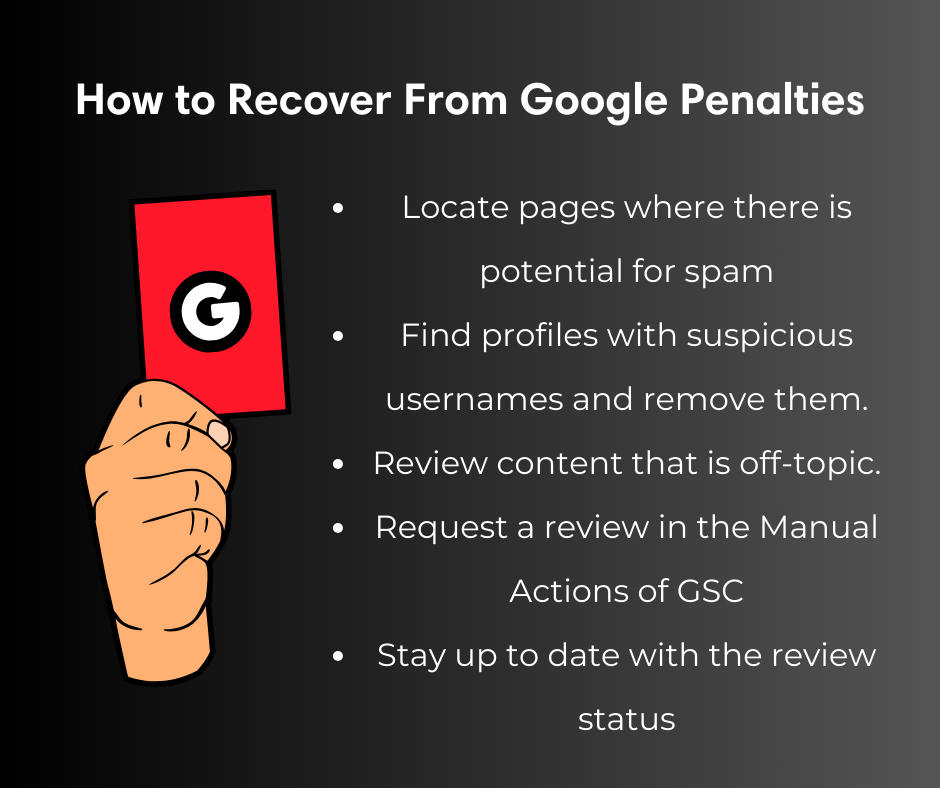
Good news, if you have a Google penalty, it is fixable! Here are 6 simple ways to fix your google penalty.
- Locate pages where there is potential for users to create spam content such as comments on blog posts.
- Find profiles with suspicious usernames and remove them.
- Examine your website for spam or any unrelated keywords that have been used.
- Review content that is off-topic.
- Request a review in the Manual Actions report section of your Google Search Console account.
- Stay up to date with the review status.
Avoid Google Penalties with Wildcat Digital
At Wildcat Digital, we pride ourselves on ethical and high-quality SEO services – so you don’t have to worry about Google penalties. Get in touch with us today by filling out our contact form, for a free initial consultation.
Or, if you’d like to learn more about SEO and how Google works, check out our Knowledge Base. Our SEO experts have been working hard to answer a wide range of real questions to help you understand what we do.