
If you want your website to rank highly on search engine results pages (SERPs), targeting high-quality, relevant keywords is essential. Knowing which keywords you should target is one of the most important aspects of a strong SEO strategy but is also one of the most challenging. So, how do you know which keywords you should target?
The best keywords to target should be relevant to your target audience and what they’re searching for online. You should also check the keyword’s search volume and difficulty. Most businesses should aim for keywords that have at least 50-100 searches a month and have a ‘very easy’, ‘easy’ or ‘possible’ keyword difficulty.
Read on for a more in-depth explanation of which keywords are best to target from the SEO experts at Wildcat Digital.
Jump to:
- What Type of Keywords Are Best?
- How Many Keywords Should I Target?
- How Do I Find The Best Keyword to Use?
- What is the Best Keyword Strategy?

What Type of Keywords Are Best?
The most important factor you should consider when choosing keywords to target is how relevant they are to your business. Your content should answer a question, solve a problem or otherwise help your target audience. Think about questions, phrases and topics that are relevant to your industry, product and services and potential customers. If the keywords you target are not relevant to your website or what you’re selling, your content will struggle to rank and any users that land on your site will likely not be interested in your products or services.
Although relevance is the most important aspect of choosing your keywords, there are many other factors that you’ll need to consider, including:
- Keyword intent
- Keyword volume
- Keyword difficulty
- Balancing short and long-tail keywords
We’ll go over these in more detail below.
Which Keyword Intent is Best?
When a user types a query into a search engine, they want to find relevant content that answers their query and matches their intent. For example, if they type in ‘buy white Nike men’s trainers’, the user wants to be shown relevant products, rather than a blog post about the most popular trainer styles. This is because the search query had transactional intent – the user was searching for specific products to buy.
There are four types of keyword intent:
- Commercial intent – Users researching available products or services before they make a purchase. For example, ‘best window cleaning in Sheffield’. You can target commercial intent keywords with comparisons, reviews, or how-to pages.
- Transactional intent – Users are looking to buy a product or service. For example, ‘Used Nissan car for sale’. You should create specific product, service or category pages to target transactional intent keywords.
- Navigational intent – Users are looking for a specific website or page. For example, ‘Semrush login’. You should naturally rank for these keywords.
- Informational intent – Users looking to learn more about a topic, find an answer to a specific question or solve a problem they have. For example, ‘which keywords are best to target?’. Blogs are the perfect way to target informational intent keywords.
Learn more about search intent and how it impacts rankings in our recent blog.

What is a Good Volume for Keywords?
Search volumes give you an indication of how many people search for a specific keyword each month. Generally, high-volume keywords mean that you have a chance of receiving a high volume of traffic if you rank highly. However, high-volume keywords tend to be highly competitive because many pages are trying to rank for these keywords.
A ‘good’ volume for a keyword will depend on how niche your industry is and where you are at in your SEO strategy. A small company operating in a niche field might consider 300 searches a month to be a very high-volume keyword, while a more established business might consider this to be a low-volume keyword.
Here’s an overview of what might be considered a ‘good’ search volume:
- 30 searches a month for a very niche offering
- 100 searches a month for a specialised industry or new business
- 500-1000 searches a month for most industries, products and services
For more information on targeting keywords with a low search volume, have a look at our blog, ’Is It Worth Targeting Keywords With Low Volume?’.
What is a Good Number for Keyword Difficulty?
Most SEO tools will also provide a keyword difficulty to show how challenging it is to rank for that keyword. These are typically a number from 0-100, with higher numbers indicating a more difficult keyword.
The SEO tool Semrush calculates keyword difficulty based on a range of factors, including the median number of referring domains pointing to the ranking URLs and the median authority score of ranking domains. Semrush gives 6 levels of keyword difficulty:
- 0-14 = Very easy. These are the best keywords to choose if you have just started your SEO strategy or want to rank highly as quickly as possible.
- 15-29 = Easy. For these keywords, you’ll need to write quality, optimised content, but you should still be able to rank highly even if your website is new.
- 30-49 = Possible. This will require well-structured, well-written content that’s effectively optimised for the target keywords.
- 50-69 = Difficult. You’ll need quality backlinks to rank for these keywords and new businesses will likely struggle to rank.
- 70-84 = Hard. To rank for these keywords, you’ll need unique content and a range of high-quality backlinks.
- 85-100 = Very hard. You’ll need to put in a lot of effort into gaining backlinks, on-page SEO and promoting your content.
Is Higher Keyword Difficulty Better?
Although high-difficulty keywords typically have higher search volumes, they have a lot of competition and can be extremely difficult to rank for. Generally, you should try to target ‘very easy’, ‘easy’ or ‘possible’ keywords, unless you have the time and skills needed to gain backlinks.
Have a look at our blog, ‘How Many Backlinks Do I Need to Rank?’ for more information on this.
What’s the Difference Between Long and Short-Tail Keywords?
Short-tail keywords are broad and generic terms that have a high search volume and keyword difficulty. They typically consist of one to three words, for example, ‘trainers’, ‘rabbit food’, or ‘all-inclusive holidays’.
Long-tail keywords are much more specific and tend to have a lower search volume and keyword difficulty. These are usually phrases, sentences or questions that have more than three words. For example, ‘best travel destinations for students’, ‘how do I fix a punctured bicycle tyre’, or ‘brown leather women’s sandals’.
For a more in-depth breakdown, check out our blog, ‘What is the Difference Between Short and Long-Tail Keywords?’.
How to Balance Long and Short-Tail Keywords?
You’ll need to balance short and long-tail keywords when choosing which keywords to target.
As a general rule, you should use short-tail keywords for the key pages on your site, such as the home page, category pages and product or service pages. Short-tail keywords will usually be the most relevant and this strategy will help you attract commercially focussed visitors to your site. Long-tail keywords, especially questions, are ideal for blog posts as you rank highly and attract potential customers who might make a purchase later down the line.

How Many Keywords Should I Target?
Targeting 3-5 keywords for each page or piece of content is the best strategy for small-to-medium businesses. This doesn’t mean your page will only rank for those keywords, as there will often be keyword variations or longer-tail keywords which you’ll also rank for.
It’s best to choose a primary keyword which is the main topic of a page and is included in the page title. You can then choose two to four secondary keywords. Secondary keywords should be closely related to the primary keyword and could include subtopics and long-tail keywords that expand on the main topic of the page.
What is Keyword Stuffing and Why Should I Avoid It?
A common misconception with SEO is that targeting more keywords means you’ll rank for more keywords and your page will generate more traffic. However, targeting too many keywords will actually have the opposite effect. Google penalises content when the amount of keywords affects the quality of the content and makes it difficult for users to understand. This process is known as ‘keyword stuffing’ and it should be avoided. To learn more, check out our guide to keyword stuffing.
Limiting the number of keywords you target is especially important given Google’s recent 2024 Core update which has put more of a focus on prioritising ‘helpful’ content. Read our March Digital Marketing Digest, to learn more about what this update means.
How Do I Find The Best Keyword to Use?
Now you understand the importance of choosing keywords based on their relevance, keyword volume and difficulty, the next challenge is knowing how to find these keywords. We’ve broken it down into four steps to make things easier.
1. Identify Keywords You Already Rank for in Search Results
The first step should be to check which keywords you’re already ranking for. You can use a paid tool, like Semrush, or a free tool, like Google Search Console. This will allow you to see your best-performing pages, prevent you from creating duplicate content and identify low-ranking pages which could be updated and re-optimised to help them rank more highly.
2. Brainstorm Keyword Ideas and Topics
Next, brainstorm potential topics, subtopics and keywords that you think your target audience might be interested in.
For example, if you own a landscaping company you might start by thinking of the following topics:
- Paving and decking
- Water features and pools
- Lighting
- Trees, shrubs and plants
- Garden layouts
- Gardening tips
3. Look at What Keywords Your Competitors Are Targeting
Another useful starting point is your competitors’ websites. You can look at what kinds of topics they’re writing about and which keywords they’re ranking for (you’ll need an SEO tool). Add any topics or subtopics that you haven’t thought of previously to your brainstorm.
4. Find Keywords Using a Keyword Research Tool
One of the best ways to find keywords is to use a paid SEO tool, like Semrush. This will give you in-depth information about the search volume, keyword difficulty, user intent and which domains are already ranking for specific keywords. You can use Semrush’s Magic Tool to view keywords broken down into topic clusters which can be a useful way to find similar keywords or research subtopics.
If you’re looking for long-tail keywords for blogs, then you can search for question keywords. Here’s what that might look like for ‘landscape gardening’:
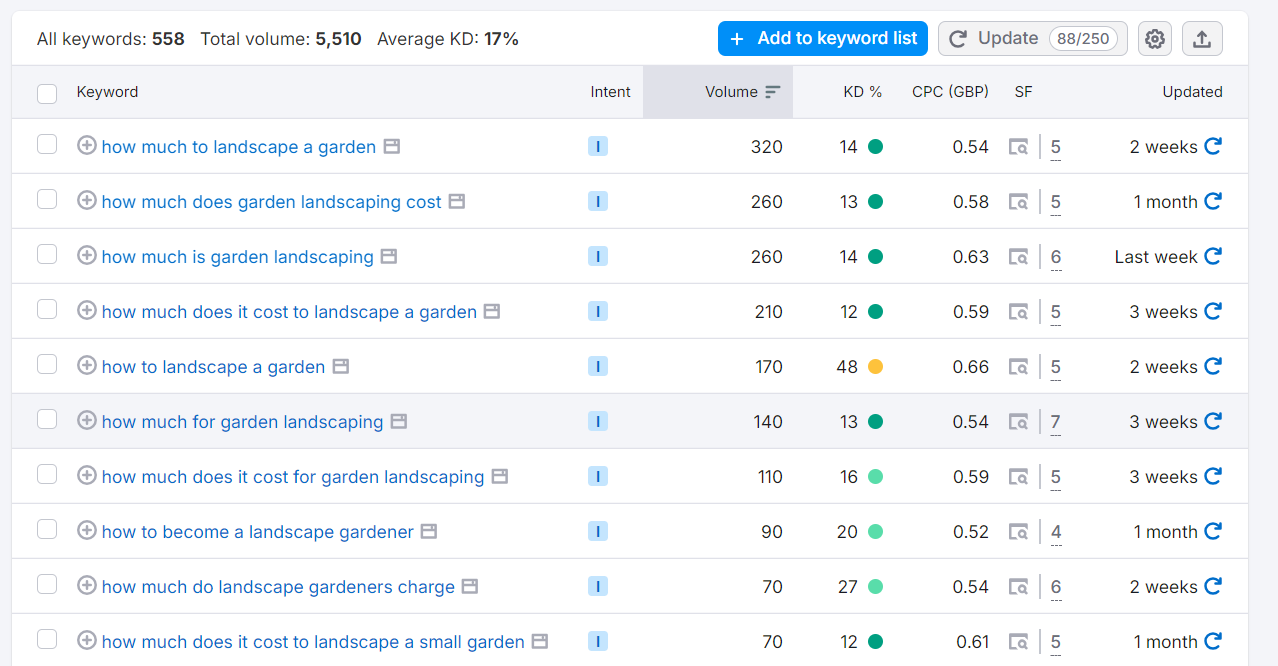
Remember to choose keywords that have a relatively high search volume, but aren’t too challenging to rank for. Make sure you also check that the intent matches the types of content you’re planning to write. For example, a blog wouldn’t be suitable if a keyword had transactional intent.
5. Identify Secondary Keywords
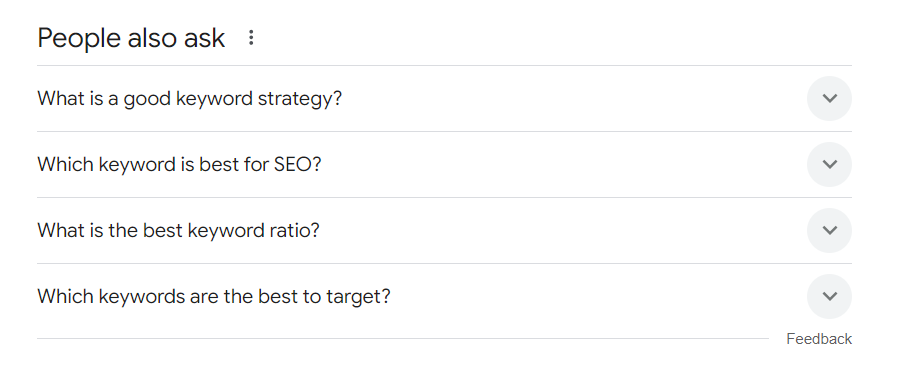
After you’ve identified your primary keywords, it can be useful to find some secondary keywords to improve your content. You can do this by looking at the People Also Ask sections of the SERP (at the top and bottom of the page). This will give you some insight into subtopics to include in your content and ensure you thoroughly cover the main topic.
What is the Best Keyword Strategy?
Building an effective keyword strategy takes time and expertise. It should involve defining your SEO goals, analysing your current rankings, reviewing the SERPs and finding relevant keywords.
Here are three simple steps you can follow to build a successful keyword strategy.
Step 1: Define Your Goals and Strategy
Start by defining your SEO goals and the strategy you’ll use to accomplish them. These goals should be aligned with your wider marketing strategy and business objectives.
Here’s what this might look like:
- Goal – Improve the number of relevant keywords your site is ranking for.
- Strategy – Write high-quality, relevant content optimised for low-difficulty long-tail keywords.
Step 2: Analyse Your Current SEO Performance
Before you start creating new content or researching new keywords to target, you must have a clear understanding of your current performance. Conduct a thorough content audit which should include which keywords your content is already ranking for.
Check out our blog,‘What to Include in a Content Audit’, for a complete list.
Step 3: Use Keyword Research Tools to Look at Keyword Intent, Difficulty and Volume
Your keyword strategy should be based on real data and although brainstorming topic ideas can be a useful starting point, using a keyword research tool is essential for an effective keyword strategy.
We’ve already covered this earlier in this blog, but here’s a quick recap of the key factors you’ll need to consider:
- Relevancy– How relevant is the keyword to your target audience?
- Volume – How many people are searching for this keyword in a month?
- Difficulty – How challenging is it to rank for this keyword?

Perfect Your Keyword Strategy with Wildcat Digital
If you’re struggling to know where to start with your keyword strategy or you’re not seeing the SEO results you want, getting an experienced SEO agency involved might be the best decision for your business.
Wildcat Digital is an award-winning SEO agency based in Sheffield. We work with local, national and international businesses, helping them choose the right keywords and punch above their weight online.
We know exactly how to choose the best keywords for your business and create high-quality optimised content that ranks highly in the SERPs. To see how our methodical approach to keyword research has helped our clients, check out our case studies. Or get in touch with our team, if you’d like to learn more about working with us.
If your business needs a hand with finding and using the right keywords, then don’t hesitate to get in contact with our SEO department today.

Kezia Humphries
SEO Executive