
As content production increases across the internet, users are exposed to more information than ever before. As AI search features scale and unverified claims spread faster than ever, search engines are under pressure to bring users content they can trust.
That’s why citations and transparent sourcing are playing an increased role in how our websites are evaluated and, for SEOs, why getting this right can mean the difference between ranking well and disappearing from search results. So, how is Google responding to the rise of misinformation?
Originally introduced in 2014, trust signals have long been a factor in the search performance of websites when assessed by Google. However, it wasn’t until Google’s major ‘Medic’ algorithm update in 2018 that expertise, authority, and trust were prioritised in search rankings, especially for ‘your money, your life’ niches. Since then, Google has focused on promoting high-quaity content that serves users, while penalising those that perpetuate misinformation.
As part of our wider Authority and Trust Signals pillar, this blog breaks down exactly why fact-checking and credible sourcing are vital to SEO performance, and how best to implement them on your website.
Why Citations Matter For Content Credibility
Citing sources and linking to further detail for the information you provide in your content plays a huge part in the expertise, authoritative, and trustworthiness (E-A-T) of your website. The more accurate information your content provides, backed up by trusted sources, the more likely your content is to be seen as credible by search engine users.
The History Of E-A-T
The concept of expertise, authoritativeness, and trustworthiness, or E-A-T, was first introduced into Google’s Search Quality Guidelines in 2014, but it wasn’t until a major algorithm update in 2018 that it became particularly important for rankings and metrics.
This August 2018 update, known as the ‘Medic’ update, significantly increased the importance of E-A-T signals. It was designed to tackle one of the most critical issues faced by search engines – the rise of low-quality and misleading content.
Following this update, a huge number of sites that were previously performing, particularly those in the ‘Your Money, Your Life’ niche, saw their rankings and performance plummet as Google tackled pages that were manipulating the search engine rankings to promote false information on sensitive topics.
The ‘Medic’ update reevaluated not only the importance of credibility, but how Google assessed it, leading to the promotion of high-quality content that serves the needs of users, instead of those that simply met the ranking criteria.
Trust Signals As We Know Them Today
As SEOs, we now know the trust signals framework as ‘E-E-A-T’, with the additional ‘E’, or experience, added by Google in December 2022. This then formed part of the updated search rating guidelines, which are used by human search raters to evaluate Google’s ranking systems.
This addition placed emphasis on content produced by someone with first-hand experience in the topic they were writing about. For example, sites offering financial advice would now be more likely to rank higher if they were credited as being written by someone with long-term experience in financial services.
Whilst E-E-A-T is not a direct ranking factor, it allows both Google search raters and content producers to identify content that has the potential to not only perform well in search results, but also be seen as accurate by users.

Best Practices For Citing Sources And Research
As with most of the work involved in SEO, there aren’t step-by-step instructions that will automatically guarantee improved rankings through citations, but there are some techniques you can keep in mind throughout the creation of your content that will signal greater authority.
Including these best practices naturally and evenly throughout content is the key to strengthening your site’s trust signals and avoiding penalisation for manipulating the algorithm.
Outbound Links
Like internal links and backlinks, outbound links are a key part of showing the authority and trustworthiness of your website and its content.
When making a statement within a piece of content, you may have the experience to simply know it as a fact, but those reading have no reason to believe that you’re telling them the truth. By linking out to other trusted sites and businesses that echo the statements you’re making, you’re showing just how knowledgeable you are about this topic.
Even if you’re not a complete expert, outbound links to reputable sites demonstrate that your content is well-researched and tells search engines that you are a credible source.
Outbound links also help search engine bots truly understand the topic of your page and which industry it belongs to, meaning your site is more likely to be shown to the right audience for the right keywords.
Citing Research
Facts and figures from credible sources are an excellent way to signal that your content is well-researched and accurate, with links to the original information only helping to boost your authority.
Citations to government websites, peer-reviewed studies, or surveys from well-known sites are especially useful in showing that your content is not just an opinion you’re using to promote your business, but is supported by reputable data.
The linking of credible websites and sources is particularly crucial for ‘Your Money, Your Life’ topics, like health, finance, or legal advice. Not only does it help to build trust with users, but it also helps to signal to Google that your information is safe and accurate, which can help to improve rankings.
Structured Data
With the addition of ‘experience’ to trust signals in 2022, first-hand experience is equally as important to building your site’s authority as links to other sites. By using structured data, often referred to as schema, you can connect your content to the author profiles of the people or organisations that have written it.
‘Person’ or ‘Organisation’ schema can help you to provide Google with more information about who the producer of the content is and what experience they have in the industry.
You can then connect this to the structured data for your article with “sameAs” properties, which helps Google to build a knowledge graph that verifies who you or your business is and what experience you offer. This, in turn, strengthens your E-E-A-T signals and increases rankings.

Well-Sourced Content vs Unsupported Claims
As more and more content is produced online every day, not all of the information provided should be viewed equally. Some claims are backed by research, data, and sources, while others simply rely on vague language and sweeping statements.
Knowing what elements to look for when provided information is accurate and trustworthy is not only important for content writers and SEOs, but also for readers when seeking out information that can be relied on. So, let’s look at an example from an industry we know well here at Wildcat – SEO!
Example 1: Unsupported Claims
“Using more keywords in content automatically improves your website’s rankings in Google.”
This content does make a statement that you could take as fact, but it doesn’t provide evidence, context, or even just a further explanation. It relies on a simple equation, ‘Content + Keywords = Good Rankings’, which we know isn’t the case in SEO.
This statement uses absolute language, ‘automatically’, which is often a red flag for misinformation when not backed up by citations. Readers here are left with no knowledge of why this is the case, when it applies, or which reputable source supports the claim.
Example 2: Well-Sourced Content
“Including keywords and phrases that are being searched for by your desired audience in your content will help Google to show your page to the right people. However, keyword stuffing, where you excessively repeat keywords over and over, is against Google’s spam policies and will likely result in lower rankings.”
This version of the content explains the same topic as Example 1, but supports it with an authoritative source – Google itself. It clarifies how content is evaluated and provides links to the original and reputable sources, while avoiding absolute language (‘likely’) to set realistic expectations and provide actionable guidance.
Key Takeaway
The difference between these examples doesn’t simply lie within the addition of a linked source. The information provided by that source gives the content depth and clarity. It replaces absolutes with explanations and helps readers to understand the reasoning behind why this information is important.
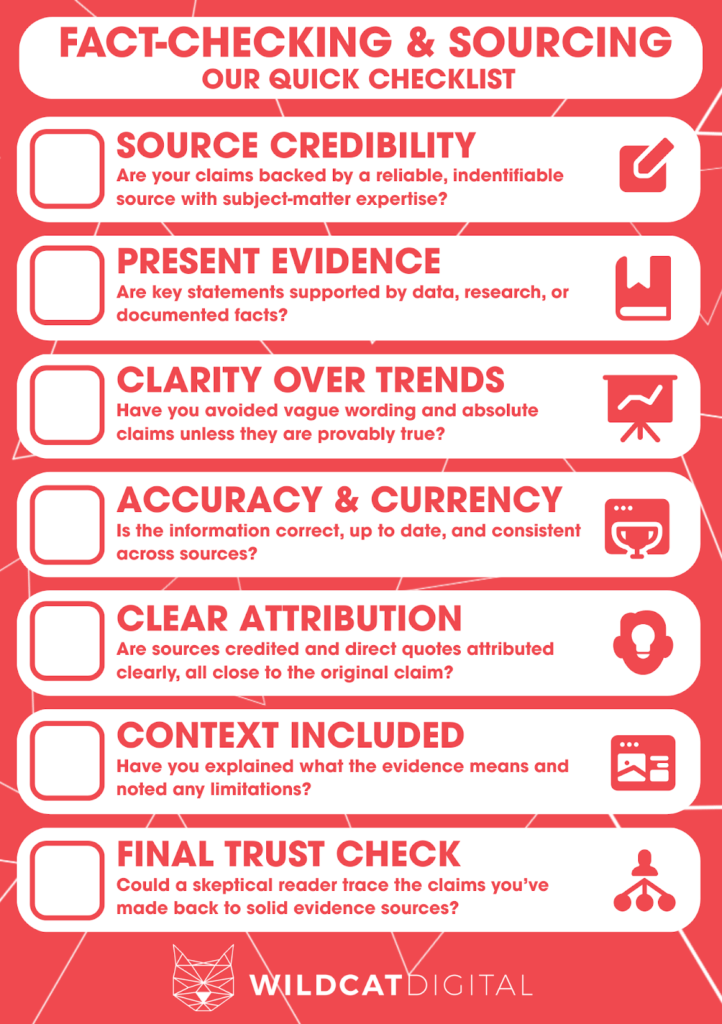
Our Checklist For High-Quality SEO Content
Fact-checking and citing sources are vital for presenting your content as high-quality and reliable. We know there aren’t always strict instructions as to how to meet Google’s guidelines, so here are some questions from the Wildact team that if you answer ‘yes’ to, your content is good to go.
✔️ Verify The Source
- Does your information come from a reputable organisation, expert, or credible primary source?
- Can you clearly identify the publisher of the information and why they’re qualified?
- Is your source free from obvious bias or conflicts of interest?
✔️ Check For Evidence
- Are any claims made supported by data or research, not opinions?
- Have statistics, studies, or quotes been clearly referenced or linked?
- Is the information current and up-to-date, especially if the topic is notoriously ever-changing?
- Do multiple trusted sources support the same conclusion?
✔️ Avoid Vague Or Absolute Language
- Have you removed phrases like “always”, “never”, or “guaranteed”, unless they are explicitly true and backed by facts?
- Are the benefits, risks, and limitations clearly explained?
✔️ Clear Attributions
- Are sources included close to the claim, not buried?
- Are direct quotes clearly marked and attributed?
- Does the content avoid copying without proper citation?
✔️ Add Context
- Have you explained what the data means, rather than simply listing it?
- Are readers given enough background information to understand the claims made?
- Are exceptions, assumptions, or uncertainties explicitly acknowledged?
✔️ A Final Credibility Check
- Could a sceptical reader trace your claims back to reliable evidence?
- Does the content build trust rather than rely on trends?
- Could you defend your claims publicly?
Tip For Content Writers: If your claim can’t be traced back to a clear, credible source, treat it as a signal to pause and verify, or leave it out entirely.
Become A Trusted Source With Wildcat Digital
No matter what sector your business is a part of, the authority and trustworthiness of your brand is key to not only improving your rankings but also to building an audience that values your experience.
Knowing exactly what to include to meet E-E-A-T guidelines is hard, which is why the team here at Wildcat Digital keep trust signals in mind when we optimise and create content for your website as part of your digital marketing strategy.
Avoid the guessing game and let our expert SEO team take over – we have plenty of experience in building the authority and performance of businesses across both the Uk and the world!
Get in touch with us today to find out more about our digital marketing services, or book your free consultation.

Amy Varley
SEO Executive