
Many businesses assume that Author and Meet the Team pages are simply a nice way to showcase the people behind the brand. In reality, these pages are an important contributor to E-E-A-T signals and can strengthen organic performance and keyword rankings across your entire website.
Search engines increasingly prioritise trustworthy, experience-led content. Users want to know who they are reading, what qualifies that person to talk about the subject, and whether the information can be trusted. Strong, verifiable author pages help answer these questions clearly. This value is passed to your business if you link these entities through schema.
This article sits within our wider Authority and Trust cluster. It breaks down why author pages matter, how to optimise them, and how they support both E-E-A-T and YMYL expectations in 2026 and beyond.

Why Are Author Pages Important for SEO?
Author pages show Google and visitors that your content has been produced by real people with relevant experience. When done well, they support Experience, Expertise, Authoritativeness and Trustworthiness (also known as E-E-A-T).
These signals have become essential for ranking competitive content, particularly in sectors where accuracy, safety or financial impact are key.
From a user perspective, people want reassurance that the content they are reading is written by someone they can trust. Seeing a name, a face, and a clear background helps build confidence and encourages users to stay longer, read further and convert more easily.
Even if the user doesn’t explicitly see these signals, they may unconsciously notice them, which helps them continue reading down the page, helping us to promote our content as marketers and SEOs.
From a search perspective, Google’s search documentation highlights the need for high-quality, reliable information. Search Quality Rater Guidelines are clear that identifiable authorship and verifiable credentials enhance trust, especially for YMYL topics.
Research from Search Engine Journal has also shown that attributed content often receives higher engagement and better reader retention.
When combined, these signals help establish stronger credibility across your site. This can contribute to improved visibility, more consistent rankings and increased user confidence in your brand. Building strong author pages, therefore, reinforces the claims made in your content by attributing it back to a real-life entity, the author.
As this author is a part of your business, this attributes trust signals from readers, search engines and LLMs back to your business, ultimately resulting in higher authority scores and improved rankings.
For more information on Author Pages and their importance to authority, why not read: What Is An Authority Score, & Can Better Rankings Boost It?
Let’s look closer at building entities within your website, allowing users, search engines and LLMs build up a better picture of your business.
Author Pages and Building Entities for Your Business
Most businesses have an internal structure of staff, assets, locations, products and services. These can be known as entities. Building an understanding of these entities is essential for modern SEO strategies.
Helping search engines, users and now LLMs understand these entities is critical for SEO in the modern era. Author pages allow your staff to build up their own knowledge graph by having their work attributed back to their own page. This page becomes a place where an understanding is built about the author, making them an authority on the topic.
Find out more about topical authority with our blog What is Topical Authority in SEO? (& How to Build it)
Here’s an example:
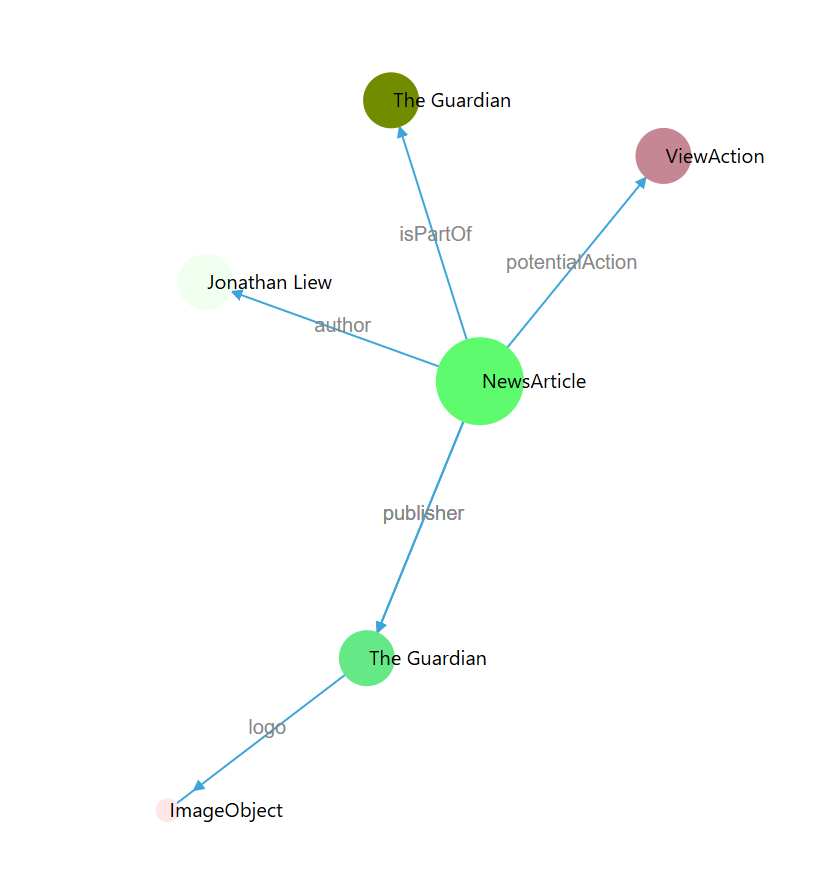
This image is of a schema snippet from a news article from The Guardian. It shows nodes of information (ie, entities) about a news article from journalist Jonathan Liew.
This schema connects these entities to each other so that a relationship between entities can be understood by search engines and LLMs (ChatGPT, Copilot, etc.), so that this information can be easily retrieved and understood when prompted.
Creating an Author Page allows authors to build up a single point (node) of information (URL) through which all of their relationships can be understood.
If we were to ask Google or ChatGPT a question related to Jonathan’s topics of journalism, it can call upon his author page for EEAT signifiers and portfolio of work to understand that he is an authority within these topics.
As such, Jonathan gets quoted more, referenced more, and appears highly in search results. This, in turn, results in more eyes on the Guardian website.
By building an author page for their writers, The Guardian has built an index of experience, expertise, authority and trustworthiness within their site, a key ranking factor for all websites online.

Author Schema and Entity SEO
Creating entities and linking them together is key to building an understanding of your business’s products, services, staff and other entities that make your business tick.
Having this information on your website is one strategy; however, building these relationships into stone-cold facts will better this understanding, allowing you to help communicate your business goals to readers and crawlers.
To achieve this, schema is often implemented on an author page to help push key players within your business and their related articles, blogs and topics. This push can appear in search results as Rich Results, but schema also acts as a menu for information on your page.
For more information on schema, why not read What is Schema in SEO or Is Structured Data a Ranking Factor?
How to Write Author Pages for SEO
Writing author pages for your team is actually rather easy, as long as you remember to include certain entities in your profile and then link these entities up in the accompanying schema.
First, let’s assess what you ought to include in your author bios to best display EEAT signals to readers and search engines.
How to Write Content for Author Pages
Writing content for your author pages should be honest and fall within your business’s guidelines. Of course, providing information online about anyone should be approved by them first.
That said, every good author page should include:
- Name
- Image
- Role
- Experience
- How long they have worked for the business
- Relevant qualifications (with evidence, where applicable)
- Topics
- Professional profiles (LinkedIn or other portfolios)
- Contact information
- Hobbies and interests
- Fun facts
Offering the above information in the written text on your website will provide enough information on you or your staff to readers. However, this may not be enough to display this information to search engines and LLMs.
To better coordinate this information and to link these entities back to the author, schema should be added to the page to enrich this information.
How to Write Schema for Author Pages
Implementing the schema on the individual author pages can also be conducted via a few methods, namely dynamically or statically. You can write the schema yourself using documentation from schema.org, or use a schema generator.
The method that you take depends on your preference, and indeed, the number of pages that you have to get through. Either way, the entities that we ought to include are nodes within the schema itself.
We are taking the ingredients of your authors and building a menu of their attributes through your website, by creating Author Schema for each page.
Let’s take another look at the list of entities above to show how they match up with the nodes required for a full schema:
- Name: Person.name
- Image: Person.image
- Role: Person.jobTitle and optionally Person.worksFor
- Experience / Bio: Person.description
- Time with business: best modelled via a Role node with startDate
- Qualifications: Person.hasCredential (type EducationalOccupationalCredential)
- Specialist areas of study: Person.knowsAbout (topics), optionally Person.alumniOf (schools)
- Interests: keep on-page, optionally also knowsAbout if relevant to writing
- Fun facts: on-page only
The above list of entities required from your staff aligns with the nodes needed to create a powerful author page. As such, dynamically implementing author pages is simple. Manual input is also a task of simple data entry.
Create the schema and add it to your page, filling the attributes discussed above, and your author page will be added to the knowledge base of Google, ChatGPT, etc.
This makes your blogs more powerful as they are now written by an attributable entity (person) online, building a centralised node of EEAT that ultimately adds power to your business and its online presence.
Where Your Author Bios Should Sit on Your Website
There are a couple of simple options when it comes to where your author bios should sit on your website. However, bear in mind that it doesn’t have to be one or the other. In fact, it’s best to feature an author bio on both:
A Meet the Team Page
This is probably the most common way of showcasing your employees. A large number of websites have Meet the Team pages that include an image of the employee and a short bio about them underneath. Some websites take it a step further by having dedicated pages or pop-up boxes that go into more detail about each employee (like us – take a look here!).
At the Bottom of Articles
If you or your team write blogs or articles for your website, it’s also a good idea to have some kind of author bio attached to these blogs so that readers and search engines can see the experience and expertise of the author, therefore building authority and trust. Usually, these are boxes at the top or bottom of an article. Take a look at the bottom of this blog for an example.
Other E-E-A-T Elements to Consider for Effective SEO
Author bios aren’t the only E-E-A-T element you can implement on your website. There are a variety of things you can do to help showcase your experience, expertise, authority and trustworthiness. Here are some of the most common:

About Page
Publishing an About Us page helps users to understand more about who you are, why you exist and why they should choose you over competitors. It’s another opportunity to showcase your experience and expertise.
In fact, some smaller companies actually choose to house their Meet the Team section on their about page.
Reviews
Legitimate reviews are a great way to build trust with your audience. Ideally, you would use some kind of plugin to draw the reviews indirectly from a third party like Google or Trustpilot – this shows that the reviews are real and not just made up to look good.
Further to this, replying to your reviews shows an additional level of trustworthiness, especially if they aren’t positive. Showing that you care and are willing to address feedback is a great way to build trust.
Contact Details
Don’t make your customers hunt for contact information! Having it in an easy-to-find place, such as on a Contact Us page or in the footer, makes it much easier for your customers to be able to get in touch with any questions or concerns. This adds another layer of trust.
Google also uses your contact information for a variety of purposes that can help with ranking. Making sure that it is easily found when Google crawls your site means that this information can be used to boost performance.
Security – SSL, HTTPS
Making sure your website is secure is an easy way to show trustworthiness with your users and with Google. Ensure that your SSL certificate is valid and consider using HTTPS instead of HTTP. Google encourages the use of HTTPS for security and privacy purposes and even made it a ranking factor.
Building Authority and Presence Online with Wildcat Digital
Building authority online is difficult, and it often takes dedicated SEOs to allow your business to flourish and eventually punch above its weight online. One area often missed by business owners is introducing the authors of the online work to the readers.
Here at Wildcat Digital, we help businesses create author pages, meet the team pages, and about us pages every day. Sending these trust signals in the era of LLMs is critical for citations. After all, it’s search engines and LLMs’ job to provide the best information possible. Having an attributable pathway back to the author only strengthens this pathway; making the process easy for machines to understand is vital in the modern era. Introduce your staff to ours here at Wildcat Digital by getting in touch to speak about SEO, PPC, Paid Social or general marketing strategy.

Jon Herdman
SEO Executive