
Many SEO reports contain detailed pages about rankings, traffic, and completed tasks, but still leave stakeholders wondering whether the results are worth their investment. The issue often lies not in the data itself, but in how it’s presented and explained in the context of the business goals. So, what data should you present and how should you explain it?
Whilst each business’s priorities and goals should be taken into account when building their report, you’ll often find that the core reporting metrics are very similar. These likely include:
Providing value doesn’t just come from the data points, however. You should also be linking these results to their support of the business goals and how they will inform the strategy moving forward.
In this blog, we’ll look further into what stakeholders are looking for in an SEO report and how to explain these in terms of their value.
What Are Stakeholders Actually Looking For In An SEO Report?
SEO reports are all about proving the value of your campaign and helping your client to justify their investment, which is where they often fail. They’re often built for industry professionals, not the people making the business decisions.
Stakeholders will rarely care about small ranking movements, a technical fix, or an acquired backlink. What they really want to know is how SEO is helping the business to achieve its goals and if this investment is actually generating value.
Different Stakeholders Care About Different Outcomes
For business owners and marketing teams, a useful report translates performance into business outcomes. However, not every stakeholder will read your report with the same priorities in mind, so it’s important to know who will be reviewing it to ensure it provides the most value.
Different stakeholders will focus on different metrics, with the most effective reports prioritising information that matters most to their intended audience.
Here, we’ve given some examples of the stakeholders you might be reporting to, what they’re looking for in their report, and some possible questions they might ask in your next meeting:
| Stakeholder | Report Focus | Possible Questions |
| Senior Executives & Business Leaders | GrowthProfitabilityReturn On Investment | Is organic search contributing to revenue growth?Have leads or sales increased?How does SEO compare to other marketing channels?Is SEO delivering measurable returns? |
| Marketing Managers | Traffic & Conversion TrendsTop-Performing ContentVisibility Growth | Which content topics are generating the most demand?Which campaigns are driving the best results?Where should we be focusing next month? |
| Content Marketers & Writers | Top-Performing Landing PagesConversion-Driving ContentEngagement Metrics | Which pages are attracting the most organic traffic?Which content is driving conversions?Which pages are losing visibility? |
| SEO Specialists | Keyword Visibility TrendsTechnical PerformanceSearch Console Insights | Which keyword groups gained visibility?Have any technical issues emerged?What are the biggest optimisation opportunities? |
Ultimately, this is the key question every report should answer: “Is SEO contributing to the growth of the business, and where should we go next?”
What Are The Core SEO Reporting Metrics?
When assessing an SEO report, it should then be decided which metrics will need a permanent place in your reports.
Every month, you can include other data points that are interesting or show particular growth, but most stakeholders will prefer a small and consistent set of metrics that demonstrate business impact.
Read: SEO Reporting & Attribution
In the majority of cases, SEO reporting is effective when built around the following key areas:
Conversions
For many businesses, traffic alone won’t pay the bills. Whilst it may be nice to celebrate an increase in new potential customers, most stakeholders will immediately question whether any of those visitors generated leads, sales, or revenue.
What is considered a conversion will differ depending on the business, but you’ll want to focus on what you can measure that best signals a complete customer journey.
For eCommerce sites, this is most likely to be purchases or ‘add to cart’, for example. On sites that require speaking to a team member to start the process, this could be contact form submissions, or clicks on the business’s contact information.
Revenue / Return On Investment
Conversions are a good signal for how effective your content is at encouraging users to convert, but many stakeholders will find revenue figures much more compelling. For them, this is ultimately what determines whether the money they’ve spent is coming back into the business and proves the SEO strategy is successful.
A website could be attracting thousands of visitors a month, but if those visitors aren’t making bookings or buying products, they have little actual impact on the business. Revenue figures help stakeholders to understand the financial value of SEO, rather than just the visibility or organic traffic impact.
If a website doesn’t have eCommerce features, you can still present this information, just in a slightly different way. By assessing the value of the leads coming through the site or of bookings that are in the pipeline, for example, you can still prove your monetary worth without immediate spending from your customers.
For most stakeholders, the most important thing they’re looking for is an answer to this question: “Is our SEO investment creating true business value?” All that changes is a shift in focus:
| Before | After |
| “Organic traffic has increased by 18%.” | “In the last month, organic traffic has generated £14,000 in revenue, driven by the traffic growth of the landing pages we have optimised.” |
Assisted Value
When reporting on the results from an SEO campaign, you may not have a large number of conversions attributed to organic search, but there may be a selection of leads that SEO has had an influence on.
Most customer journeys will involve several touchpoints before a final conversion, and you can extract value from SEO’s role in this, even if the final event isn’t attributed to your channel.
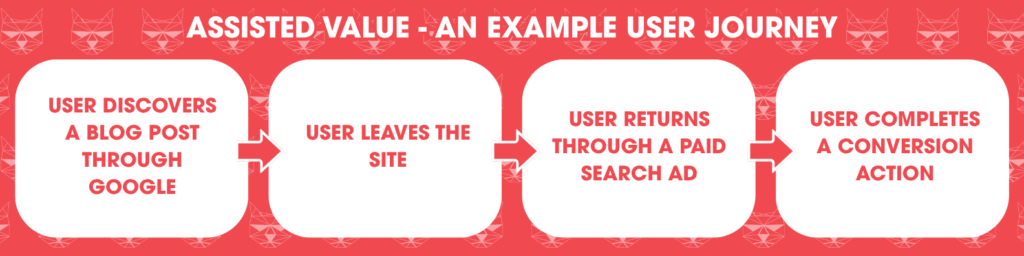
If the example above were measured using a last-click attribution model, paid search would receive all the credit for that final conversion, even though SEO played an important role in the initial interest.
Tools like Google Analytics use data-driven attribution by default, which uses machine learning algorithms to learn how different touchpoints impact key events (previously known as conversions).
By using this model, you’ll be able to measure the contribution SEO makes, even if it isn’t the final step before conversion. Without assisted value, the contribution made by SEO can seem smaller than it actually is.
Read: How Does GA4 Attribute Traffic to Different Channels?
Content Performance
As an organic marketing channel, most SEO growth comes from a website’s content. Many reports will stop at the overall traffic numbers, but explaining content performance will help to link page-level activity to improvements in business outcomes.
Not all of your traffic will be valuable in the same way – let’s look at an example of two pages:
| Page | Monthly Active Users | Conversions |
| Glossary of industry terms | 8,000 | 2 |
| Comparison of products | 1,500 | 48 |
If an SEO report were to stop at the top-level traffic figures, the glossary on this site would be considered the better page out of the two and celebrated. However, if we take a deeper look at the activity on these pages, we can see that the comparison page is much more valuable to stakeholders in terms of their business goals. It may bring in less traffic, but those who do visit are more likely to convert. This is especially important to highlight if SEO work has been implemented on the comparison page, but not the glossary, for example.
Analysis of this data can then be used to determine next steps – if we’re seeing the most conversions from product comparison, how do we take advantage of this? You may want to consider expanding this content pillar – compare more products in greater detail, or address how your products differ from competitors. You might also use this data to find out which products are landing well with customers and deserve more focus in other marketing channels.
It’s easy for stakeholders to get caught up in the larger numbers and ask, “Why is that page not doing as well when you’ve worked on it?” But with content performance reporting, you can help them understand what is actually bringing in revenue.
Visibility
Conversion data lets you know how well your past actions have performed, but visibility is a great indicator of what could happen in the next few months. Traffic can fluctuate for a number of reasons, including:
- Seasonality
- News cycles
- Market demand
- Algorithm changes
Visibility, on the other hand, can often provide a much more stable measure of SEO performance by measuring how prominent a website is in the results of a tracked set of keywords. Visibility evaluates overall search presence, rather than individual rankings, and is more of a health indicator for organic performance.
Metrics like visibility score, share of voice, and ranking distribution can help separate SEO performance from broader, unavoidable market fluctuations and help stakeholders see SEO improvements even if traffic is declining.
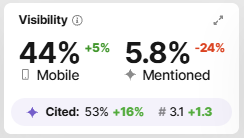
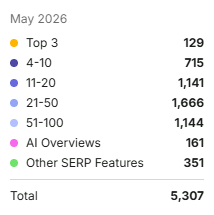
Visibility metrics are often used as indicators, allowing both you and the stakeholders to identify opportunities and risks before they appear in the measured results.
It’s important to recognise that visibility should more often than not be treated as a leading indicator, not the end goal. Strong reports still place the main focus on performance and how it ties to conversions, revenue, and business outcomes whenever possible.
Read: How Do I Track My Keyword Positions on Google?
‘Good’ SEO Reports vs ‘Bad’ SEO Reports
Two SEO reports can use the same exact data set, but can be vastly different based on the highlighted metrics and direction of explanation. There isn’t necessarily a ‘good’ or ‘bad’ way to report on SEO, but there are ways to make them more valuable for stakeholders.
You should be telling a story: what happened, why it happened, and what you’re going to do next in response.
What Makes An SEO Report ‘Bad’?
Reporting Metrics Without Business Impacts
Less impactful SEO reports often focus solely on overall activity, rather than outcomes of the implemented work. They’ll often include large data sets without any specific context, forcing stakeholders to interpret them alone.
An example:
| Metric | Result |
| Number of keywords tracked | 150 |
| Average position | 18.3 |
| Backlinks acquired | 27 |
| Pages crawled | 231 |
This data is technically accurate and might be useful for you internally, but it doesn’t explain if performance has improved, revenue has increased, or if the business is on track to achieve its key performance indicators (KPIs) or goals.
Providing Data Without Context
Providing a report without context also reduces value. If stakeholders are told, “organic traffic has increased by 20%”, they’ll often walk away feeling as if it’s incomplete. Stakeholders are more likely to want to know:
- Why did traffic increase?
- Did this increase lead to valuable conversions?
- Was this a direct result of SEO work?
- Can this growth be continued or replicated?
A valuable report explains both the cause and the business impact.
| Before | After |
| Organic traffic has increased by 20% | Organic traffic has increased by 20% following the upload of five new product category optimisations, which also generated 24 additional conversions. |
Overwhelming Stakeholders With Data
Detailed reporting on both a site-wide and page-level basis can often be really useful for us as SEO professionals, but it can quickly become difficult to interpret. In order to prove your value, stakeholders should be able to easily find the data that backs up the strategy, and this is likely to be lost if they have to work hard to find it.
Focusing On Tasks Over Outcomes
Stakeholders are making an investment in your SEO services, and it can be helpful for everyone if a report outlines what work was completed during the month. The downside comes when entire sections are dedicated to this without additional explanation.
For example:
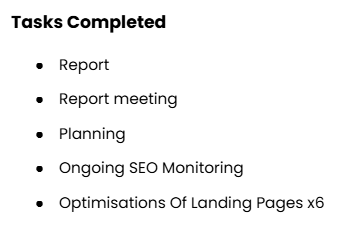
These activities are important because they are what drive any improvements in an SEO campaign, but stakeholders are usually more interested in the results this work has produced.
Connecting your tasks to an outcome becomes much more meaningful for the decision-makers in a business.
| Before | After |
| We wrote and uploaded four blogs last month. | The four new blog posts we uploaded last month have since generated 1,300 active users and 14 new conversions. |
What Makes An SEO Report Good?
Summarising The Data
Often, the most influential decision makers in a business are those with the least amount of free time. Good SEO reports prove that their investment was worth it, so keep the most important insights in an easily digestible summary.
This might include:
- Key wins
- Key challenges
- Major performance changes (and if this links to any SEO work implemented)
- Recommended next steps
An example:
“Organic conversions increased by 22% month-over-month, generating an additional £14,000 in attributed revenue. Growth was primarily driven by improvements in commercial-intent content and increased visibility for high-converting keywords. The next priority is expanding content coverage within the product comparison category.”
Focusing On Outcomes
Stronger SEO reports highlight the metrics that directly support the business’s goals, instead of generic data sets.
For example, instead of:
| Metric | Result |
| Keywords In Top 10 | 52 |
| Backlinks Acquired | 9 |
Try this:
| Metric | Result | Change |
| Organic Conversions | 149 | +23% |
| Assisted Revenue | £11,000 | +54% |
| Organic Conversion Rate | 3.1% | +38% |
Explaining Why Performance Has Changed
Valuable monthly reports don’t simply contain the results SEO has achieved, but explanations that answers questions like:
- Why did conversions increase?
- Which pages drove growth?
- What caused visibility declines?
For example:
“Organic visibility increased by 12% following optimisation of key commercial pages. Three pages entered the top three positions for high-intent keywords, contributing to a 19% increase in organic leads.”
Rather than simply reporting numbers, explanations like this tell us what’s worked, how we can expand this to other pages, and where the strategy might need to shift.
Including Clear Recommendations
Reporting on what comes next is a key part of the SEO strategy, but is often overlooked after the data has been covered. Strong reports not only let everyone know what has happened as a result of the work, but also the direction this provides for the roadmap moving forward.
For example:
| Observation | Impact On Future Strategy |
| A particular blog topic is performing well. | Expand this content into a full cluster and cover more queries. |
| Some pages are dropping in visibility and/or traffic. | Refresh these pages with updated keyword research and new content. |
| Key pages are not bringing as many conversions. | Improve internal linking to these key pages across the site, but especially from naturally high-performing pages. |
| Impressions are increasing, but the traffic is not translating onto the site. | Optimise the pages that are naturally ranking in positions 4-10 to increase click-through rate. |
Our Top Tip: SEO Reporting Made Simple
With so many data points available at our fingertips, it’s hard to know what brings value and what hides the true value of SEO to a business. Here at Wildcat Digital, reporting is part of our monthly plans for every client, tailored to explain the exact metrics stakeholders are looking for.
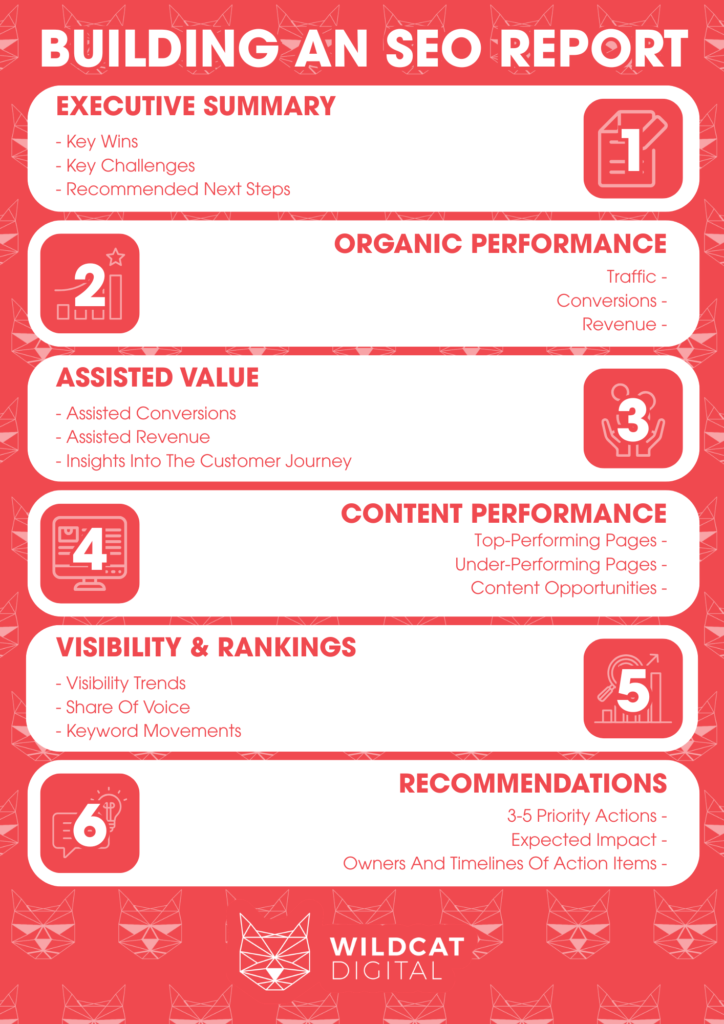
Here’s a simple outline to build an effective SEO report, featuring the most valuable metrics that can help to form explanations that prove SEO’s worth to the right stakeholders:
Proving The Value Of SEO With Wildcat Digital
Effective SEO reporting isn’t about showing more data; it’s about linking activity to business outcomes and actionable insights. By focusing on the right metrics, reports become much easier for stakeholders to understand.
Making the most of your data can be difficult, but the team here at Wildcat Digital focuses on providing you with the right insight from the very start of your campaign. Get in touch with us today to not only get an SEO campaign guided by our expertise, but a strategy truly informed by real results and business goals.

Amy Varley
SEO Executive