
Could your website be too ‘thin’ to rank well? Are you even aware of the ways it could be lacking in quality? Thin, duplicate, and overlapping content are important to minimise in relation to your website’s SEO health, because they all impact not only the user experience but also how search engines think about your website’s quality. So, how do you identify thin content, and how can it improve your SEO?
Consistent, quality content will lead to a higher topical authority level, which can increase your rankings. Thin content can be identified by:
Keep reading to learn how thin content and topical authority affect your search rankings, and how you can fix thin content on your website in detail.

Thin content is content that lacks either quantity, quality, or both. This means that the content:
There is no point in having thin content. At best, readers leave with the intention of seeking the next best alternative. At worst, it results in a hit to your overall topical authority, a drop in search rankings, and a decrease in website traffic.
If you want your website to grow organically, you need to ensure there is no thin content (editorial or technical) on any of its pages. Types of thin content include:
A good SEO practice is to ensure that every page on your website is unique. This sets you up well for internal backlinking (yes, just like that one!), and it improves the user experience by reducing uncertainty about whether they’re seeing the correct page.
‘Duplicate content’ refers to content that is identical between one or more webpages on a domain, subdomain, or across the internet at large.
Duplicate content reduces the value of individual pages by diluting the pool of information available, making it harder for users and search engines to find original, valuable content. This, subsequently, could result in a page not ranking.
Scraped and copied content is closer to blatant plagiarism. Sometimes small chunks of text are copied; other times, entire pages (or even multiple pages) are scraped. This applies to all kinds of stolen content, including unattributed quotes. Plagiarism is not only bad on a legal and moral level, but it’s also bad for both SEO and user experiences.
Content that was generated using software like ChatGPT or Copilot can be considered thin when it fails to offer original insights or firsthand experiences. LLMs inherently draw on other content to generate their own, meaning they struggle to provide meaningfully original insights, new information, or firsthand experiences.
These are blogs that have nothing original to say, or do say something unique, but fail to explore further.
Consider whether the blogs you’ve got currently are parroting the same things as everyone else, and try to identify where you can add your own perspective to the narrative, or your own texture to the writing.
A product page might be seen as low-value if it fails to communicate key information about the products, is broken on a technical level, or just looks uninspiring. Make sure that all the information a customer would want to know is available at a glance:
Product pages with only a handful of products could also be classified as low-value. This often happens if you’ve narrowed down your categories too much, or if you just don’t have enough products to make a page feel full.
Tackle this by restructuring your product pages without being dishonest; it is okay to sometimes have only a few products on a page, just make sure it’s not the case on every product page.
An affiliate page is a page whose value comes from the fact that it is linked to something else, somewhere else. These are usually about products; you’ll have heard an influencer talk about the “affiliate links down below”.
Thin affiliation involves copying product descriptions and reviews directly from the original merchant without any additional value. Google might see your syndication of the original content as a violation of their quality guidelines and subsequently remove your page from their index. Improve your affiliate pages by adding:
Doorway pages cater to specific, very similar queries to those of a website’s actual domain in order to dominate a chosen keyword on the results page. This is a form of spam.
They create intermediate pages that don’t provide as much value as the final destination, funnelling users through pages to force unnatural traffic.
Google hates doorway pages tailored to exploit search engines because they can lead to, in the worst cases, entire results pages featuring unique links that all lead to the same single website. As a user, this is an incredibly frustrating experience.
From 2022–24, Google rolled out the ‘Helpful Content Update’, which refreshed how topical authority was judged. The update elevated content that was helpful, high-quality, and displayed firsthand experience, before it became part of Google’s core ranking systems in 2024. The update primarily intends to prevent large-scale, low-quality, automated and AI-generated content from ranking above webpages with genuine, people-first value, based on the content’s EEAT factors and Google’s human search quality evaluator guidelines.
Topical authority refers to your website’s overall level of expertise and credibility on a particular topic.
It fundamentally relies on the principles of E-E-A-T (Experience, Expertise, Authoritativeness, Trustworthiness) to determine whether you have anything original or of quality to say. You can check a domain’s topical authority by using SEO tools like SEMrush.
Topical authority and EEAT factors become more important if your website deals with sensitive issues. These kinds of websites are known as YMYL, which you can learn more about in our blog: What is YMYL & Why it Matters for SEO
Your website needs a high level of topical authority on its chosen subjects because it demonstrates that:
If the content on your website is consistently thin, Google will think that you are not an authority on the subject and will reduce your topical authority ‘score’. You will find, for example, that if you have AI-generated content on your website, search engines and insightful users will trust that content less because it doesn’t display first-hand experience.
For example, Wildcat Digital has a ‘High’ level of topical authority for the keyword ‘SEO agency Sheffield’, a ‘Relevant’ level of topical authority for the keyword ‘Marketing’, and a ‘Low’ level of topical authority for the keyword ‘Spaceships’.
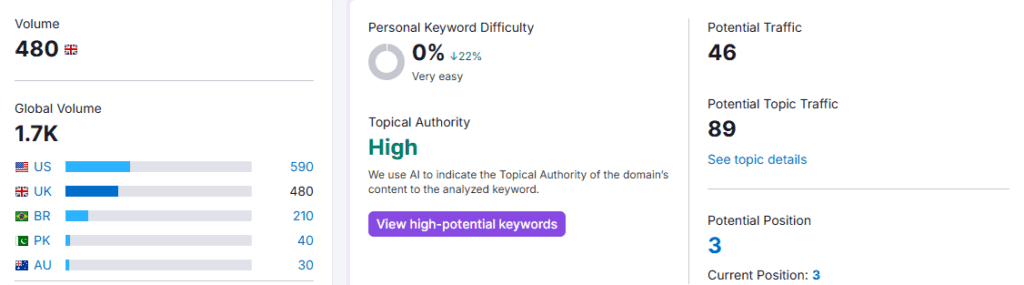
This means that when someone searches “SEO agency Sheffield” into an LLM or search engine, Wildcat Digital’s website will be prioritised as a trustworthy source of information for that topic, resulting in a citation or higher results page rank. We wouldn’t get cited for questions about Area 51, though.

Bob thinks he’s cracked the case, but little does he know… BOB was the duplicate content all along!
Duplicate content is one of the more important types of thin content because, while duplication doesn’t specifically get punished by Google, it does have knock-on consequences for the user experience.
Duplication happens for a lot of reasons, some accidental, some intentional, some exploitative. The three main reasons for duplicate content, however, are:
Generative AI and LLMs are trained on pre-existing content, meaning that anything they output after will be a regurgitation of something which already exists.
This can also involve repetitive phrasing. Think about how much of what ChatGPT says sounds so similar, so clean, so friendly. Users can subconsciously identify such weak, repetitive writing and, when they do, they bounce away.
Using AI-generated content as a placeholder to fill space on your website is pointless. At best, using AI-generated content will result in users bouncing from your page. At worst, your page’s ranking and topical authority score will be treated as if you were using scraped or plagiarised content.
Syndicated content is content taken from another website directly without making changes or adding value. Inherently, this creates duplicate content on the internet.
In some cases, syndicating content from another website is acceptable, particularly if you correctly attribute credit by linking to the original and using a canonical URL or meta robots noindex tag. Not every website owner will be happy with this, however, and you should always ask for permission first anyway.
There are ways that you can accidentally (and intentionally) end up with duplicated technical elements, commonly identified by their variations in page URLs.
Pages with a printer-friendly version on a separate URL (for example, eg.com/print/blog-content vs eg.com/blog-content) are considered duplicate content if there is no canonical URL implementation for the main version.
URL variations such as parameters, session IDs, and tracking and analytics codes have the potential to cause duplicate content issues because they can construct URLs that are almost identical.
Often, this is caused by human error and misunderstanding what a URL actually is, both by yourself (or whoever works on your site), or from the developer who doesn’t prioritise SEO – they quite literally speak a different language!
If a website has separate versions of webpages (www.page.com vs page.com), with the same content, these are effectively duplicate content.
The same applies to sites that use both http:// and https://. For reference, http:// is the same as https:// with the only difference being that https:// includes encryption and verification, making the page more secure and ideal for eCommerce sites or sites that capture personal information.

Whilst you can reverse the effects of thin content penalties, it’s best to avoid them altogether or fix them as soon as possible. Follow our decision tree to help you decide how to deal with thin content, and read about each piece of advice in more depth below.
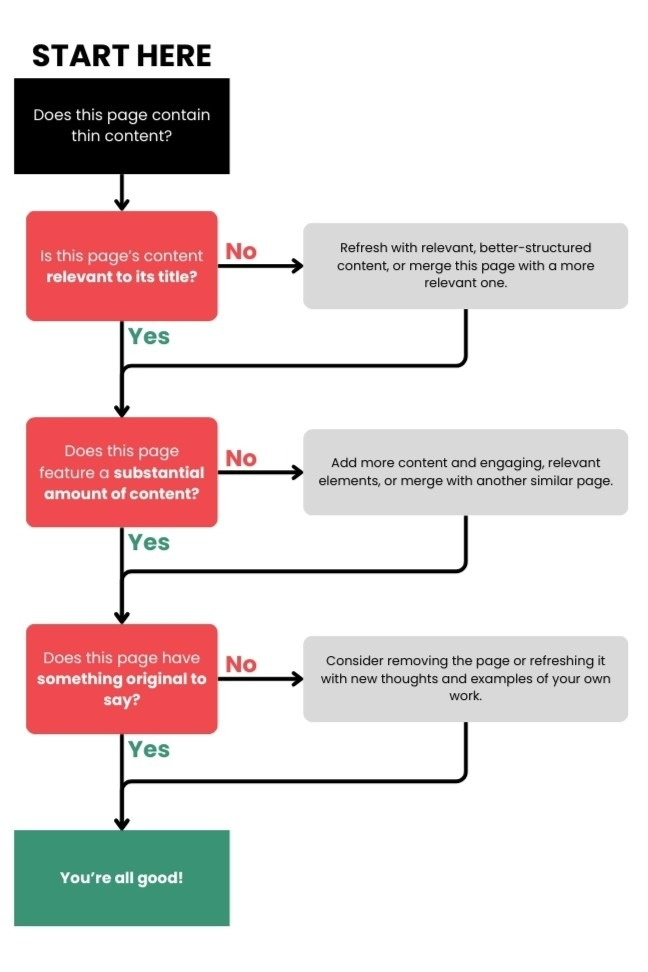
Low-quality content can be made more SEO-friendly by giving it a refresh, merging it with higher-quality content, or removing it entirely. First, though, you need to find the thin content.
To find content that might be considered thin or duplicate, conduct a mini content audit of your own website. Read through your blogs, landing pages, product listings, and everything in between and assess whether each page has all of the following features:
Sometimes you start writing, fall down a rabbit hole, and suddenly your latest blog is 4000 words long and includes incoherent details about the Treaty of Versailles. We content writers are empathetic; search engines are not.
Deal with irrelevant content by consistently linking back to your title as you write. Additionally, put the most important information at the top of the page. This is done for two reasons:
Following this advice will naturally match the user’s intent to your page better. If a user clicks on your blog titled ‘How To Teach Your Cat to read’, they’ll be very disappointed to discover that it’s actually a blog about how to potty train dogs.
Page titles, H1s, and title tags all contain information for search engines about what a page is about. If the body of that page is then not aligned with the title, Google will think you’re not an authority on the subject, and your page won’t rank.
A good blog length is 1000 words. Some are longer, and some are shorter, depending on necessity, but 1000 words is a good general-use target. How long are your blogs?
There are fewer rules for other types of pages, but the core point is that if a page doesn’t feature enough content, search engines will think it has no value to add to the subject and won’t prioritise it in the rankings.
Simple solution: add more content- wait! The extra content does actually need to be of value, don’t just AI-generate more words.
When adding new substantive content to your pages, try to fulfil some EEAT criteria, especially if your website is YMYL. Consider how you can demonstrate your expertise, experience, authority, and trustworthiness on this topic. This could include:
Read more about EEAT factors and how to optimise for them in our blog: What is EEAT in SEO & Why is EEAT Important?
Finally, your content must include something original. Whether that’s in-depth breakdowns of your services, well-researched think pieces, or quotes no one else has got, your content will fail if it parrots what everyone else is saying.
The best way you can spawn some originality is by considering your true thoughts on the alternatives. If you’re creating a service or product page, research what your competitors are doing and look for gaps. If you’re writing a blog, try to empathise with another perspective and argue against yourself.
Canonicalisation involves specifying which version of a page is the primary version that you want to appear in search results. There are two key methods for enforcing canonicalisation.
301 redirects are often the best way to fix URL duplication because they literally redirect the duplicated page to the one that you want to appear in search results. This stops the duplicate pages from competing with each other and also creates a stronger relevancy and popularity signal that will positively impact the master page.
Rel=”Canonical” tags tell search engines to actually treat the tagged page as duplicate content and to attribute any value from links, content, metrics, and “ranking power” to the specified URL.
You can hide pages with necessary thin or duplicate content from search engine results pages (SERPs) by adding a ‘no index’ tag. This tells search engine crawlers to exclude the tagged page from indexing, ensuring that the page can’t appear on SERPs and, therefore, won’t compete with other pages.

SEO Executive
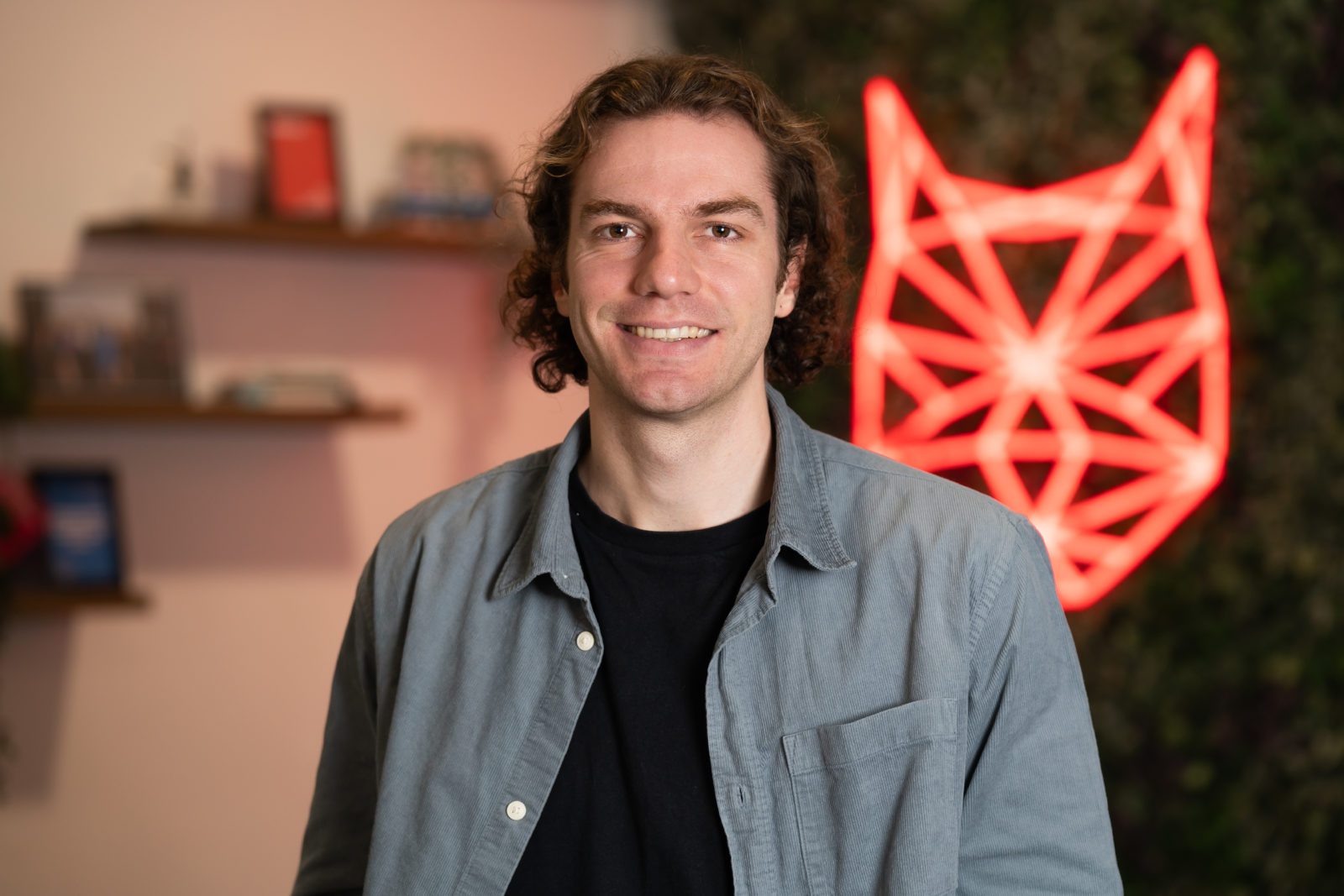
Founder
Our founder, Will Hitchmough, worked at a number of high profile Sheffield Digital Agencies before founding Wildcat Digital in 2018. He brings an extensive knowledge of all things related to SEO, PPC and Paid Social, as well as an expert knowledge of digital strategy.
Digital Marketing can be a minefield for many businesses, with many agencies ready to take your money without knowing how to deliver results. I founded Wildcat Digital to deliver digital success to businesses with smaller budgets in a transparent way.
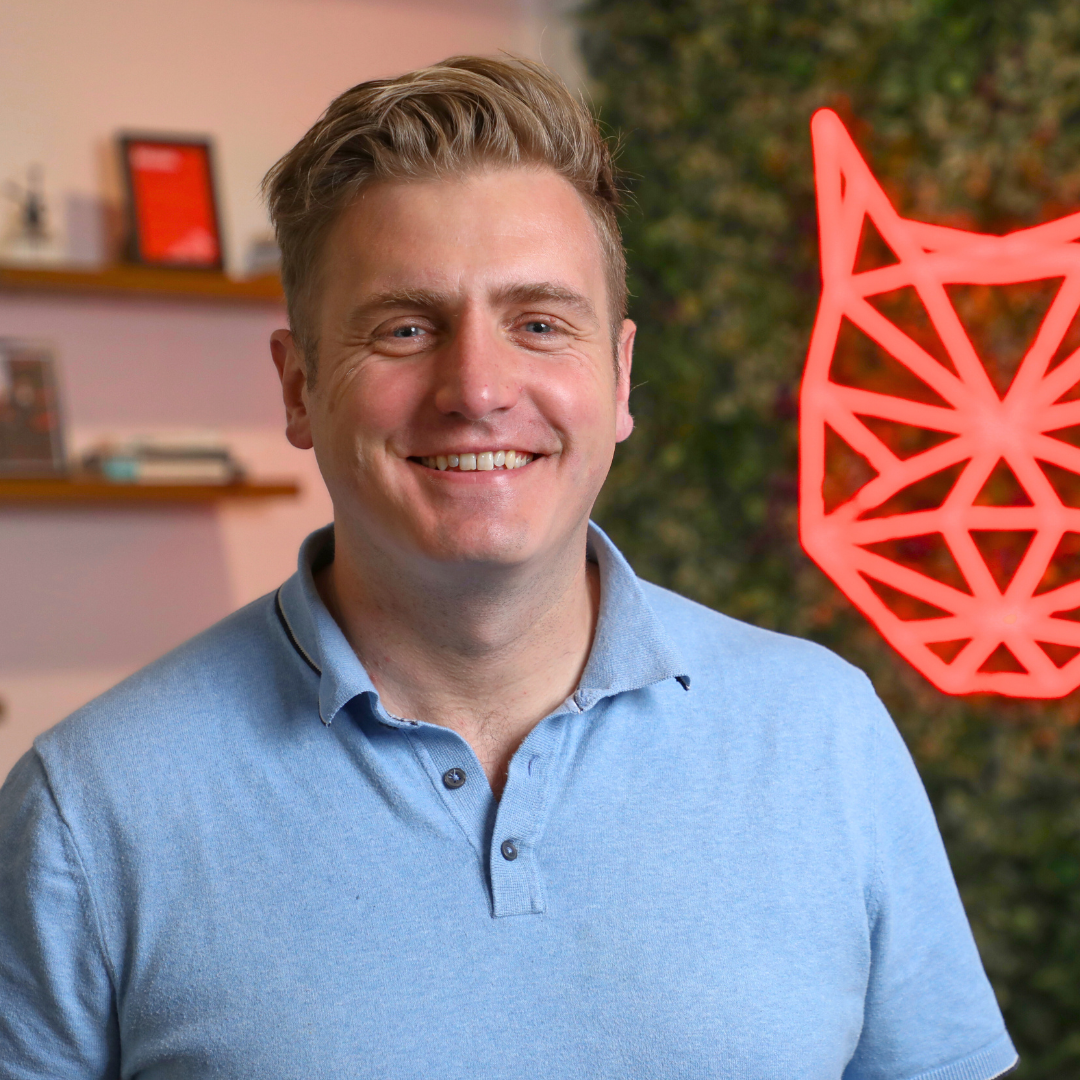
Head of Growth
Rich joined us in May 2024 to head up our growth team. With years of experience helping other agencies to grow, Rich joins us at an exciting time as Wildcat is working on a five-year plan to become one of the biggest agencies in the UK.
Outside of work, Rich is a father to three children, which keeps him very busy! He’s also recently started running again to keep fit and loves a bit of DIY.
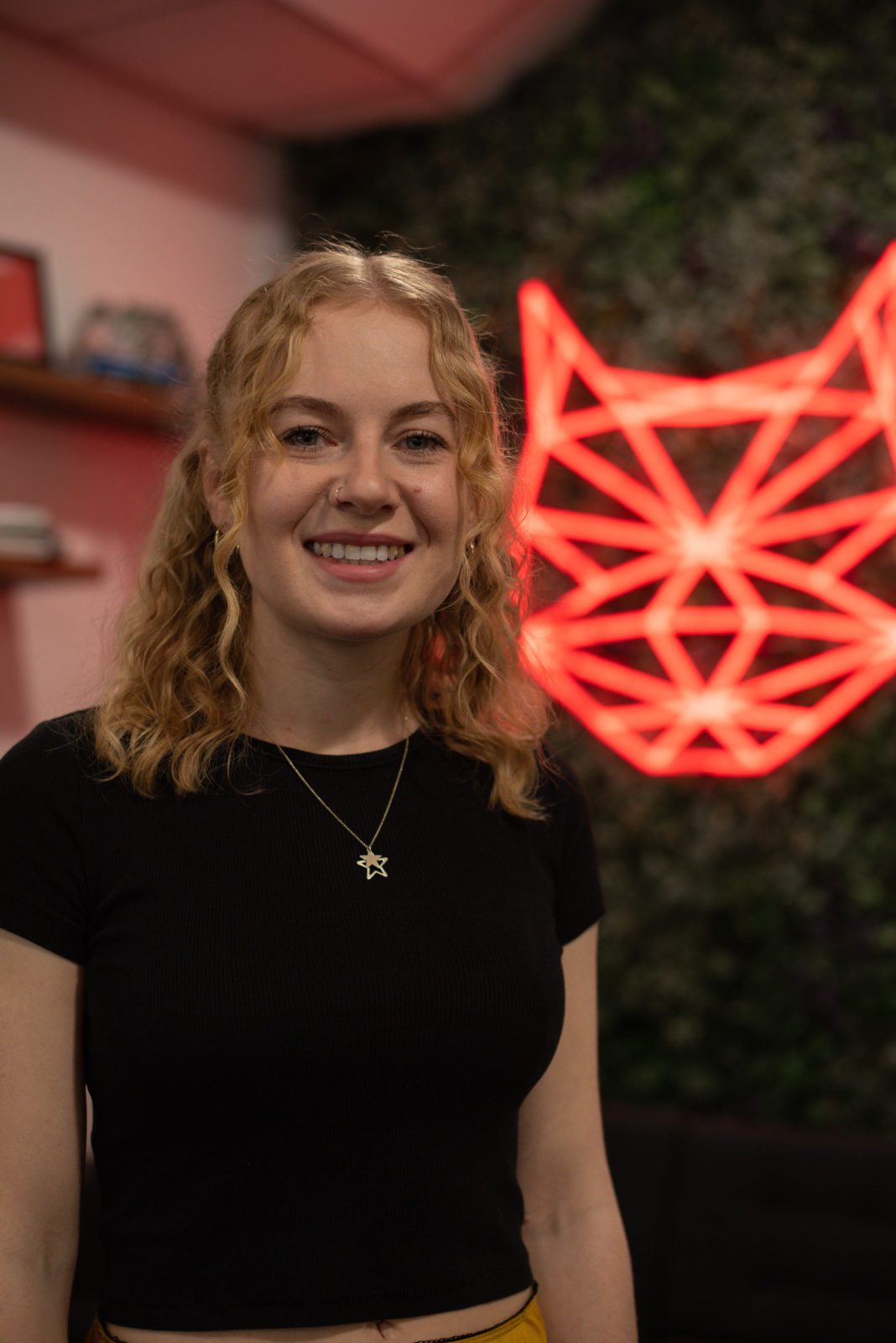
Head of Digital
Sarah joined Wildcat in January 2025, bringing over seven years of SEO expertise to the team. With a background in Fashion Communication and Promotion, she has worked both in-house and at agencies, covering a range of digital marketing specialisms before focusing on SEO.
Passionate about all things search, Sarah thrives on helping brands grow their online presence.
Outside of work, she enjoys walking her dog, running, and shopping for vintage clothing.
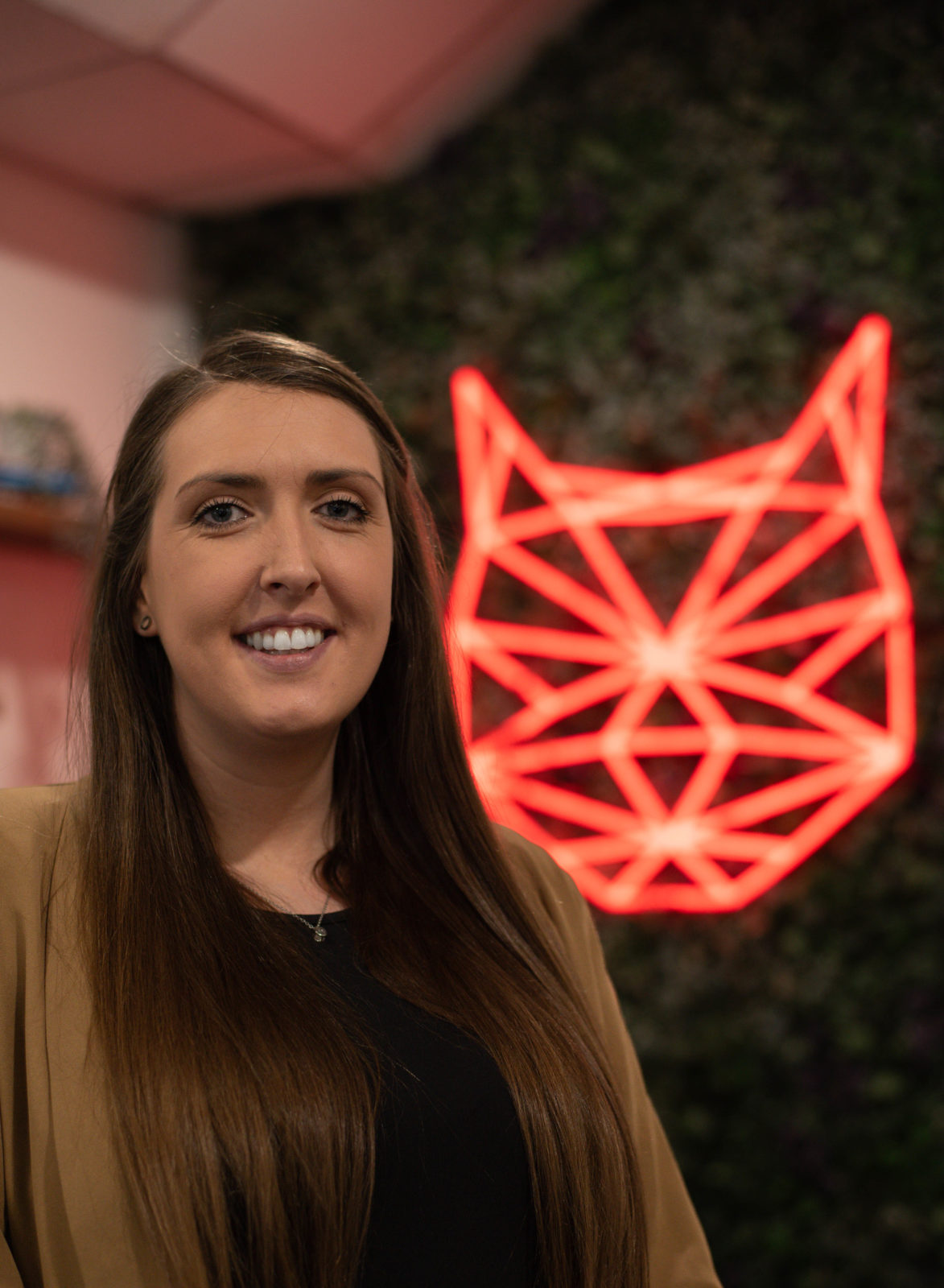
Office Manager
Amelia joined Wildcat Digital in January 2025, bringing extensive experience in HR, Health & Safety, Facilities Management and IT Support. Previously an Operations Manager at The University of Sheffield, she has a strong background in creating efficient and well-organized work environments.
Specialising in HR, Health & Safety, and Facilities Management, Amelia ensures the Wildcat Digital team has the resources and support needed to thrive. Whether managing office operations, maintaining compliance, or fostering a positive workplace culture, she keeps everything running smoothly.
Outside of work, Amelia loves trying new things, traveling, camping, and walking. She also enjoys socialising and exploring new places with friends and family. Her adventurous spirit and proactive approach make her a valued member of the team.

Client Success Coordinator
Siena joined us in 2023 with a background in sales and digital marketing. She leads on client relationships across the company, ensuring that our customers are happy throughout their journey with us, from their initial consultation through to onboarding and beyond.
Outside of work, Siena enjoys travelling and getting stuck into the local culture. She likes to make the most of her experiences and particularly enjoys watching sunrises and sunsets from beautiful locations around the world.
SEO Account Director
Paul has a strong background in SEO, having previously founded and ran a successful eCommerce business, as well as running a personal blog that achieves an average of 17K users per month. Paul’s knowledge of SEO is extensive, with a strong emphasis on client handling and technical SEO.
Outside of work, Paul enjoys spending time with his family and staying active with weight lifting and combat sports.
Team Lead & Technical SEO Account Manager
With a degree in Computer Science and SEO experience dating back to 2017, Dariusz has a wide range of SEO skills and knowledge. His specialist knowledge of Technical SEO has firmly landed him the title of Wildcat’s Technical Wizard, and he has recently taken on the responsibility of Team Leader for the Panthers Team.
In his spare time, Dariusz loves hiking, experimenting and trying new coffees and loves learning new things. He is currently learning more about CRO and AI and how this could benefit our clients.
Team Lead & Senior SEO Account Manager
With a background in sales, Molly is a natural Account Manager, brilliantly handling any issues that come her way. Having joined us as a Digital Marketing Executive, and working part-time through her final year of University, Molly is a shining example of how hard work pays off. She is now an SEO Account Manager with a particular interest in Content and Client Management.
In her spare time, Molly loves to get out in nature, hiking and exploring the Peak District. She also loves cooking and likes to unwind with a bit of yoga.

PPC Team Leader
Libby joined Wildcat in 2021 as our first PPC hire. With a degree in Digital Media Production, a Master’s in Digital Media Management and previous experience in Social Media Management, Libby hit the ground running and has since climbed the ranks to Senior PPC Account Manager and has a particular interest in the eCommerce sector.
Outside of work, Libby likes gaming, and cooking and likes to keep active by lifting weights.

Senior SEO Account Manager
With a degree in Film and TV production, and a varied career history, Jamie made the move to marketing with a Masters degree in Digital Media Management. He has since worked in SEO at Agencies across Sheffield, before joining Wildcat and working his way up to SEO Account Manager. Jamie has a particular interest in backlinks and Digital PR and has recently gained a client a valuable backlink from Forbes!
In his spare time, Jamie is an avid foodie and loves trying new restaurants and cuisines. He also loves to travel and spent a year travelling to Australia after university.

SEO Account Manager
Jasmine joined Wildcat in 2022 with a strong background in SEO and Account Management. At the time, she was finishing up a Level 4 Apprenticeship in Digital Marketing from the Chartered Institute of Marketing, and has since worked her way up to SEO Account Manager. Jasmine excels at content writing and promotion, and particularly enjoys finding creative ways to join the dots on multi-channel campaigns.
In her spare time, Jasmine volunteers at a charity, helping combat loneliness & social isolation experienced by older neighbours. Outside of Wildcat, she owns a catering company, Savery Grazing, creating delicious grazing tables & platters for a range of events. She also loves skiing and exploring the Peak District.
Senior SEO Executive
After spending ten years managing businesses, restaurants, cafes and event spaces across Sheffield, Jon decided to change careers and joined Wildcat as an SEO Executive in 2022. He especially enjoys the client management side of the job, helping them to understand digital marketing and ways in which they can build their business’s presence online.
Outside of work, Jon likes to keep fit with running, badminton and football, and also loves music.

Senior SEO Executive
Andy joined Wildcat in 2023 after starting his digital marketing career in-house for a local Sheffield company. Since joining, he has developed a strong interest in Technical SEO and has strong skills in Account Management.
Outside of work, Andy loves music and plays in a couple of bands. He also enjoys rock climbing, cycling, photography and good food.

PPC Executive
Before joining Wildcat, Tom worked across different industries, building skills in sales and customer service. He later developed a passion for digital marketing whilst working on personal marketing projects and freelance ventures, and gained numerous certifications in PPC and Social Media.
Outside of work, Tom enjoys staying active by going to the gym and hiking. He also loves travelling and motorbiking.
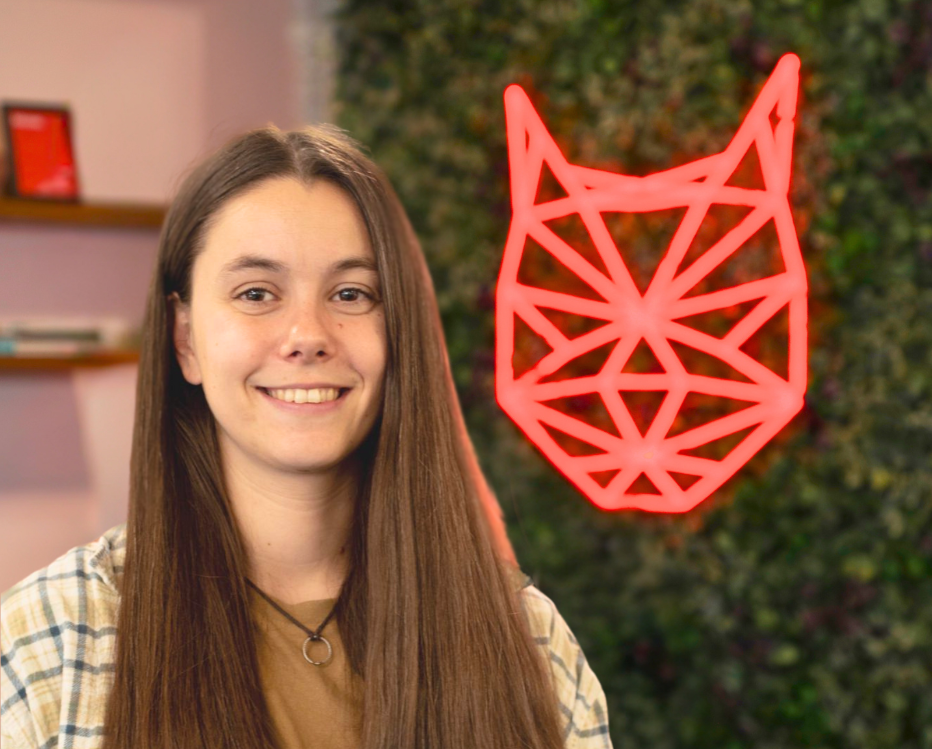
Senior SEO Executive
Kezia joined us in July 2024 after completing a CIM Certificate in Digital Marketing and gaining experience in Content SEO at another Sheffield agency.
In her spare time, Kezia loves to get outdoors, bouldering, hiking and travelling.
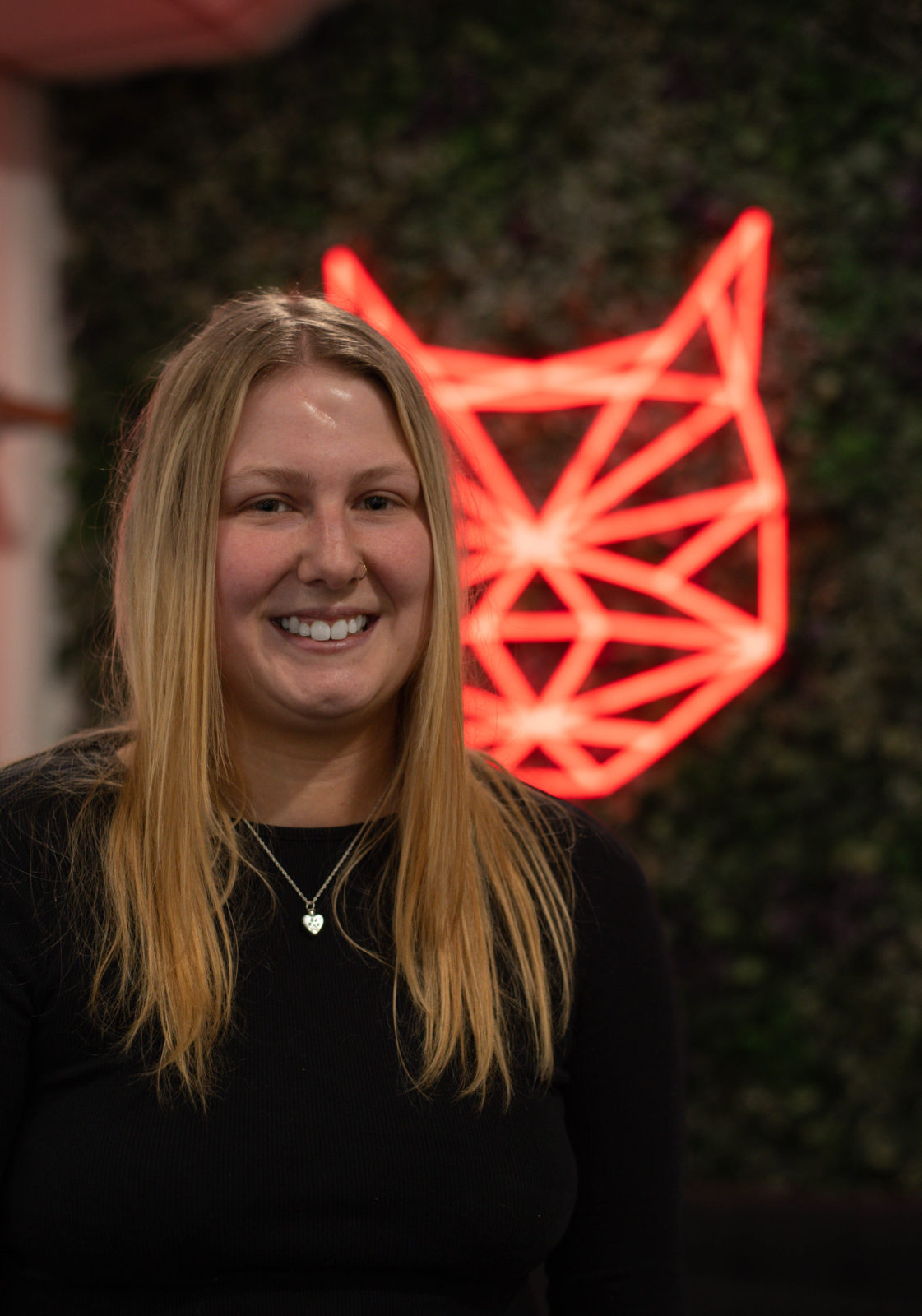
Senior PPC Executive
Alex joined Wildcat Digital in December 2024 as a Senior PPC Executive, bringing a strong background in Paid Media, Paid Social, and Programmatic advertising. With a degree in Business & Marketing and Google Ads certifications, she has the expertise to craft high-performing campaigns that drive results.
Before joining Wildcat Digital, Alex worked at two leading agencies in Leeds, honing her skills across various digital advertising platforms. Her analytical mindset and strategic approach help businesses maximize their online presence and advertising budgets.
Outside of work, Alex enjoys spending time with her dog, Lola, and going on walks with her dog walking group. She’s also a keen footballer and loves playing five-a-side whenever she gets the chance. Her enthusiasm and team spirit make him a great addition to the Wildcat Digital team.

SEO Executive
Amy joined Wildcat in 2024 with a background in journalism, having worked as a News Editor and Editor-in-Chief at The Sheffield Tab. She is naturally interested in Content SEO and research, so will no doubt prove to be a content power-house.
In her spare time, Amy loves watching crime shows, listening to music and hanging out with her dog, Eddie!

SEO Executive
Reiss joined the Wildcat Digital team in July 2025, with a background in journalism and digital content, Reiss brings both creativity and technical know-how to the team.
After graduating with a Journalism Studies BA from the University of Sheffield, where he also served as Games Editor and Deputy Editor for the student-run newspaper – Reiss jumped straight into the world of climate tech communications.
Outside of work, Reiss loves crochet, swimming, playing guitar, and diving into both video and board games. He’s always up for picking up new skills and trying new things – which makes him a perfect fit for our team!

Content & Proposal Writer
Liv joined the WildcatDigital Team in June 2025, with a strong background in financial admin and client care, Olivia is taking an exciting step into the creative world – and we’re so glad she’s doing it with us!
She’s currently studying content creation through her apprenticeship with Wildcat, and already bringing fresh energy and creativity to the team.
Outside of work, Olivia runs her own BIAB nail business, loves reformer Pilates, long walks, and is a member of a competitive dance team.
January 26, 2026
We made it to the end of January! One month into 2026, and it feels like a lot has changed.…

Paul Pennington
January 23, 2026
Many businesses assume that Author and Meet the Team pages are simply a nice way to showcase the people behind…
Jon Herdman

December 17, 2025
As we enter into 2026 and reflect back on the year as business owners and digital marketers, we can’t help…
Jon Herdman