
October’s digital marketing updates could change how you spend your advertising budget, promote your offers and understand your SEO results. We explain what’s changed, what it means for your business and which updates deserve your attention before Black Friday and Christmas.
How keyword ranking tools responded to October’s data issues
Ranking tools such as SEOmonitor automatically check where a website appears in Google for particular searches. This helps us track changes over time, rather than relying on what we happen to see in a single search ourselves.
During October, Nozzle’s research and Search Engine Land’s coverage highlighted “poisoned SERPs”. Some automated checks were receiving misleading search results that differed from those people saw when searching themselves. A tool could therefore show a ranking change caused by the data it received, rather than a change in the website’s actual position. This was a data-collection issue, not something businesses needed to fix on their websites.
SEOmonitor, which we use at Wildcat, recorded some incorrect results between 9th and 13th October. It reprocessed the affected keywords on 13th October and added a check against each keyword’s recent history, so suspect results can be collected again before being recorded.
We’ve shared guidance with our team on checking unusual movements. Rankings help us understand a campaign, alongside Search Console, website traffic and enquiries. That gives us the context to explain a change and decide whether anything needs doing.
Google’s September spam update finishes
Google uses automated systems to identify websites that break its spam policies, such as sites using deceptive tactics to manipulate search rankings. A spam update improves those systems, which can change which websites appear in the results.
The September spam update covered in our September roundup finished on 8th October, following its launch on 24th September.
If your traffic changed during the rollout, look at the pages and searches involved before drawing conclusions. An update can change where you appear in Google, while seasonal demand can change how many people are searching in the first place.
Bing can show you where your content is missing
When Bing creates an AI answer, it can draw information from website pages and link to them as sources. For a business, that means its content can help answer someone’s question even before they visit the website.
Bing Webmaster Tools already lets website owners see which pages are being used in those answers. On 13th October, Microsoft introduced Topics Portfolio, a new feature being tested within that reporting.
It brings related searches together into topics, so you can see the subjects your website is being cited for. It also highlights questions where other websites appear as sources and yours doesn’t. That makes it easier to spot possible gaps without working through every search individually.
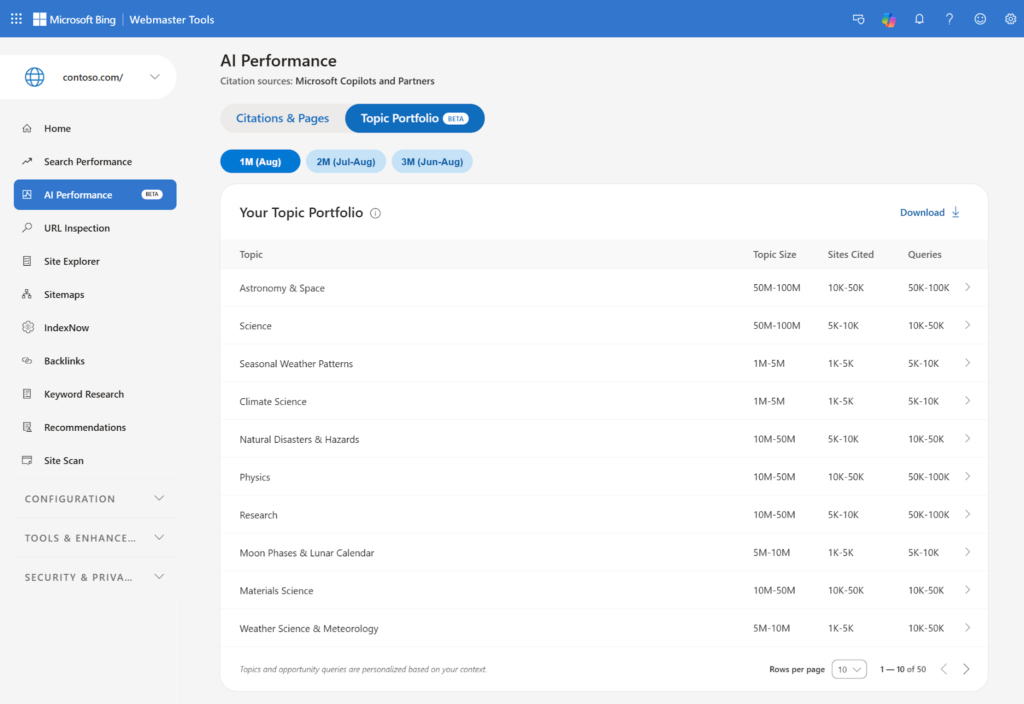
Bing’s Topics Portfolio report groups AI search queries into topics. Source: Microsoft Bing.
We’d start with questions that help someone choose what to buy. For a service business, that might mean explaining costs, who the service suits or how two options compare. If Bing highlights one of those gaps, it’s worth a closer look. A vaguely related topic is less useful, even if writing about it could get you mentioned in an AI answer. The figures are estimates, and smaller sites may not have enough data to see the report yet.
More say over where Google spends your ad budget
Google Ads campaigns can show adverts in different places. Depending on the campaign, that might include Google Search, YouTube or other websites that carry Google ads. Google’s automated systems help decide how the budget is spent across the places available to that campaign.
On 14th October, Google announced channel prioritisation and budget allocation controls, with a gradual rollout starting the next day. These let advertisers give supported channels higher or lower priority and, in some campaigns, set a spending allocation for lower-priority channels. For example, a Search campaign could prioritise Google Search over search partner sites.
Say your ads bring in lots of inexpensive enquiries, but few become customers. These controls give you another way to test whether spending elsewhere brings better results. We’d judge that by what happens after the enquiry. Is it relevant, does it lead to a sales conversation, and does the person buy? A lower cost per lead only tells part of that story.
In Performance Max, Search, YouTube, Maps, Gmail and Discover are still grouped together, so these settings won’t give each one its own budget. Demand Gen gets the priority controls but not the new budget allocation option. Google’s guidance also explains that allocations aren’t strict daily spending caps.
For a campaign that’s already bringing in good customers at a sensible cost, we’d keep the settings that are working. The value of a new control is having it available when there’s a reason to use it.
Google can add your website offers to your ads
A promotion asset adds offer details, such as a discount or a voucher code, alongside an advert. Advertisers can create these themselves to highlight a sale and encourage someone to click.
With automated promotions, Google can find an offer on your website and create that extra detail for eligible Search and Performance Max ads. Some advertisers were notified that automated promotions would activate from 12th October. For example, an offer on a product page could start appearing in an ad without someone manually adding it to the campaign.
This applies to campaigns with location assets, which show details such as your business address, and no manual promotions running. You can check your account to see whether it’s enabled and what Google has added.
This could save time, but someone still needs to check the offer is right. Imagine advertising a discount on selected products and having a customer think it applies to everything. Before Black Friday, make sure your ads, emails and website agree on what’s included and when the offer ends.

Other updates
Facebook recommends posts and short videos in Feed and Reels based on what it thinks people will enjoy. Your algorithm, announced on 13th October, gives users a more direct way to influence those recommendations by choosing topics and describing their interests in their own words. We’ll watch how that affects which business posts people discover as they start using it.
AI Mode is Google’s conversational search experience, where people can ask a question, read an AI-generated answer and ask follow-up questions. Ads can appear within that experience as well as in conventional search results.
On 28th October, Google expanded AI Mode ads to ten more countries and said a UK launch was planned for the last three months of 2026. For UK advertisers, we’ll have more to assess once availability is confirmed.
Key marketing dates for November 2026
- 5th November: Bonfire Night
- 8th November: Remembrance Sunday
- 11th November: Armistice Day
- 27th November: Black Friday
- 30th November: Cyber Monday
What we’d focus on before Black Friday
Before increasing your ad spend, work out what each discounted sale will leave you. It’s easy to sell more during a promotion and still make less money.
As a simple example, take a £100 product reduced to £80, with all figures excluding VAT. If the product costs you £50 and you pay £5 towards delivery, you have £25 left before advertising, other costs and profit. That gives you a much clearer starting point for deciding what you can afford to spend to win the sale.
Once the numbers work, check that the offer is explained the same way in your ads, emails and website. Customers should know which products qualify, when the offer ends and what delivery will cost.
Top tip: Place a test order on your phone before the campaign starts. Check that the discount works on the right products and that the final price matches what your ad promised.
How Wildcat can help
If you’d like to talk through what these changes mean for your business or get your campaigns ready for Christmas, speak to Wildcat Digital.