
Though Schema markup is not new, there has been a sharp increase in the demand for knowledge on how to use it and why it’s important. This is because of its role in how Large Language Models (LLMs) interpret site data.
Schema markup is a universal coding language that helps search engines and LLMs interpret your data. It also allows pages to appear as ‘rich snippets’, providing immediate value and information to potential users.
LLM visibility doesn’t just refer to searches made via AI ask engines such as ChatGPT and Gemini. It also includes Google’s AI overview feature, which has become the new ‘rank 0’ of the SERP.
Put simply, schema doesn’t just help LLMs and search engines find your content; it helps them understand it.
Though search engine search is still dominating the market, it’s predicted that AI search will take over as soon as 2028, according to research by Semrush. They also report that “the average AI search visitor (tracked to a non-Google search source like ChatGPT) is 4.4 times as valuable as the average visit from traditional organic search, based on conversion rate”.
This is where schema markup and structured data become a critical part of your website curation, to help your pages appear in these results.
Why Is Structured Data Critical For AI Search?
Schema markup and structured data help LLMs dissect the content, trustworthiness, and relevance of a page in relation to search inputs.
Interpreting Authority and Context
It’s important to remember that LLMs are a machine, so making a page’s content machine-readable seems like a no-brainer. That’s what schema markup does, allowing search engines and LLMs to:
- Identify key entities (authors, brands, products)
- Understand user intent
- Evaluate authority and credibility
- Find precise answers (prices, dates, amounts)
This removes any ambiguity and helps to prevent AI hallucinations.
The need to have such well-rounded and detailed information comes from the way LLMs don’t rank pages based on a keyword. They have been created to answer specific, contextual questions.
If you’re not too sure what Schema markup is, or could benefit from a refresher, we’ve got everything you need to know in our article What Is Schema In SEO?

Changes In Query Language
There is a stark difference between the queries entered into a search engine like Google and those entered into an LLM like ChatGPT. Consumer queries entered into an LLM request include more specific details than those searched in Google. This is because of a general awareness of the capabilities and limitations of search engines vs LLMs.
For example, in Google, we might type:
‘Activities for toddlers’
As well as some sponsored links, we would expect to find listicle blogs and articles, detailing a range of activities toddlers might enjoy. There may also be videos, images, and localised toddler-friendly attractions.
However, a similar search in an LLM would look like this:
‘My daughter is 2 and a half, and loves crafts and cats. What activities can we do for free in Sheffield?’
The LLM will then locate information and results that match the key entities of the query. In this case, that’s:
- Age (2 and a half)
- Crafts
- Cats
- Activities
- Free
- Sheffield
The results are then localised, specific and prompts for further exploration are offered. In this instance, ChatGPT offered: ‘If you want, I can help plan a weekly toddler activity schedule in Sheffield with current dates and times!’
Both query types have their own advantages, and each user will have different preferences. However, ensuring content is placed to be picked up by search engines and LLMs increases the chances for organic traffic.
Though unstructured data can be retrieved by LLMs, structured data improves how reliably the content is interpreted and generated.
Does Schema Markup Really Make A Difference?
Yes, it does! Data on optimising for LLMs is still in its infancy, but we are now finally seeing verified data from experiments showing that what we know as effective in theory also works in reality.
In an experiment by Aiso, sites utilising Schema markup saw a ‘30% improvement in accuracy, completeness and presentation quality’ of data provided about marked up sites vs unmarked up sites from ChatGPT.
Vague and potentially misleading or inaccurate information will be far less likely to drive conversions as opposed to detailed, relevant, and accurate content.

How Do LLMs Find Search Answers?
Before a search is made, a lot of the fact-finding groundwork has already happened behind the scenes. This is why answers come so quickly, even for more complex requests.
There’s a difference in how data is retrieved by a search engine versus how it works for an AI-powered search.
Search engines crawl and index billions of pages, gathering vast amounts of data on pages, their content and their authority. LLMs are trained on enormous datasets to make them understand language, meaning and relationships between entities.
AI search combines these two systems to maximise speed and accuracy: a traditional search index for finding information, and an LLM for interpreting and explaining it.
Here’s how the process works in practice:
Crawling and Indexing
Search engines like Google still do much of the work when it comes to discovering pages. Engines use ‘bots’ to crawl web pages, which then read the HTML, follow the links and collect content. The information is then indexed for fast retrieval later.
At this stage, much like with SEO, if a site isn’t crawlable or indexable, it won’t be picked up by search engines or LLMs. This means the fundamentals still really matter:
- Clear site structure
- Quality internal linking
- Accessible content
- Technical SEO implementation
If you want to know more about the process of crawling and indexing, check out this blog: What Is Crawling and Indexing in SEO?
Understanding and Extraction
LLMs search through indexed material and extract key pieces of information, analysing it to see what it actually contains. They extract:
- Entities (brands, products, people, etc.)
- Attributes (price, availability)
- Relationships (mentions, reviews)
- Context and structure (FAQ, guides, articles)
Structured data really comes into play here, telling the LLM exactly what it’s looking at and why it should be mentioned in its answer.
Retrieval and Generation
When a query is submitted to an AI engine, it doesn’t scan the entire internet in real time. What actually happens is:
- The most relevant indexed pages are retrieved
- The information is sent to the LLM
- The LLM extracts facts, compares sources and interprets intent
- The LLM generates a clear answer to the query
This is called Retrieval-Augmented Generation (RAG). This is where just the relevant information is sent to the LLM by a search index.
When data is structured using schema markup, the information retrieved is more likely to be precise and unambiguous, compared to unstructured data. This supports entity confidence from LLMs.

Most Impactful Schema Types For LLM Visibility
Not all schema types are created equal. Though all offer value, some are particularly effective when it comes to increasing LLM visibility. We’ve broken down the most effective schema types:
FAQ Schema
FAQ schema is a method of pairing specific questions and authoritative answers. Not only is it familiar, user-friendly, and simple to write, but it’s also a great way for LLMs to interpret your content and cite/link to you in their answers.
Why FAQ Schema is Impactful For LLMs:
- It provides concise, self-contained, and specific answers
- Allows easy inclusion of natural language queries (another effective method of LLM optimisation).
- Reduces ambiguity around intent, giving relevant and engaging answers about your business/field of expertise.
What Page Types Should Use FAQ Schema?
- Service/product pages – Providing niche pieces of information about services provided or the company that don’t fit in the wider page copy. Allows for addressing buyer objections before they arise.
- Informational blog content – Answer questions and provide information on topics that didn’t warrant a whole section in the blog. Great opportunity to add CTAs and links to other pieces of informational blog content.
- Category/Collection pages – Address broad questions about the category of products or services, to help direct customers and answer topline queries.
HowTo Schema
Though instructions and guides can be broken down into easy-to-read formats, if they are not structured with HowTo schema, LLMs do not read them for what they are. When formatted correctly, LLMs can summarise, re-present, and reference your instructions accurately.
Why HowTo Schema is Impactful For LLMs:
- It allows LLMs to recognise step-by-step instructions and align with reasoning models.
- It supports ‘how to’ task queries, giving your page better chances of being cited or linked to.
- Reduces the risk of LLMs mixing the order of steps, causing incorrect information.
What Page Types Should Use HowTo Schema?
- Tutorials – Pieces of content that specifically teach users a process or skill. Think craft instructions, recipe pages, and DIY guides.
- Product/Business-related guides – Pages that talk users through how to use your product or service, for example. This can also apply to pages that give detailed procedural explanations of other processes, such as ‘how to apply for a loan’ or ‘steps to getting qualified as a therapist’.
- Video pages – Creating videos for instructional content is a great way to make things accessible. However, if your content is only available as a video, it becomes less accessible for people with other accessibility needs. It also affects how LLMs can analyse your content. By adding text versions of instructions marked up with schema, it’s easy to get the best of both worlds.

Author and Article Schema
Unlike search engines, LLMs look at who wrote an article specifically, as opposed to simply the site it came from. It will also look for key trust signals that the article is new, relevant, and marked as an authoritative piece of content. Schema markup helps LLMs identify these features.
Why Author and Article Schema Is Impactful For LLMs:
- It connects the content to a real entity, allowing the LLM to search for other mentions of that entity. For example, if an article is written by Jane Doe from Wildcat Digital, the LLM will be able to find other articles by Jane and mentions of her in conjunction with other entities. Indicating her as a trusted source.
- As a result, it helps differentiate expert and reliable insight from generic content with questionable trustworthiness.
- It supports E-E-A-T (experience, expertise, authoritativeness, trustworthiness) evaluations used by search engines and AI engines alike.
What Page Types Should Use Author and Article Schema?
- Thought Leadership Articles – Creating articles establishing a company, and/or its team as thought leaders, is a great way to establish authority and trustworthiness. Being sure to mark them as articles, or specifically scholarly or news articles.
- Blogs – Blogs can often contain personal insights, so making sure readers (and potential customers) can see who these insights are coming from helps give key trust signals to LLMs.
- YMYL Content – If content is being written on YMYL (your money, your life) subjects like health and finance, understanding the credentials of the person behind the article is vital. Why would a consumer trust what’s being said about something so important if they don’t know who’s written it or why they are an authority on the subject?
Product Schema
For commercial and e-commerce sites, having product pages marked up with schema is particularly important. Schema.org defines a product as ‘Any offered product or service. For example: a pair of shoes; a concert ticket; the rental of a car; a haircut; or an episode of a TV show streamed online’.
Why Product Schema Is Impactful For LLMs:
- Accurate information is retrieved and provided directly to users. This is especially important as more consumers are using AI to directly compare products before purchasing. If the information is incorrect, it could lead to an unreliable comparison or a lost sale.
- It allows for more specific queries to be answered. As well as appearing for simpler queries such as ‘Which 4 slice toaster is better, A or B?’, products and sites backed up with schema markup provide additional information to answer things like ‘Where can I find a reliable 4 slice toaster for under £50 in Sheffield today with a student discount?’. Not only could an LLM retrieve the price information, but it can also retrieve location information, availability, ratings, and discount policies.
- At a base level, it’s important to mark product pages as such with the relevant schema to ensure LLMs and search engines alike can unambiguously see it is a product for sale, rather than an article or review about the product.
What Page Types Should Use Product Schema?
- E-commerce product pages – Pages should be marked up with all relevant information of the product, including availability and delivery times (if applicable).
- Service pages – Even if it is not a physical product, a service page is still selling something, and should be marked as such. This should include service details, locations, and how to book.
- Software as a Service (SaaS) pages – Similarly to regular services, these should be marked up with product schema. Rather than availability and location information, this should prioritise technical requirements for the software and price.
Review and AggregateRating Schema
Reviews are a common trust signal used by search engines and LLMs. This can be in the form of simple review schema or AggregateRating schema.
Simple review schema allows search engines and LLMs to view a review from a single source.
AggregateRating schema collates multiple reviews and displays an average rating. Both styles usually display this to users as a star rating.
Why Review and AggregateRating Schema Is Impactful For LLMs:
- It enables accurate analysis of user sentiment. Both types of this schema are beneficial and may be used differently depending on the size or purpose of the business. Smaller businesses may use simple review schema to show reviews that highlight the business benefits. Larger businesses, or at least those with a wider range of reviews, may opt to use AggregateRating schema to show an average score.
- It signals trustworthiness to LLMs as well as customers. This is particularly important when answering comparison-related queries.
- With the rise in AI informing purchasing decisions, it is likely that real review data will not just inform LLM outputs but will be a core trust signal. This means pages without rating schema may not be referenced at all.
What Page Types Should Use Review and AggregateRating Schema?
- Product pages – This means individual products being sold can display relevant ratings, specific to the product itself, rather than the business or category as a whole.
- Service pages – Service pages are uniquely positioned to provide reviews on the service itself as well as the business and its team. This is especially effective for services performed in person, on personal property, or on an individual, where trust is paramount.
- Local business pages – Either on a business homepage, or a location page for a business that operates in multiple areas. This aids in local comparison queries like ‘Who is the best dentist in Liverpool currently taking NHS patients?’.
Other Useful Types Of Schema Markup
Many different types of schema markup can be added to any of the above. In fact, more than one type of schema is essential to make the most of the benefits structured data brings.
- Organisation – Organisation schema identifies the business or brand behind the site as an entity. This aids in creating trust and authority.
- Brand – Identifies the specific brand relating to a product. For example, a business selling second-hand designer clothing would add brand schema to each item being sold.
- ImageObject – Specifies images included on the page, allowing LLMs and search engines to understand what they contain.
- SKU – This stands for Stock Keeping Unit. An identifier for a product variant and good for displaying availability.
- Colour/Size/Variants – Defining attributes of variations available.
- EstimatedTime – Specifies how long a task should take as part of HowTo schema.
- SameAs – This links an entity to other external profiles, like social media accounts or even Wikipedia pages.
- StartDate or EndDate – Used on event pages to display accurate start and end information.
- DatePublished – Shows when a piece of content, like a blog or article, was published.
- DateModified – Shows the last time the content was updated. Good for showing search engines and LLMs that content is fresh and maintained.
Before & After Schema
A great way to understand the difference between pages utilising schema markup and ones without is to look at their results as they would appear in a search engine.
I’ve created an example here for a fictional business: Sami’s Biscuits.
Before Schema:
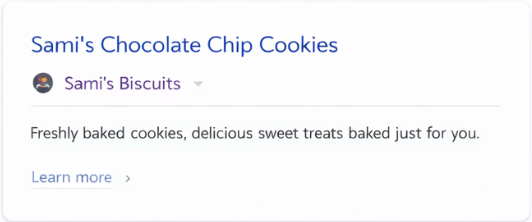
The result for the page that does not use schema markup shows:
- A title tag
- A meta description
- A link to ‘learn more’
- Traditional blue link to click
- Company name
After Schema:
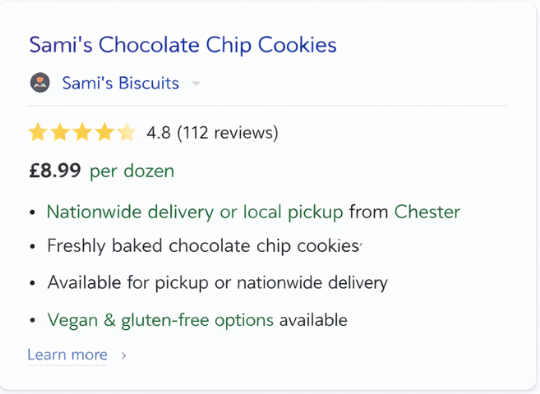
There’s a huge difference here. The page utilising schema markup shows:
- An AggregateRating summary of reviews
- Price details
- Delivery information
- Location information
- Variant information (vegan/GF options)
This illustrates how a search engine can take the data provided by effective schema markup and display it in a rich results format. However, it’s also a way to visualise how schema allows LLMs to understand and extract key pieces of information.
How To Implement And Validate Schema
Implementing effective schema markup isn’t as complicated as it might look, but it must be accurate and as descriptive as possible. Poorly implemented schema markup can be ignored by search engines and LLMs. It could even lead to incorrect data being shown, affecting trustworthiness and sales.
We’ve laid out the basic steps here for anyone attempting to utilise schema markup and structured data for the first time.
To make things clearer, we’ve added screenshots from a fictional product page, selling a cookie.
Step 1. Choose The Right Schema For The Right Page Intent
Analyse the intent of the page – both the intent of the business and the intent of potential visitors. Ask ‘what is this page doing?’ and from there, assign the relevant schema types. For example:
- Is it selling a product or service?
- Add Product Schema
- Add Offer Schema
- Add Review Schema
- Is it a guide or a process explanation?
- Add HowTo Schema
- Is it answering commonly asked questions?
- Add FAQ Schema
- Is the intent to increase brand and topical authority?
- Add Article Schema
- Add Author Schema
Don’t just add any old thing. Only add schema markup that reflects the visible content on the page. LLMs can see right through that, and it could affect the trustworthiness of the site.
Step 2. Create The Schema Markup Using JSON-LD
JSON-LD (JavaScript Object Notation for Linked Data) is the most commonly used format for creating schema markup. It’s also recommended by Google. JSON-LD sits separately from the HTML of the page, and doesn’t affect the design or layout.
Best practice templates and detailed guides can be found at schema.org, the source for all things schema. JSON-LD schema can be written up manually, however there are tools available to assist, such as:
- Google Structured Data Markup Helper
- Rank Ranger Schema Markup Generator
- Schema Markup Generator GPT
When generating JSON-LD schema, as much relevant information as possible should be added. For example, a product schema should go beyond a name and description. It should also contain:
- Price
- Currency options
- Availability
- Reviews
- Shipping/Return details
- Variants (size, colour, material)
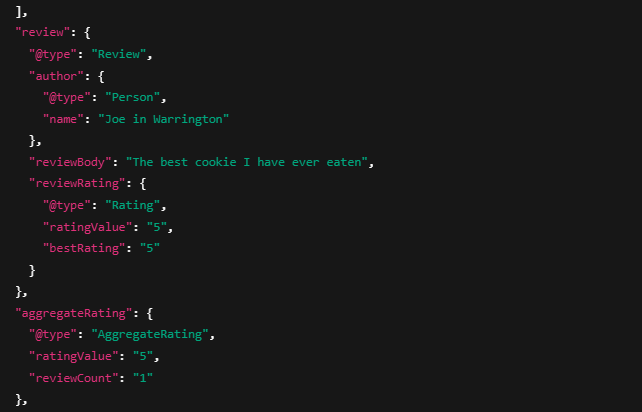
Here’s an example of schema markup generated using one of the tools listed above. The tool has generated different types based on the information provided.
For example, offer schema. After telling the tool the cookie cost £2.00 or 6 for £10 it generated the following:
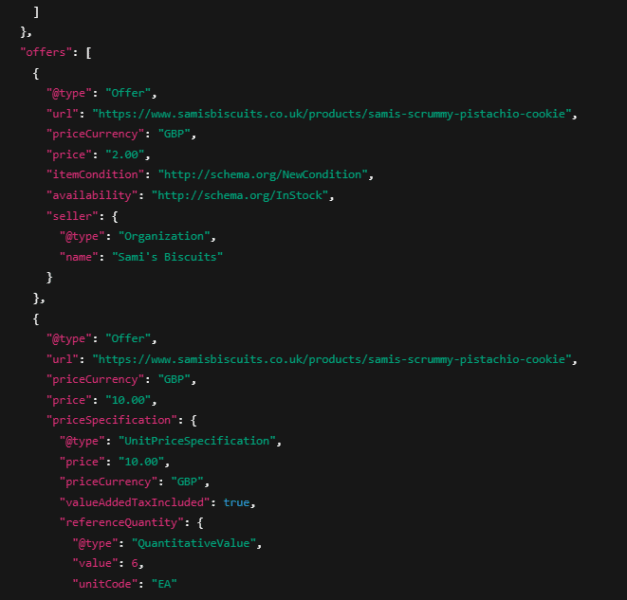
It also generated review and AggregateRating schema based on a given review.
Step 3. Add The Schema To The Page
The JSON-LD should be added to the page at this stage. The generated schema can be inserted into either:
- The <head> section
- Just before the closing </body> tag
It can also be added via Google Tag Manager. To learn more about Google Tag Manager and how it can be used, have a read of our article 5 Things You Didn’t Know You Could Do With GTM.
Step 4. Validate Created Schema
It’s hard to see whether everything has worked as you’d hoped simply by looking at the JSON-LD code. Fortunately, there are free and easy-to-use tools to check and validate the schema you’ve created. Use Google Rich Results Test or Schema.org Validator.
These tools can highlight errors and warnings, allowing them to be fixed and rechecked. In the example below, we can see which elements of the JSON-LD code have worked, and which need attention.
Step 5. Revisit And Update
If any changes are made to the information detailed in the schema markup, ensure they are reflected as soon as possible to avoid misinformation. Changes can be made in the same way that the JSON-LD schema was created initially.
Checklist: Essential Schema For LLM Visibility
It’s important to consider the page type you’re creating, and which types of Schema markup are essential, and which you can add to give a visibility boost for LLMs.
| Page Type | Essential Schema | Optional Enhancements |
|---|---|---|
| Blog/News | Article, Author | Breadcrumb, Publisher, ImageObject, DatePublished, DateModified |
| Tutorial | HowTo | EstimatedTime, Tool, StepNumber, Review, AggregateRating, ImageObject |
| FAQ Page/Section | FAQ | Question, Answer |
| Service Page | Organisation, FAQ | Offer, Review, Price, Offer |
| Product Page | Product, Price, Offer, Review, AggregateRating | Brand, SKU, ImageObject, ShippingDetails, ReturnPolicy, Colour/Size/Variants |
| Collection/Category | CollectionPage | BreadcrumbList, ImageObject, ItemList |
| Recipe Page | Recipe, HowTo | ImageObject, Review, AggregateRating, CookingTime, NutritionInformation |
| Event Page | Event, StartDate, EndDate | Location, Performer, Reviews, AggregateRating |
| Local Business Page | LocalBusiness, Organisation | OpeningHours, PriceRange, Review, AggregateRating |
Conclusion: The Competitive Advantage Of Schema Markup
With the rise of AI-driven search, structured data is becoming more than an optional extra when creating and optimising webpages.
Before, the main advantage of schema markup was simply enhanced search snippets on the standard ‘10 Blue Links SERP’. Now, it allows for these complex algorithms and LLMs to read the data, understand it correctly and cite it on search engines, in AI overviews, and in AI-powered search tools like ChatGPT.
Though schema markup is not a magic spell, it does give a competitive advantage over pages lacking proper schema implementation. When done well, schema markup helps signal authority and trustworthiness of pages, putting them in the best position to be found and cited, to maximise organic traffic. That’s why it’s so important to understand it and incorporate it into a content optimisation strategy.
Implementing schema markup properly isn’t as simple as adding a few lines of code. Knowing which schema types matter, how to structure your data, and how to connect entities in a way that search engines and LLMs trust takes technical expertise and strategic thinking. That’s why it’s advisable to seek professional guidance.
At Wildcat Digital, schema isn’t an afterthought; it’s part of the foundation. We help businesses audit their existing markup and implement structured data that aligns with real search intent. Take a look at our AI SEO and GEO Services to see how we can help improve visibility across both traditional search results and AI-powered platforms, or arrange a free consultation.