
Redirecting web pages is a necessary process for keeping your website organised and functioning properly. As a web user, you may not even realise that the web page that you are visiting has been redirected. Good, well-run websites seem to run flawlessly, linking web pages together without the user ever seeing a dreaded 404 page.
However, as a website owner, SEO, marketing executive or de facto youngest-person-in-the-office, you might have to resolve a broken URL or two. In this article, we have decided to provide a quick one-stop-shop for website redirection, and hopefully answer many of your questions about web page redirection. Reading this blog will allow you to save your valuable SEO assets, built on good URL structures that offer your services and products effectively.
So, what exactly happens when you need to redirect a web page, and how do you do it?
When you set up a redirect, you tell search engines, browsers and users to locate information, in this case, a web page at a different URL than the one originally requested. This new location can be issued by the website or server, depending on your redirect configuration.
Redirecting a URL can be a little laborious for the website crawlers who visit your site to index it. So Setting up the correct status codes and methods can help keep SEO value between old and new URLs.
Redirecting URLs still remains a practical and safe way to move change and relocate contents within your website. You can permanently or temporarily redirect URLs, however, which may have different effects on your website’s SEO.
There’s quite a bit to unpack, so without further ado, let’s jump into the topic of website redirects, SEO and how implementing them differently can affect this valuable business asset.
For more information on the value of your web pages and their internal and external links, catch up with our article What is Link Juice in SEO?

Jump to:
- What is a 301 Redirect?
- What is a 302, Found or ‘Moved Temporarily’ Redirect?
- Meta Refresh Redirects
- How to Set Up Redirects to Maintain SEO
- How to Check Website Redirects
What is a Web Page Redirect?
At a glance, website redirection can be broken down into essentially 3 groups:
- 301 or Moved Permanently
- 302, Found or Moved Temporarily
- Meta Refresh
You want to set up a redirect to your webpages as they are linked to throughout your website, and from others around the globe. These links make your web pages valuable, so you want to ensure that these links are preserved. If you can’t preserve them, redirect them.
You can redirect URLs in many different ways, however, these ways require the correct status code to issue correct information to website crawlers and browsers so that link relevance and value can be preserved.
Let’s take a look at each of these 3 website redirection types to see how each differs, how they can be implemented, and how each may affect your marketing efforts.
Important Note: it may be good at this point to export your 404 Redirects report from Google Search Console before attempting to execute any of the following methods. This will allow you to review your success, once your redirects are in place. If you use tools such as Sitebulb or Screaming Frog, then a URL status report before and after will allow you to monitor your redirects.
What is a 301 Redirect?
A 301 redirect is the name given to a server-side redirection directive. Using a 301 directive sends signals to Google and other search engines that the URL has permanently moved to another location. Googlebot, the website crawler which finds, reads and indexes web pages sees this redirection and canonicalises the old URL to the new.
A 301 response is a simple request for the browser to make another leap before it finds the content that needs to be shown to the user. A 301 is still a sign of a successful response from the server, however. You will then be relocated to the new URL without encountering any issues.
For SEO, a 301 isn’t perfect as making this extra leap can be seen as wasteful by the crawler. If this occurs too many times due to a misconfiguration or mismapping, this can lead to a redirect loop. As this is wasteful for the crawler, it can potentially have a negative impact on the SEO for that URL.
However, when configured correctly, it still allows you to retain most if not all of the SEO value associated with the old URL for the new URL.
Learn more about how Google crawls your website in our detailed blog, What Does Google See When it Crawls Your Site?
What is a 302, Found or ‘Moved Temporarily’ Redirect?
A 302 redirect is similar to a 301, except it lets crawlers know that the old URL will be back soon, so there is no reason to index the new, temporary URL that the crawler and users are being redirected to.
It isn’t clear how long ‘temporary’ is, but eventually, Google will start to treat a 302 as a 301 after a couple of months.
A 302 redirect is also a server-side redirection method. A 302 response from Googlebot’s perspective is a weaker version of a 301, and the old URL isn’t canonicalised the new URL automatically.
302 responses are seen as ‘weaker’ because the URL has been moved temporarily due to site maintenance, A/B testing, or if a product is temporarily out of stock. You may also want to use 302 in instances of location targeting, potentially when you wish to show a user a regional variant of a web page.
For SEO, 302 redirects can be useful if you want to simply move users to a different URL, but not change and reallocate link equity in the eyes of the Google bot from the original URL.
It should be noted that, if you have bookmarked a page within your browser, or you have viewed a recently redirected page, then Google may offer this cached version (ie, the old one) rather than the new, temporary one.
Learn more about 301 and 302 redirects in our recent blog, where we explain which is better to use.
Meta Refresh Redirects
A Meta Refresh redirect is served from the client side of the website load. Essentially, this redirect sits within your <head> much like your meta title or meta description. It informs the browser to load another page after a certain number of seconds.
Similar to a pop-up, a meta refresh usually results in a poorer user experience. Client-side or meta refresh redirects are often used when you can’t implement a redirect via the server, however, they do offer some SEO value according to Google.
You may have seen a meta refresh if you log into a website and you see a message similar to ‘you will be redirected in 5 seconds’, such as after a successful recaptcha.

How to Set Up Redirects to Maintain SEO
Setting up redirects is the job of an SEO as link equity is being traded between 2 URLs, and valuable link equity needs to be preserved.
As SEO professionals, we essentially try to increase the value of a URL by optimising the content on the page and making adjustments to its visibility from a user and crawler perspective.
Setting up the correct response code therefore preserves SEO value, and helps preserve your website’s value as a business asset.
Setting Up a 301 and a 302 Redirect
Once the page becomes valuable, we don’t want to lose this value if we change the URLs of the page. To keep this value, we now want to actually go about redirecting URLs, and there are a number of ways to do it. You can either:
- Using a plug-in such as Yoast or Redirection (user-friendly methods)
- Edit the .PHP file
- Using .htaccess on an Apache Server
Using a Plug-in such as Yoast or Redirection for Website Redirects
The easiest way to redirect URLs on your site is by a plugin such as Yoast or Redirection. To use these plug-ins, you will need to create a CSV document and map the old and new URLs.
Here’s an example:
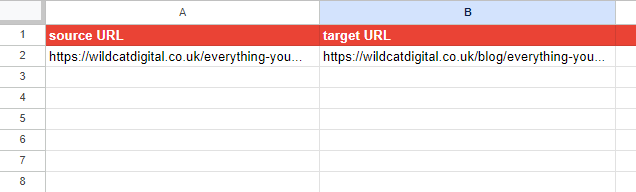
Here, we are redirecting this very blog to our blog subfolder on the Wildcat Digital website. We have the source URL (old) in column A, and our target URL (new) in column B. Once mapped, we will take this spreadsheet and upload it into a redirection tool (Redirection, Yoast etc.) via our CMS. In this case, WordPress.
The CMS will alter the records in its database, keeping note of the old URL, and setting up the new URL so that it will be shown instead.
As you can see, setting up redirects is actually quite easy if you have a little experience with Microsoft Excel or Google Sheets. Just remember to save the file in comma-spaced value (CSV) format, and your redirects should work after the import is complete.
Editing the .PHP File for Website Redirects
If you’re comfortable with code, another way to set up redirects is by directly editing your site’s .PHP files. This method is useful if you’re looking to avoid plug-ins or if you want more control over how the redirects are handled.
In your site’s root folder, you’ll find the functions.php file (or another relevant file, depending on the CMS or theme you’re using). You can add a custom code there to handle 301 or 302 redirects.
Here’s an example of a simple .PHP 301 redirect:
<?php
header(“HTTP/1.1 301 Moved Permanently”);
header(“Location: https://www.https://wildcatdigital.co.uk/blog/everything-you-need-to-know-about-redirects”);
exit();
?>
In this code snippet, we are instructing the server to permanently redirect the old page to the new URL. The status code 301 indicates that this is a permanent move. If you want to temporarily redirect the page, then you should use a ‘302’ status code.
Just like with the plug-in method, you’ll want to map your old and new URLs in a spreadsheet before adding your redirects to the PHP file. Once mapped, the developer or you can apply the code to ensure a smooth redirect process.
Make sure to back up your PHP files before making changes, as editing these files directly can affect the website’s functionality. If something goes wrong, then you can revert back to your saved .PHP files and potentially try again.
Using .htaccess to Redirect a Website
Some systems may also write directly to server-side configuration files like .htaccess (on Apache servers) or manage it internally. This means that you can redirect URLs within your website, without having to edit the .PHP files.
Another way to handle redirects is by editing the .htaccess file if your site is hosted on an Apache server. This method gives you server-level control and can be more efficient than using plug-ins, especially on large sites.
In the root directory of your website, you’ll find the .htaccess file. You can open it and add your redirect rules directly. For a 301 redirect (permanent), you’d use the following syntax:
Redirect 301 /www.https://wildcatdigital.co.uk/everything-you-need-to-know-about-redirects https://www.wildcatdigital.co.uk/blog/everything-you-need-to-know-about-redirects
Just like with the other methods, you’ll want to map your old and new URLs in a spreadsheet to keep everything organised. After mapping, apply the relevant redirect commands to your .htaccess file.
Make sure to back up your .htaccess file before making changes, as an incorrect rule can cause the website to break or become inaccessible.
Setting up a Meta Refresh Redirect
Setting up a meta refresh redirect means that you need to edit the <head> for a specific page, To do this, you can alter the <head> of your site using the Headers and Footers Plugin, and add a code similar to the one below:
<meta http-equiv=”refresh” content=”4; URL=’https://wildcatdigital.co.uk/blog/everything-you-need-to-know-about-redirects'” />
This redirect URL would sit on our defunct https://www.https://wildcatdigital.co.uk/everything-you-need-to-know-about-redirects page, and redirect you after ‘4’ seconds to the new …/blog/… URL.
This method is simple, however, if it is missed by an error in HTML parsing by a crawler or browser, then you may end up showing your old URL. It is therefore not recommended for preserving the value of your URLs.

How to Check Website Redirects
Checking website redirects can be as simple as trying to visit the old URL, and seeing if you are relocated to the new URL. However, in some cases, it may be best to use a website auditing tool such as Sitebulb or Screaming Frog to view a mass amount of URLs for you.
Another great way is to review Google Search Console for any signs of a page not being found. This can be done by inspecting the URLs individually, or by looking at your Search Console Report.
Search Console only knows what (and indeed where) your URLs display when it crawls them, so requesting a crawl of your redirected pages first would give you an up-to-date view of your redirection.
Any new ‘Not found (404)’ or potentially ‘Soft 404’ pages will alert you to a potential misdirection.

Setting Up Redirects with Wildcat Digital
Setting up redirects can be tricky, and you may have to audit your website using URL mapping and auditing tools like Screaming Frog or Sitebulb to crawl your site after the redirects have been implemented.
At Wildcat Digital, we use a combination of the tools and practices above to redirect URLs and help restore our SEO efforts to new URLs as your business develops. This allows your website to change, and integrate new products and services into your business’s URL structure, whilst preserving your SEO as an asset of your business.
If you would like to find out more about redirecting URLs on your website, growing your business, or even just making sense of URL mapping and redirection, then reach out to our friendly team, today.

Jon Herdman
SEO Executive