
Are you looking for ways to refresh your content strategy and boost SEO? Or perhaps you’re just getting started and are looking for the best ways to approach a content strategy. In this article, we go into detail about the concept of topical authority, explaining why it’s such a great content strategy, and how to gain topical authority.
Key Takeaways
Here’s a quick introduction to to topical authority and how to build it:
- Topical authority is the concept of becoming the go-to source for a given topic.
- This provides users with a wide variety of information about that topic, but also tells search engines that you are an authority on that topic, helping to boost SEO.
- To build topical authority, you need to publish content about every sub-topic relating to that original query.

What is Topical Authority in SEO?
Topical authority (not to be confused with domain authority) is the concept of becoming the go-to place for a given topic (or multiple topics). Not only is this beneficial for users, but it also tells search engines that you are an authority on that topic, helping to boost your rankings.
To put this into perspective, let’s take the topic of content SEO as an example. Writing just one blog about content SEO isn’t enough to solidify you as an authority on the topic. It’s a huge topic with a lot of competition. Plus, you couldn’t possibly cover everything about content SEO in one blog.
However, you can build topical authority by writing every possible blog relating to content SEO, breaking it down into sub-topics and looking at things from different perspectives. This is often referred to as content pillars or topic clusters.
For example:
- What is Content SEO?
- What Does Content SEO Include?
- Why is Content SEO Important?
- How Does Content SEO Fit Into the Wider SEO Strategy?
- Is Content SEO Better Than Technical SEO?
- Best Content SEO Strategies
You can achieve topical authority by fully covering a topic, rather than just publishing a single blog and targeting individual keywords. This way, you potentially could rank for every single keyword related to a desired niche.
Why Topical Authority is Important
When you create a number of blogs around the same topic and interlink them, in the eyes of search engines, your topical authority increases as you’re showing them that you are literally an authority and a trusted source on the topic.
As such, search engines will recognise the relevance of your content to a given search term and will likely return your content in search engine results pages (SERPS). Even if your website domain authority is relatively low compared to the competition, your topical authority on a given topic will result in your content being returned in SERPS. It is an effective strategy for websites that struggle to compete against high-competition.
How Does Topical Authority Work?
No one knows for certain how topical authority actually works, but we know that it relates to two things: relevance and E-E-A-T.
Relevance
We know for certain that Google likes relevance. Content has to be hyper-relevant to a search term in order to rank well. Gone are the days of keyword supremacy (although, they are still important); content must be well written, relevant and showcase experience, expertise, authority and trustworthiness.
E-E-A-T
E-E-A-T stands for experience, expertise, authority and trustworthiness; all of which you need to showcase in your content to prove that your content is of a high quality and should be ranked highly for a given topic. Learn more about E-E-A-T in our related blogs:

How To Build Topical Authority
There are five key steps to start building topical relevance on your website:
- Review and organise existing content into pillars or topic clusters.
- Do keyword research around each topic/pillar/cluster you want to focus on. Find all of the talking points within those topics.
- Organise these topics within your existing content pillars.
- Produce new content and optimise relevant existing content, working pillar by pillar.
- Build internal linking through your pillars.
1 – Review Existing Content
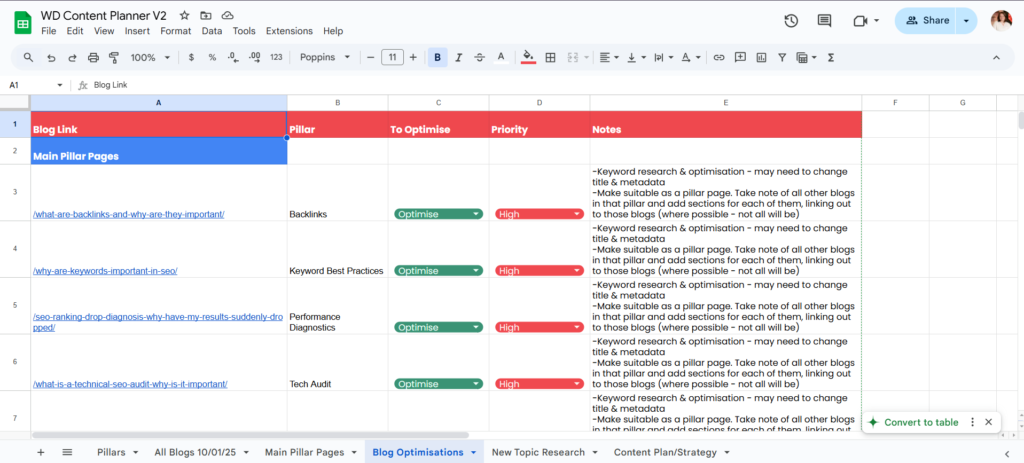
Before you start looking at new content, you first need to review your existing content. Sometimes they just need small edits to give them a large boost. We also want to ensure that they will fit within your new topic clusters.
First, bring together a list of all of your existing blogs in a spreadsheet. You’ll need to go through them one by one to determine if they need optimising, and to assign a topic cluster to each one. To determine if they need optimising or not, you’ll need to explore a few methods:
- Content Decay – Has the performance of the content decayed over recent months or over time? If it was once popular but has now seen a dip in traffic, this is a sign to refresh it.
- Keyword Rankings – Is the content ranking on pages two or three of search results? This has high optimisation potential and likely just needs a little extra content or E-E-A-T optimisation.
- Outdated Information – If a blog contains outdated information it’s time to update it. This includes outdated data, statistics, expired trends or obsolete technologies, just to name a few examples.
- Competitor Analysis – Keep an eye on what your competitors are doing. If they have recently published similar blogs to yours, this is a sign to review and refresh your version to remain competitive.
Learn more about how to spot optimisation opportunities in more detail in our blog, Is Blog Optimisation Worth It?
Other related blogs:
- How Often Should You Refresh Content for SEO?
- Is Blog Optimisation Worth It?
- How Do I Refresh Old Content for SEO?
(Do you see what we’re doing here…?)
2 – Keyword Research for New Content
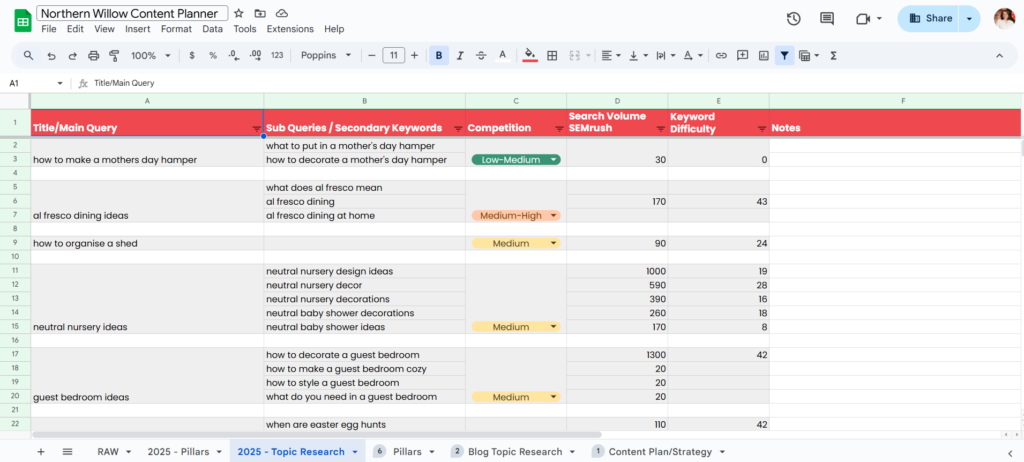
Next, you need to consider new content and how that works alongside your existing content and topic clusters. Take each cluster and conduct keyword research for each.
Choose a good seek keyword for each topic – something that isn’t too vague and clearly focuses on the topic – and explore keywords around that seed. Using a tool such as SEMrush or Ahrefs, you’ll be given a variety of keyword options, but we recommend focusing on the questions provided – these are ready-made blog titles that you know people want answers to. For example, let’s look at Content SEO again.
Using SEMrush, I’m presented with a list of potential topics I could write about, such as:
- What is Content SEO?
- How Do You Integrate SEO into Your Content?
- How Do You Write Content SEO?
- Does Content Marketing Benefit SEO?
You can also look at a feature called Keyword Strategy Builder that helps you to build content pillars or topic clusters. The feature works by taking a relevant keyword to your seed keyword and provides other related keywords. Similarly, SEMRush has a Topic Research Tool that works in a similar way, finding related topics based on your seed keyword.
Another great place to find relevant topics is Google’s People Also Ask section. Simply search relevant keywords and it will provide you with related topics that people actually ask. Click the drop down on any of them, and it will provide more.
You can also see what your competitors are doing. You can do this by simply reviewing the pages that appear for your relevant keywords, or by using SEMRush/Ahrefs – take a look at the SERP analysis under the Keyword Overview. Look for sites that have a relatively low Domain Authority (this is called Authority Score in SEMRush) but a good amount of keywords. From here, you can review their site and find some potential content ideas.
Put together a list of as many relevant keywords as possible per topic. Focus on long-tail keywords opposed to short-tail keywords.
Related blogs:
- What is the Difference Between Short and Long-Tail Keywords?
- Which Keywords Are the Best to Target?
- Is There a Downside of Having Too Many Keywords?
3 – Organise and Plan
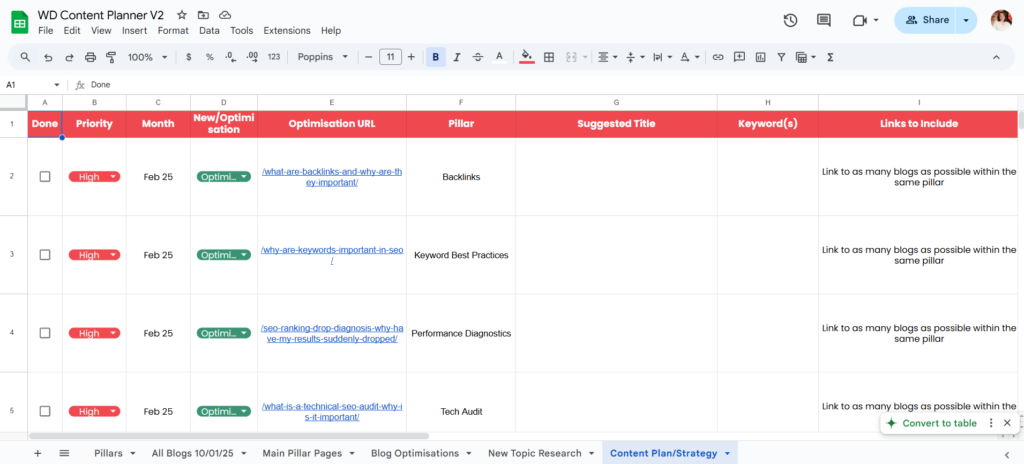
Now that you have finished your analysis and research, you need to put your strategy into a cohesive plan. We recommend first sorting everything by pillar (perhaps each in a new tab) and laying everything out as follows:
You’ll need columns for:
- A done/completed checkbox to keep track
- Priority
- Month/when you’ll be working on the content
- Whether it is new content or an optimisation
- Optimisation URL
- Suggested title
- Relevant keywords
- Marketing funnel stage
- Any links to include
You can of course add or remove from this list, but the information you would input here would give you (or a team member) a good plan of action.
4 – Write the Content
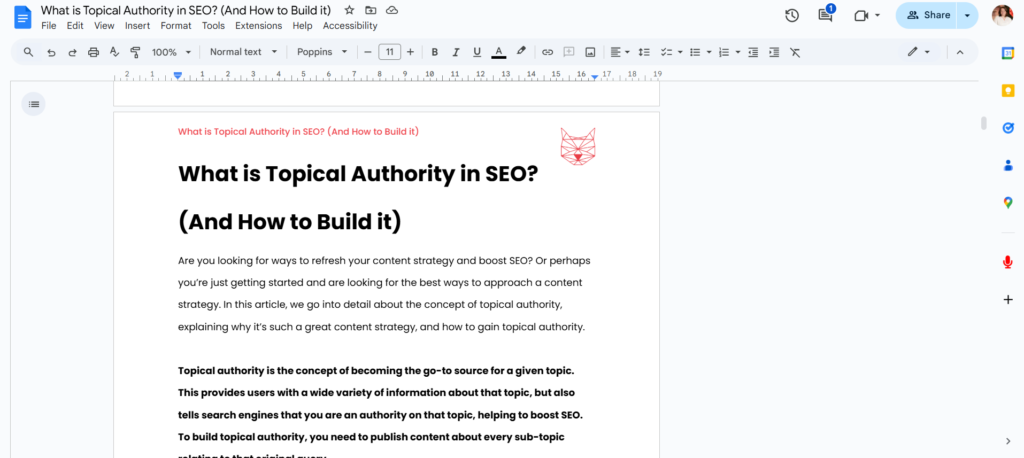
Take your plan and start writing and optimising the content. Start with blogs that could be used as a main pillar piece – something that would link off to other content. These blogs are quite broad (you may often see them as “Everything You Need to Know About XYZ” blogs) and give you the opportunity to write subheadings about each (or a number of) your subtopics, linking off to each of them.
Once the main pillar page is written, you’ll then need to work through the rest of that pillar’s content, remembering to interlink as you go (not forgetting to link from that original main pillar page).
Some key factors to consider when writing your content:
- Ensure your content is high-quality and the best possible source of information about that topic.
- Keep E-E-A-T factors in mind.
- Don’t forget internal links.
- External links to authoritative sources to show responsibility and trustworthiness.
Learn more about writing and optimising blog content in our detailed blog, How Do You Write E-E-A-T Content?
Other related blogs:
5 – Build Internal Linking
Ideally, you will build internal linking as you go, but don’t forget to put time aside to go back through your pillars and add links to newly uploaded content. Blogs in your pillars should all interlink, and ideally link to/from your main pillar page.
Related blogs:

Build a Sustainable Content SEO Strategy With Wildcat Digital
Ready to refresh your content strategy and reap the benefits of SEO? Wildcat Digital’s team of content specialists are here to help with bespoke Content SEO strategies tailored to your business and industry. We’re here to help you punch above your weight online.

Chloe Robinson
Content Strategist & Team Leader