
Spring has finally arrived, and with it comes another digital marketing news roundup!
This blog covers the latest news updates in digital marketing, SEO and PPC, plus some important dates for your marketing diary. Here are the key changes you need to know about.
Sky-High Keyword Volatility
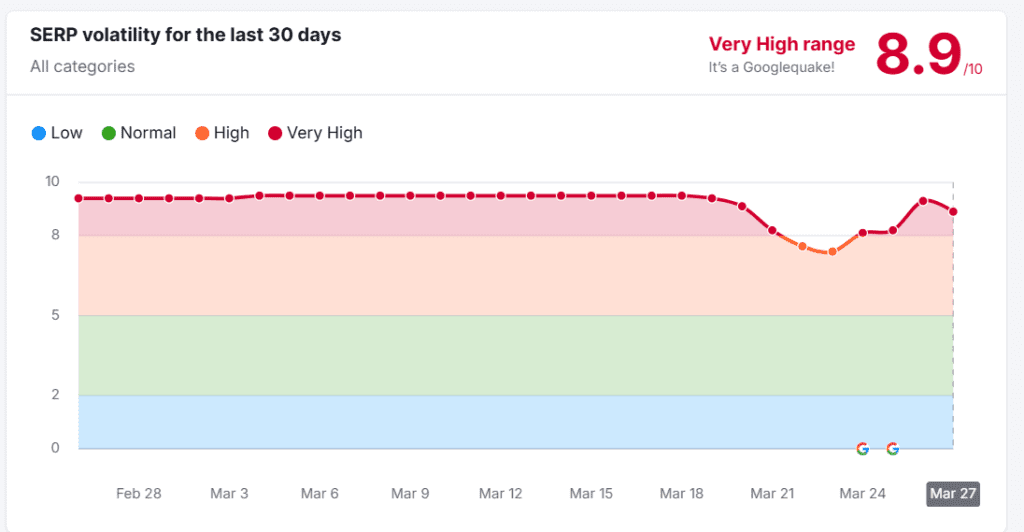
March has been plagued by exceptionally high keyword volatility – with Semrush Sensor reporting ‘Very High’ levels for nearly the entire month.
Why This Matters
High keyword volatility means lots of sudden shifts and drops in rankings. While volatility is not inherently bad, it does mean you need to be wary of making significant site changes as a result of a drop in rankings.
Instead, it’s essential to monitor performance closely and look for consistent trends rather than isolated dips. This helps to distinguish between normal SERP turbulence and genuine issues that require action, allowing you to make informed, measured decisions rather than reactive ones.
Google March Spam Update Completes in Under 20 Hours
Google’s March Spam Update started rolling out on 24th March 2026 and completed less than a day later on the 25th March.
On the Search Status Dashboard, Google stated:
“Released the March 2026 spam update, which applies globally and to all languages. The rollout may take a few days to complete.”
With no further information provided by Google, this is presumed to be a standard Spam Update, unlike the 2024 March 2024 update, which introduced new spam categories such as ‘scaled content abuse’ (mass-produced, low-quality pages).
What is a Spam Update?
A Google Spam update is an algorithmic update designed to penalise websites with low-quality content that violates anti-spam policies. Recent spam updates have focused particularly on identifying and penalising AI-generated content which has been produced with no or minimal human oversight and offers no value to users.
The March 2026 Spam Update was the first since the August 2025 spam update, which took nearly 27 days to complete.
Why This Matters
The 2026 March Spam Update aims to improve search quality. More and more, high-volume, low-quality AI-generated content is being penalised in the SERPs. Google’s SpamBrain is skilled at spotting patterns, and if large portions of your site are AI-generated, this can put the rankings of the entire site at risk.
With this update, combined with recent high volatility (according to tools like Semrush Sensor), SEOers are likely to see unstable rankings, including sudden drops and gains, until things start to stabilise. So, it’s important not to react too quickly to any negative keyword movement.

Google Analytics Launched Scenario Planner and Projections
Google Analytics has launched Scenario Planner and Projections, two new features designed to help advertisers plan and monitor cross-channel budgets. These tools are part of Google Analytics’ cross-channel budgeting feature, which is currently still in beta and not automatically available to every property.
What is the Scenario Planner Feature?
The Scenario Planner feature allows advertisers to plan for the future by modelling different budget allocations across channels and estimating how those changes could impact conversions, revenue or return on investment. It’s designed for pre-launch campaigns.
What is the Projections Feature?
The Projections feature allows advertisers to monitor and adjust live campaign budgets, depending on whether it’s on track to meet set KPIs. It’s designed for active campaigns.
Why This Matters
These tools help advertisers make more informed, proactive and data-led decisions by modelling future scenarios and tracking live performance against set goals. Ultimately, improving ROI and reducing the guesswork in your management of cross-channel marketing efforts.
Discussion Forum and Q&A Page Structured Data Documentation Update
Google has expanded its structured data support for forum and Q&A pages, adding new properties, including the digitalSourceType property that lets publishers indicate if AI created the content:
- Use TrainedAlgorithmicMediaDigitalSource for content created by LLMS.
- Use AlgorithmicMediaDigitalSource for content created by simpler algorithms, such as an automatic reply bot.
- Omit the property for human-generated content.
Google has also added commentCount as a recommended property for both Discussion Forum and Q&A pages. This lets you declare the total number of comments on a post or answer, even if not all the comments appear in the structured data. For Q&A pages, answerCount + commentCount should equal total replies of any type.
Google has also expanded the Discussion Forum documentation to include four supported subtypes of the sharedContent property:
- WebPage for shared links.
- ImageObject for posts where an image is the primary content.
- VideoObject for posts where a video is the primary content.
- DiscussionForumPosting or Comment for quoted or reposted content from other threads.
Why This Matters
These updates give publishers more transparency and control over how their forum and Q&A content is interpreted in the search results. The addition of the digitalSourceType property signals a growing focus on distinguishing between human and AI-generated content, which could impact how content is evaluated for trust and quality in the SERPs.

Google Tests AI-generated Headlines in SERPs
Google has started testing AI-generated headlines in traditional search results. This follows a similar pattern to when Google started rewriting headlines using AI in Discover last year – the test was termed “small”, but by the following month, it had become a fully fledged Discover feature.
Google confirmed to The Verge that the goal is to:
“identify content on a page that would be a useful and relevant title to a user’s query” and “better matching titles to users’ queries and facilitating engagement with web content.”
While Google has been rewriting title tags for years, the rewrites previously drew from on-page elements. Now, re-written title tags are appearing, which use phrasing that is not used anywhere in the content, suggesting generative AI is being used.
Why This Matters
This move toward AI-generated headlines means publishers now have less control over how their pages appear in SERPs. While optimising title tags is often an integral part of SEO strategy, this new feature means even well-optimised title tags may be replaced within AI-generated text that better matches the intent of a specific query.
Key Dates For Your Marketing Diary
As we move into April, which is also Stress Awareness Month, there are a few key events you should have marked in your marketing calendar:
- 1 Apr – April Fool’s Day
- 3 Apr – Good Friday
- 5 Apr – Easter Sunday
- 6 Apr – Easter Monday
- 7 Apr – World Health Day
- 11 Apr – National Pet Day
- 14 Apr – National Gardening Day
- 21 Apr – National Tea Day
- 22 Apr – Earth Day
- 23 Apr – St George’s Day
Stay Up To Date With Wildcat Digital
While staying up to date with the latest marketing news is a great way to stay informed, sometimes specialist expertise is needed to help your business get ahead, especially when the marketing landscape is changing so quickly.
Find out more about how Wildcat Digital can support your organisation with SEO and PPC. Arrange a no-obligation free consultation today, and start punching above your weight online.
Read More
For more news roundups, guides, explainers and tips on digital marketing, check out more of our Wildcat blogs:
- Quick Ways to Improve Conversion Rates on SEO Pages
- SEO Trust Signals: How to Build Authority with E-E-A-T
- External Authority Signals for SEO: Links, Mentions and Social Proof

Kezia Humphries
SEO Executive