
If you own a website, or you’ve sat in on a marketing meeting, you have heard people talk about ‘keywords’, and why keywords are important to SEO. However, if you are unfamiliar with keywords, then you might be wondering how they are so important to a website’s rankability, and what makes words ‘key’ at all.
A ‘keyword’ is any word that you aim to be the main topic of the content that is present on a webpage or website. This word is typically identified before content is created, and it is strategically placed within key areas of the text. This may include areas such as the introduction, headers, or titles to help the page be found for that keyword when that keyword is searched online.
You ought to research these vital keywords before you start writing to help your content fit a market gap.
Here at Wildcat Digital, we deal with keywords every day. So, in our ongoing effort to help our clients better understand keywords and their importance, we thought that we would turn the spotlight on one of the most important factors of online marketing: the keyword.
Jump to:
- Why Are Keywords Important in SEO?
- How Do Keywords Improve SEO?
- Where Else Are Keywords Important?
- How to Find Keywords
- Researching Your Market
- How Often Should You Use Keywords For SEO?

Why Are Keywords Important in SEO?
Keywords are perhaps one of the most important factors in SEO strategies. At its heart, SEO is an attempt to get search engines to find key strings of text on a website or webpage, and consider the content on that page to be the direct answer for a search query.
To help illustrate my point, let’s take a closer look at how Google works on a basic level.
Let’s say that we simply want to find out ‘how to start a career in digital marketing’. In this instance, we may want to use Google for our answer.
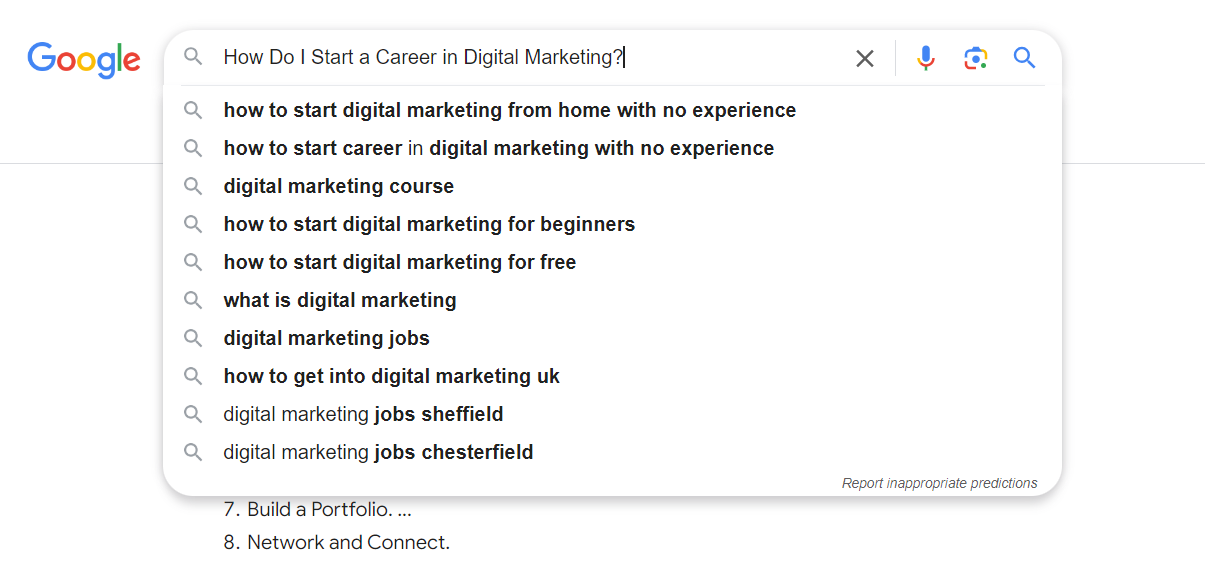
This search offers us useful articles, frequently asked questions, and resources around our chosen topic. However, how does Google know to serve this information in the first place?
Keywords play a vital role in identifying resources available online to help fulfil this search query. Google is essentially serving us the content which has the words from the search term in the content it ranks. This makes us consider the words in our content as the ‘key’ to getting this content to rank well on Google.
By serving useful content to the searcher, Google is doing its job by serving its users with useful content online.
However, this probably isn’t that surprising to you at this point. It is likely how you found this article in the first place.
Let’s take a closer look at how keywords played a role in presenting these results to Google users by looking at the content provided through just one of the results from Google’s Index.

Upon opening the page, we can see that the text features our query ‘How Do I Start a Career in Digital Marketing?’ at the very top of the page. Looking closer, we can see that this piece of text has been enriched with a special tag, known as a <h1> tag. This gives search engines a key identifier that the content (in this case, our Header 1 or Page Title) is key to the nature of the content below.

We can consider ‘How Do I Start a Career in Digital Marketing?’ our main keyword, in this case. However, we may also consider ‘start a career’ or ‘career in digital marketing’ to also be keywords in this case, as they are directly written in the <h1>, too.
When we Google this keyphrase, our article pops up on Google Search, offering information to our visitors and we achieve our goal of offering this information. Google also has provided a good resource to its users.
Keywords, in many ways, are a language that is used between content creators, businesses, website owners, webmasters, or forum users and search engines to help serve information to web users.
How Do Keywords Improve SEO?
Keywords improve SEO by allowing written text to be a simple interface between user and software. If SEO is a human instruction to get Google to show my webpage to its users, I have to give it (Google) some indication that I want it to do so.
It’s odd, but Google or AI actually doesn’t understand any query that is searched online. These tools simply convert what you have written into binary – a string of 1s and 0s – and compare this string to strings which exist within their databases.
Once this string is matched up, or the string of data is comparable to a similar string, then Google returns data from its database based on this query/ string.
As you can imagine, the internet is pretty big, so it makes sense for all parties to enrich certain strings with a higher priority than others to make these tasks quicker, easier, and more precise. This priority is essentially what we mean by ‘key’ when we talk about ‘keywords’, and making web search quick, easy and efficient is how SEOs make a living.
Review our Case Study: Achieving A 100% Increase In Keyword Rankings Through Content Seo
Where Else Are Keywords Important?
Once the main title of your page has been enriched with a keyword. You can then identify and enrich other areas on the content of the page, such as <h2>s, <h3> etc. and within the text itself.
Exact keyword placement isn’t the same for every site or page. There is no number of keywords that you can insert into a page that will get it to rank above other similar pages. It also isn’t the case that more keywords are better than fewer.
What is clear is that keyword placement ought to be natural to the text beneath it, but you can get creative with wordings to help squeeze in keywords using a creative use of language.
In this section of the blog, I am writing whilst bearing in mind that one of my keywords is ‘are keywords important’. This informed the header of this section ‘Where Else Are Keywords Important?’.
Perhaps it would be more grammatically correct to head this section with ‘Where Else Can You Use Keywords’, but that exact phrase doesn’t contain my keyword. It’s a balancing act between well-written content and SEO factors such as keywords.
So, keywords are important to content online as it helps align content and search terms. But where do we find keywords in the first place?
How to Find Keywords
As keywords are used to help search engines find content, products, services or snippets of information, they are used by marketers as a part of SEO strategies. In fact, SEO is vastly dependent on keywords, as these are the first aspects of a webpage or website when we are ‘optimising’.
As SEO is a branch of marketing, it is best to base your strategy around keywords and the marketing possibilities that they present.
Finding Keywords Using Semrush
In this section, we will use a powerful marketing tool called Semrush to find keywords and decide on whether to target them based on the frequency at which they are being searched (search volume) and current usage online already (keyword difficulty). You can also see if that keyword is currently being targeted by PPC campaigns and roughly the cost of targeting that keyword in dollars per click.
Later, keyword intent will also play a vital role in selecting our keyword, as modifiers such as ‘where’ and ‘how’ will change the style of result that Google returns to us. For instance, if you search ‘how to apply for a job in SEO’, you are looking for advice on the matter in blog form. Compare this to the intent behind the search ‘apply for SEO jobs’ may bring you a careers page.
Semrush breaks down its keywords into 4 categories, for which searches may look like:
- Navigational: ‘Where is hiring an SEO?’
- Commercial: ‘SEO Agency Sheffield’
- Transactional: ‘Buy Semrush subscription’
- Informational: ‘How do I start a career in SEO?’
Picking keywords is a compromise between high search volume with a high possibility ranking, but we also need to ensure that the intent behind our keywords is fit for our purpose, too.
Writing a blog optimised with the keyword ‘buy Semrush’ wouldn’t yield many views, as its purpose doesn’t align with the user’s intent.
Finding Keywords Using Google Search Console
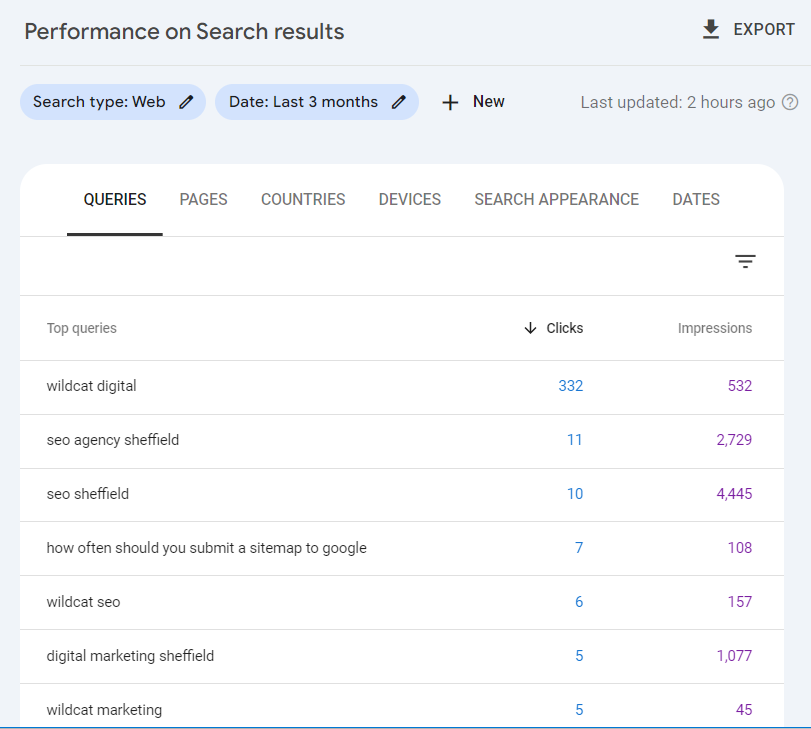
Using Google Search Console (GSC) is a free way to find keywords for which your content is starting to rank.
Adding GSC to your domain allows you to view the amount of clicks and impressions that your website is receiving for certain queries online. Impressions are a measurement of how often your site is being viewed, but not clicked on, within Google’s search results. Clicks are the number of times users have clicked through to your page, equating a click to a visit.
Using these metrics, you can find keywords for which your page already ranks, but does or doesn’t receive a click-through. Understanding this can give you insight into which pieces of content (and therefore the keywords associated with the content) are receiving a high number of impressions, but receiving a small number of clicks, and consider it for re-optimisation.
Researching Your Market
We research our market by simply typing into Semrush some queries around the topic of finding a job in SEO. Here are our results.
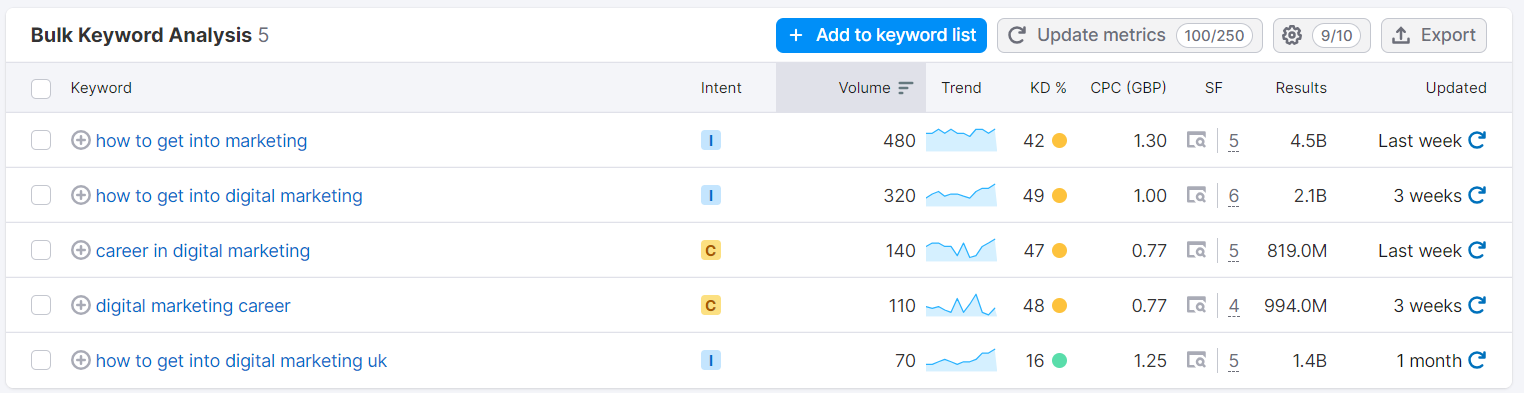
We can see our keywords in the left-hand column, and then ‘keyword intent’ shows that we currently are researching keywords with ‘Informational’ or ‘Commercial’ intent.
Next is our keyword volume. Depending on which tool you use, and from which dates you select, you get an estimate of the number of searches these keywords get across multiple online platforms such as Google over that set period. If we want to write content or display a product to people online, then surely it would be best to target the keywords with the most search volume.
Unfortunately, the ‘KD%’ column brings the keywords into focus. ‘KD%’ is known as ‘keyword difficulty’, and it is a metric that shows how difficult it may be for you to rank for this keyword based on existing market competition and positions. A higher KD% indicates that the keyword will be harder to rank for than with a lower KD%, with ‘harder’ meaning that the keyword is already being targeted regularly by big players in that particular marketing niche.
What we are searching for is ‘low hanging fruit’, or viable gaps in the market where search is high, but results are attainable.
At this point, our research doesn’t present us with a viable marketing strategy based on our desired outcome. We need to continue to research and find a marketable gap in the market.
Picking the Best Keywords
Looking again, we may want to opt for the keyword ‘how to get into marketing’ as this presents us with the largest market of searchers, and therefore the largest pool of potential customers we can market our product to. However, with a difficulty of 42%, there may be an easier path to getting our product or page seen.
Let’s take another look at Semrush.
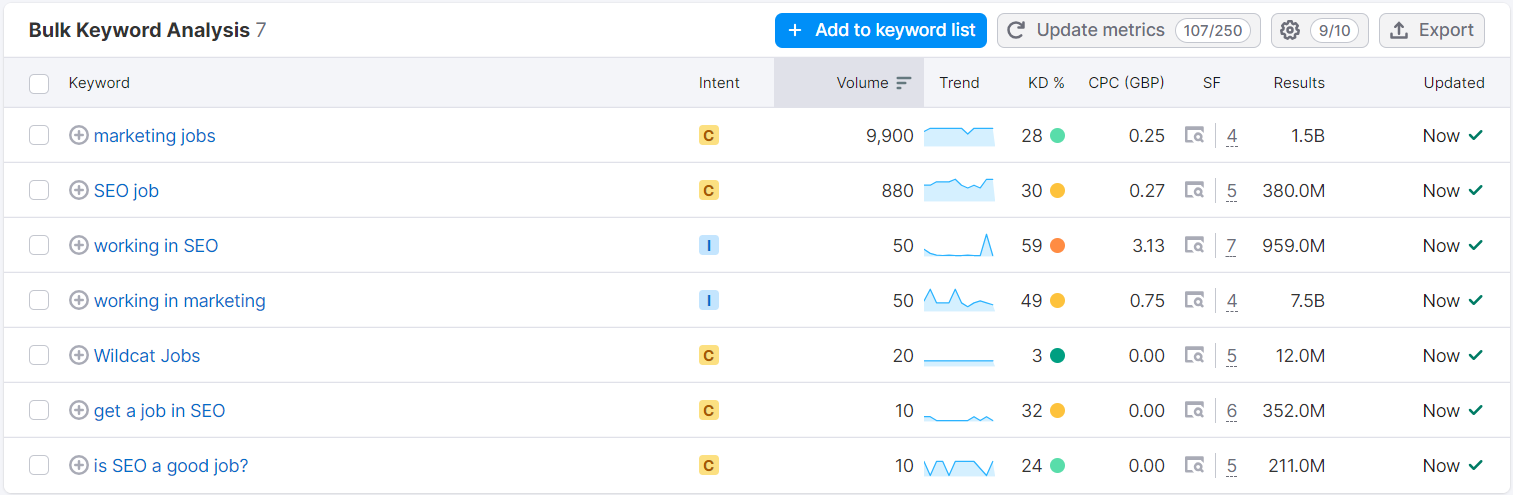
Broadening our scope slightly, asking questions and changing the length of our keywords presents us with further opportunities.
We can now select a combination of these keywords which match our intent, and our ability to rank, and we can also see an estimate of the volume of searchers per month that we are targeting.
We can now save and combine a mix of these keywords into our content strategy, and use it to inform the creation of usable marketing content.
Do SEO Keywords Need To Be Exact?
For the most part, yes, keywords have to be exact. However, as Google uses Semantic Search, you have a little wiggle room. As a rule, you can add words such as ‘a’ and ‘the’ to your keyword and still target them effectively. In this case, if there is volume behind ‘how to get job SEO’, then using ‘how to get a job in SEO’ as one of your keywords will likely yield results.
As search queries aren’t always written in good, clear English, SEOs often need to get creative with how they use keywords so that search engines can match up their index of content with the search term from the user.
Looking at our initial research again, we can see that we have some volume behind the keyword ‘how to get into digital marketing UK’. As this isn’t a natural use of English, we can change this keyword slightly for use in one of our key identifier locations (title tags, <h1> tags, introductory sentences etc.) to ‘how to get into digital marketing in the UK’.
This will be semantically understood by the search engine, and it will allow us to target the users who search for this keyword effectively. However, your keywords only need to be contained within your content, generally.
How Often Should You Use Keywords For SEO?
Whilst working in SEO is often a combination of writing, research and online technical development, at its heart, SEO is an attempt to use words and phrases to show search engines a product, service or piece of information. Creating these clear signals allows your intended audience to find your content, and then act how you want them to act. Taking a wider view, we essentially want web users to find us, and then complete our business objective, whatever that may be.
We need to use keywords sparingly as Google and other search engines can tell when keywords are crammed into content to attempt to ‘black hat’ the system. Google details this in their Spam Policy.
Cramming keywords can also lead to the user becoming alienated from your content or resource, too. You can often see this yourself when shopping online and less-than-scrupulous retailers have crammed their content full of inorganic keywords. The content is awkward, and users are less likely to ‘convert’ than with useful, well-written content.
Read up more on how to avoid keyword stuffing with our blog How to Avoid Keyword Stuffing – Keyword Best Practices.
Are More Keywords Better For SEO? Keyword Placement Explained.
Best practice dictates that keywords should be placed within the opening sentence of the text, as well as being used, where necessary, throughout the text as a whole.
This may mean that you may only mention the keyword in your <h1> and <h2>, plus once each below the headers themselves. This may be enough to get your page ranking within the top 10 results on Google.
More isn’t always more, and you can’t simply add your keyword over and over again and expect Google to rank you above your competition. As mentioned above, Google will actually negatively rank your page if you attempt to stuff your page with keywords, according to their Spam Policy.
For more information on how many keywords are the best for your content campaign, why not read our blog How to Avoid Keyword Stuffing – Keyword Best Practices?

Unlocking Your Keywords With Wildcat Digital
Wildcat Digital is an SEO agency based in Sheffield. We work with local, national and international businesses, helping them harness keywords and punch above their weight online.
As an agency, we conduct keyword research every day. We also monitor the performance of the content that we create and report to our clients on the improvements that these changes have made for their businesses.
For more information on the benefits that SEO has brought our clients, why not check out just some of our best campaigns through our case studies?
If your business needs a hand with finding and using the right keywords, then don’t hesitate to get in contact with our SEO department today.

Jon Herdman
SEO Executive