
As the modern landscape of search engines continues to evolve, so too does the content we see online. Whereas for previous iterations of Google’s algorithm, websites could produce blog after blog without considering their wider strategy, we are now seeing Google putting increased emphasis on the type and quality of content being uploaded.
It’s no longer enough to simply write content; you must consider the wider picture of your topical authority. For example, how deep does your content go, and how many topics do you cover? In this article, we’ll take you through content depth, content breadth, and how to effectively use both for your SEO campaign.
So, what is content depth and content breadth for SEO?
Both content depth and content breadth are vital considerations when producing content for an SEO-optimised website:
- Content depth – Producing long-form content that comprehensively provides an answer to a user’s query, focusing on a single keyword or topic and approaching it from every perspective.
- Content breadth – Creating content that covers several related queries with surface-level information.
Keep reading to learn more about the differences between each of these content types and how a combination approach can provide a positive impact for your SEO rankings.
Jump to:
- What Does Content Breadth Mean?
- What Does Content Depth Mean?
- How Does Google Evaluate Content Depth?
- When Does Content Depth Matter More than Content Breadth?
- When Does Using Content Breadth Make Sense?
- Examples
- How to Move from Content Breadth to Content Depth
- Summary
What Does Content Breadth Mean?
It’s a pattern we often see when we start working with small businesses. Either through their own volition or the direction of a previous SEO agency, business owners will oversee the production of numerous articles published to their website, offering little to no value for internet users. While there may be many articles covering a wide variety of topics, the content itself provides surface-level information on each of the topics. This demonstrates content breadth.
Content breadth typically involves producing many blog posts of around 800 words in length, targeting long-tail keywords.
When produced in accordance with SEO best practices, content breadth helps to build a network of related pages that target a collection of highly relevant keywords.

What Does Content Depth Mean?
Content depth, on the other hand, involves comprehensively covering a single topic and approaching it from as many different angles as possible. Content that provides depth is longer and uses various supporting content, such as:
- Case studies
- FAQs
- Expert quotes
- Internal links
While longer content doesn’t always equate to higher SEO rankings, providing suitable content depth where appropriate can help to build topical authority.
Having content depth means demonstrating to Google that you have a comprehensive understanding of a topic and can share this information in a concise format that users engage with.
Learn more about how to build topical authority by reading our detailed blog: What is Topical Authority in SEO? (And How to Build it)
How Does Google Evaluate Content Depth?
When evaluating content published on websites, Google primarily looks for content that provides convincing, direct answers to search queries. By comprehensively covering one topic and providing clear, informed answers to a user’s query and information that aligns with Google’s helpful content guidelines, you are making it clear to Google that you have expertise on the subject.
While Google penalises ‘fluff’ (tangential information), it favours well-structured, thorough, and concise content that satisfies the search intent of users. Content with good depth will often appeal to informational search intent, providing extra content for Google to extract the most relevant answer.
Content depth can be supported internally by connecting your content to other relevant pages and ensuring users can easily browse a number of sources in one session.
Learn more about how Google treats long-form content by reading our article: Does Long Form Content Rank Higher?
When Does Content Depth Matter More than Content Breadth?
If your website faces fierce competition in the SERPs, content depth provides the optimal way to stand out amongst other content. Building topical authority with long-form, comprehensive articles that target long-tail keywords will help increase engagement with your content and attract a highly relevant audience. To effectively stand out in the era of AI-driven search, your content must have depth that uses real-world examples and human insights.
Producing content that fully answers a few of the core topics of users’ queries will be rewarded by search engines, as opposed to numerous surface-level articles spread across many subjects.
AI models can easily handle surface-level content and broad overviews, but providing content depth will help your content gain visibility in SERPs and improve user engagement.

When Does Using Content Breadth Make Sense?
Content breadth is best-suited to situations in which you must establish your brand as a trustworthy source of information in the sector. For example, if you created a new website, covering a wide range of topics that provide surface-level information will help to prove to Google that your website is relevant to the keywords you have used and are targeting with your content. Creating content breadth will help with brand discovery and targeting diverse audiences to provide broad and shareable coverage.
If your brand offers products and/or services to various distinct buyer personas, you will need broad coverage across many topics to ensure there are various relevant entry points to your business.
Examples
In most SEO campaigns, using a combination of both content breadth and content depth will provide the optimal solution for improving website visibility and drawing in relevant, engaged users. On our own website, for example, we create topic clusters using a blog pillar strategy.
For example, we created a comprehensive blog pillar titled ‘Content Maintenance & Refresh’, which links to various related topics to comprehensively cover the subject of content maintenance. Some examples of providing content breadth from this pillar include producing blogs such as:
- SEO Content Audit: How and When To Review Your Content
- What Causes Keyword Cannibalisation?
- Identifying Thin, Duplicate and Overlapping Content to Improve SEO
- Evergreen Content Planning and Refresh Strategy
How to Move from Content Breadth to Content Depth
To ensure you are providing both content breadth and content depth in your content, a vital step is to review content already live on your website and evaluate how these pages fall into a wider pillar strategy.
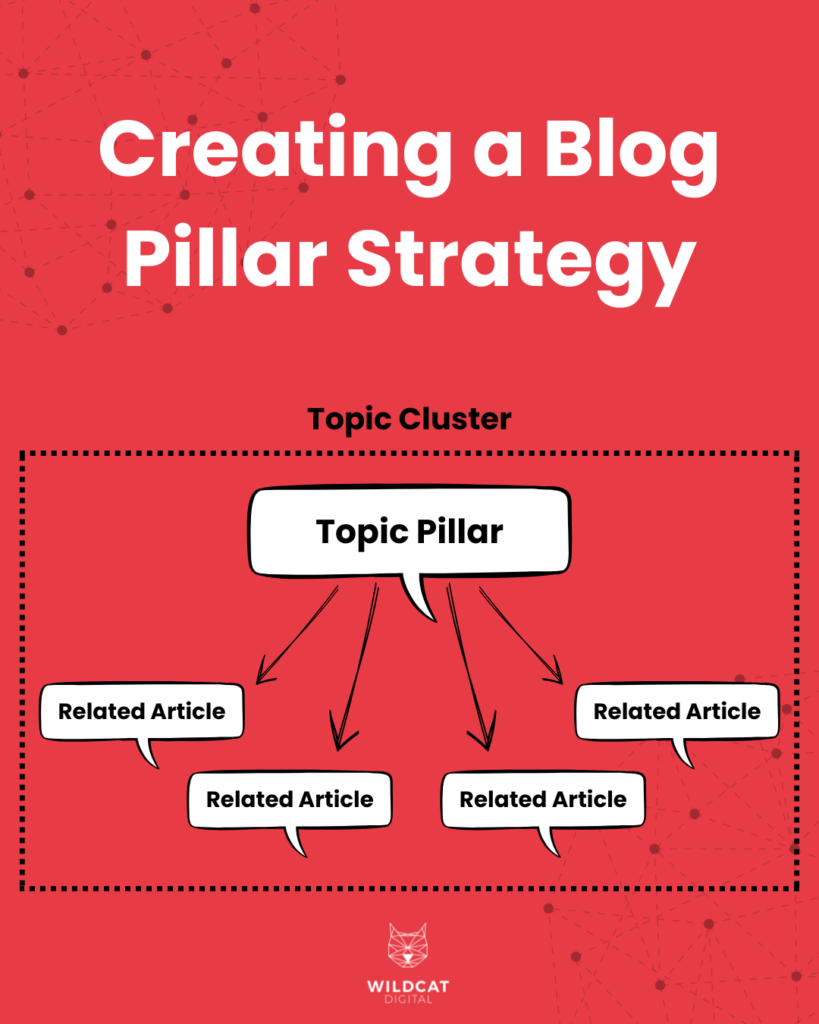
Ensure that for each topic you are covering, you are providing one in-depth article that comprehensively covers every aspect of the topic. This pillar article should then link to each relevant article that covers the nuances of the topic.
To find out more about creating the optimal blog pillar strategy, read our complete guide here: SEO Content Architecture pillar
In Summary:
- Both content breadth and content depth are vital aspects of a well-structured, SEO blog strategy
- Providing depth to your content will help to encourage users to engage with your website
- Google favours content that provides concise and comprehensive answers to user queries
Speak to the SEO Experts at Wildcat
To learn more about building topical authority and enhancing your content, speak to a team of SEO professionals.
At Wildcat Digital, our SEO experts produce successful blog pillar strategies for businesses across the world. Contact us today for a free consultation.

Andy Blanchard
Senior SEO Executive