
Evergreen content is seen as the foundation of a successful SEO strategy, but the initial creation is only half the battle. To deliver consistent traffic and long-term value, evergreen content needs to be carefully planned, regularly reviewed, and continuously improved.
Evergreen content is content that stays relevant over time and continues to drive consistent traffic. However, it requires regular updates to maintain rankings and relevancy. A strong evergreen content strategy includes planning, ongoing optimisation, and refreshing content to match evolving search intent.
Read on to learn how to plan, create, and refresh evergreen content so that it continues to perform in search and deliver long-term SEO value.

What Does Evergreen Content Mean?
Evergreen content is search-optimised content that remains relevant and valuable to readers over time. It can:
- Targets consistent search demand
- Answers ongoing questions
- Builds long-term traffic and authority
A blog about a recent event will slowly decay in traffic as time goes on, and less and less people are interested in it. However, a blog about how hot the sun is will always be relevant, because the sun will always be present (hopefully).
Creating high-quality evergreen content is essential if you want a steady stream of organic traffic and compounding SEO returns.
What is NOT Evergreen Content?
Evergreen content should retain its value for a very long time and have no set expiration date. Here are some pieces of content that aren’t evergreen:
- News articles and current events
- Statistics or reports that are likely to become irrelevant quickly
- Pieces about a specific holiday or season
- Product reviews for the latest generation or model
- Articles focused on a current trend
- Latest clothing and fashion trends
At Wildcat Digital, we regularly write monthly digital marketing news roundups. Although these are useful and provide lots of timely and relevant information to readers, they aren’t evergreen content and traffic will likely drop significantly as they become less relevant a few months after they are published.
Seasonal vs. Trending vs. Evergreen Content
Seasonal content is only relevant at specific times of the year, for example, ‘10 Date Ideas for a Perfect Valentine’s Day.’ Trending content is only relevant for a limited period, for example, ‘Everything You Need to Know About the Google December 2024 Core Update’. Neither seasonal nor trending content is evergreen as it doesn’t stay relevant all year long or for a very long time.
- Seasonal Content: Relevant at specific times (e.g. Valentine’s Day ideas)
- Trending Content: Short-term spikes (e.g. Google Core Updates)
- Evergreen Content: Long-term, consistent relevance
The most effective strategy combines all three – but evergreen content should form the foundation of your strategy.

Why Evergreen Content Still Decays Over Time
A common misconception is that evergreen content will rank indefinitely. In reality, even the best content declines without maintenance.
Here’s why:
1. Outdated Information
Statistics, tools, and best practices change. Even laws that seem like they’ll exist forever will often have frequent adjustments that need to be updated. Content that isn’t updated will quickly lose credibility.
2. Shifts in Search Intent
Google’s search results pages evolve over time. A keyword that once returned only blog posts could now favour:
- Video content
- Comparison pages
- Product-led results
- Map packs
- AI overviews
This could even be as simple as suddenly preferring a high-authority competitor site. One of my clients held the 1st place position for a keyword about tax for years, suddenly, we saw Google prefer the .gov website instead – bumping us to 2nd. Monitoring this and ensuring that we made adjustments immediately meant that we were able to recover this placement.
3. Increased Competition (Including AI Content)
AI tools have made it easier to produce large volumes of similar content, increasing competition for evergreen topics. Even AI Overviews on Google started scraping up a lot of websites’ traffic, since the answer to the user’s query was suddenly found right there on the search page.
4. Algorithm Updates
Google increasingly rewards:
- Depth
- Original insights
- First-hand experience
If you wrote your content 5 years ago, when we didn’t need to consider these factors as much, you could see your content performing worse over time.

Evergreen Content Benefits
Creating evergreen content should be a key part of your wider content marketing strategy. Here’s an overview of some of the main benefits of creating evergreen content for your business:
Provides a Higher Return on Investment
Evergreen content can often provide you with a better return on investment compared to trending or seasonal content. This is because evergreen content stays relevant for a long time, providing you with a consistent stream of traffic and the potential for leads and conversions.
Improve Your Topical Authority
Evergreen content often focuses on answering common questions (such as this blog, ‘What is Evergreen Content?’) that can demonstrate to Google and your target audience that you’re an expert in your field or industry. Learn more about what topical authority is and how to improve it in our blog, ‘What is Topical Authority in SEO? (And How to Build it)’.
Earn More Backlinks
Websites with lots of backlinks tend to rank higher in the search results and because evergreen content remains relevant for a long time, it has the potential to attract more backlinks. This can help improve your website’s overall rankings by improving the keyword performance of your product or service pages.
Learn more about backlinks in our blog, ‘What Are Backlinks and Why Are They Important?’.
Consistent Flow of Traffic
Creating optimised evergreen content is one of the most effective ways to drive a steady stream of traffic to your website. Unlike with seasonal or trending content, you won’t need to worry about drops in traffic and it should stay consistent.
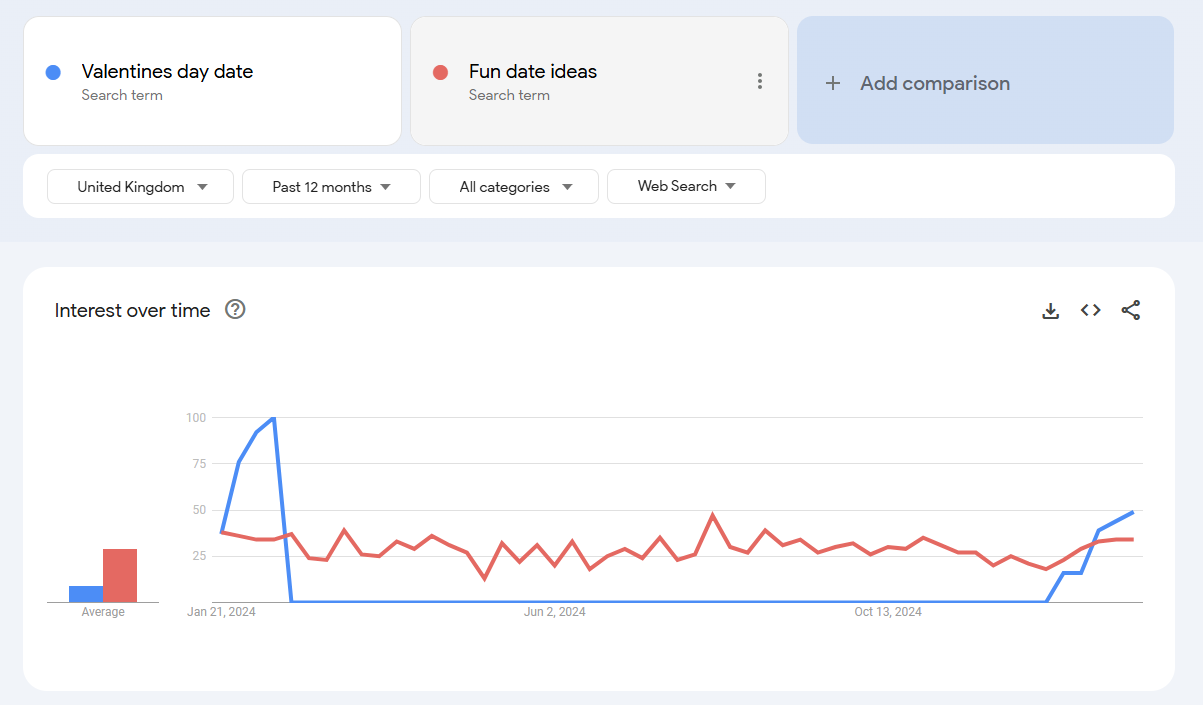
Below you can see the difference in search volume (using Google Trends) between a seasonal search term ‘Valentine’s Day Date’ and an evergreen one ‘Fun Date Ideas’. Writing a blog on ‘Fun Date Ideas’ is more likely to provide your website with a much steadier and more consistent stream of traffic.
Evergreen Content Ideas and Examples
Many formats work with evergreen content. Here are some of the most commonly used formats to give you some inspiration with real-world examples:
1. How-to-guides
How-to guides break down a process or skill into clear, actionable steps. The key to How-to guides is to choose a topic that won’t go away, such as our blog “Identifying Thin, Duplicate and Overlapping Content to Improve SEO”, which walks users through the process of finding and addressing thin, duplicate, and overlapping content – a topic that will always remain relevant in SEO.
2. Comprehensive Guides
Comprehensive guides will cover a topic from every possible angle. These posts answer most, if not all, questions your audience might have on a subject. For example, our guide “SEO Content Audit: How and When To Review Your Content?” offers in-depth explanations on a range of topics related to the title, such as the best tools for completing your audit.
3. FAQs
FAQ-style content targets common questions that your audience frequently asks, providing clear and thorough answers. A post like “What Causes Keyword Cannibalisation?” explains the causes and effects of cannibalisation and offers practical advice on how to address it. Because the question itself is evergreen, the content remains relevant.
4. Listicles
Listicles combine tips, strategies, or resources into an easy-to-understand format. A well-made listicle like “Top 10 Tips on How to Do SEO for Vets” allows users to return to it repeatedly as a reference, and the advice can remain valuable for years with only minor updates.
It’s important to remember that writing in one of the above formats does not automatically make your content evergreen. You also need to ensure that the topic covered or question being answered will be consistently relevant to your audience for a long time.

How to Create Evergreen Content That Ranks Well
One of the main challenges with creating effective evergreen content that ranks well in search engine results is that it can feel like most topics have already been covered. This can make it tricky especially if you’re a small business that is just starting out with your content marketing strategy. One of the best ways to create evergreen content that will rank highly is to focus on smaller niches and topics within your industry.
We go over this in more detail below
1. Choose an Evergreen Topic (and Narrow it Down)
Start by choosing a timeless evergreen topic you want to focus on and then narrow that down. For example, if you run a renovation company, you might choose to focus on kitchen renovations. Then you need to think of all the questions your target audience might have about this topic:
- Price
- Time
- Planning permission
- Kitchen styles
- Mistakes to avoid
Once you’ve come up with your questions, you can then choose one specific question to focus on. For example, you might write a blog called ‘How Much Does a Kitchen Renovation Cost?’. Generally, this will be a better way to rank than writing a more general blog on kitchen renovations.
2. Select Evergreen Keywords
If you want your evergreen article to rank in the search results, you need to target the right evergreen keywords. For the topic of kitchen renovation, you could put this phrase into an SEO tool (we’ve used Semrush’s Magic Tool in the picture below). This will give you all the phrases people are searching for about kitchen renovation. You can also select ‘questions’ so that you’re only shown question-based keywords which is really useful when you’re writing evergreen content.
Try to choose keyword phrases with a high search volume but a low keyword difficulty.
On Semrush you can also easily check if a particular keyword is evergreen by clicking on ‘keyword overview’ and then ‘trend’. Let’s click on the top question keyword ‘how much does a kitchen renovation cost’. Under ‘trend’ you can see the search volume data for the last 12 months. Although there have been some dips, it has remained largely consistent indicating that it’s an evergreen keyword.
3. Follow SEO Best Practices
Once you have chosen your topic (kitchen renovation cost) and keyword (how much does a kitchen renovation cost), you can choose your title – an obvious choice for this example would be ‘How Much Does a Kitchen Renovation Cost?’.
You’re then ready to create your evergreen content. Below we’ve put together our top tips for creating engaging and SEO-optimised evergreen content.
Our Top Tips on Writing Engaging and SEO-Optimised Evergreen Content
Here are some tips to follow when creating evergreen content:
- Include your selected keyword in the title, title tag, URL and throughout the body copy. Make sure to avoid keyword stuffing!
- Link to similar blogs you’ve written or relevant products or services. You can also link to useful information on other websites (just make sure the website is authoritative and trustworthy).
- Show off your expertise. Make your evergreen content as detailed and informative as possible. If you have an expert in your business, you can include expert quotes or unique insights to make the content more engaging.
- Write for beginners. Although you want to show that you’re an expert, you don’t want to alienate your readers. Remember that most people who are searching for question-based keywords are doing so because they want to know more about a topic or know an answer to a specific question. Try to avoid jargon and explain any specific industry terms.
- Include visual elements where possible. Add pictures, diagrams, infographics and videos to make your content more engaging and help readers better understand the topic.
- Regularly update and refresh your evergreen content. Even though evergreen topics have a very long lifespan, this doesn’t mean that evergreen content doesn’t need to be updated regularly. Ensuring that all your information is still relevant and correct, and making improvements to your content is the best way to ensure your evergreen content continues to perform well.

How to Build an Evergreen Content Calendar
To keep evergreen content performing over time, you need a simple system for reviewing and updating it regularly.
Start by auditing your existing evergreen posts to identify which pages are still performing well and which are starting to decline. As you review them, assign a refresh due date to each piece so that updates are planned rather than reactive.
Next, decide how often each page should be reviewed. High-value or competitive pages may need updating every six months, while others can be reviewed annually. It’s also important to remain flexible – if rankings drop or search results change, you may need to refresh sooner.
Finally, build in regular checks for competitor updates and new keyword opportunities. If competing content becomes more detailed or starts targeting new queries, your content should evolve to match. Over time, this ensures that your evergreen pages stay relevant.
Example Evergreen Content Calendar
A simple evergreen content calendar doesn’t need to be complex, but it should provide clear visibility over when content was last updated and when it needs to be reviewed again.
| Content Piece | Type | Last Updated | Next Review | Priority |
|---|---|---|---|---|
| Site Speed Guide | Evergreen | Jan 2025 | Jul 2025 | High |
| SEO Basics Guide | Evergreen | Mar 2025 | Mar 2026 | Medium |
| Internal Linking Guide | Evergreen | Feb 2025 | Aug 2025 | High |
How to Refresh Evergreen Content
Refreshing evergreen content is where long-term SEO gains are often won. Rather than starting from scratch, improving an existing piece of content allows you to build on its authority, retain existing rankings, and better align with current search intent. The most effective updates focus on strengthening value, not just making small edits.
Below are the key techniques to focus on when refreshing evergreen content:
Update Data, Quotes or Sources
One of the quickest ways to improve a piece of content is by ensuring that all of the information is accurate and up to date. Over time, statistics become outdated, tools evolve, and industry best practices shift.
When reviewing your content, look for:
- Old statistics that can be replaced with more recent data
- Outdated tools, platforms, or examples
- References to studies, reports, or sources that may no longer be relevant
Expand with New FAQs or Related Sections
Search intent often evolves, and what was once a complete article may now feel limited compared to newer, more comprehensive content.
Take a look at the current:
- “People also ask” questions
- Competitor subtopics you haven’t covered
- Gaps in your current content
Improve Internal Linking and Schema Markup
As your website grows, your internal linking opportunities increase. Refreshing older content is a great time to strengthen these connections.
Focus on:
- Linking to (and from) newer related blogs
- Adding links to key services or pillar pages
- Updating anchor text to better reflect target keywords
- Enhancing schema markup, such as FAQ or Article schema
Add Multimedia to Match Modern SERPs
Search results are becoming more visual and interactive, with content that doesn’t evolve falling behind.
Consider including:
- Short explainer videos
- Infographics or diagrams
- Screenshots or step-by-step visuals
Wildcat Case Study: Refreshing Evergreen Content
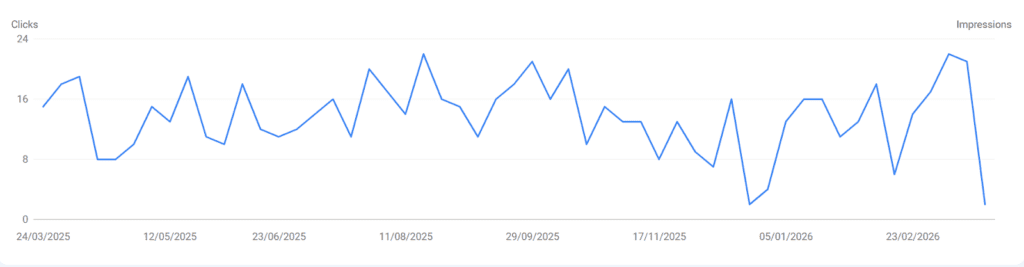
The blog above started to see a small decline in traffic from around mid-October through to November (ignoring the expected Christmas drop). Because we constantly monitor the performance of our clients’ blogs, we managed to catch this early, planning a new optimisation of the content, updating it to include new tools and best practices, as well as improving the user experience with new text & image sections that look a lot more appealing and improved engagement.
With this, we were able to regain our traffic and rankings in around 5-6 weeks, ensuring that we came into the new year with the blog actually growing rather than declining.
How to Promote Evergreen Content
Once you’ve taken the time to craft a high-quality piece of evergreen content, don’t just upload it and forget about it. Instead, take the time to promote your valuable article so that it can be read by more of your target audience.
Here are a few techniques you can use to promote your evergreen content:
- Share your evergreen article on your social media channels. You can even break up the blog post and share it across multiple posts. Include key points or create an engaging infographic based on the information in the article.
- Highlight your evergreen posts on relevant pages. For example, if you have a kitchen renovation service page on your website, you could include all evergreen blogs about that topic at the bottom of the service page.
- Include your evergreen blogs in your email newsletters. You could even segment your email lists and send relevant blogs based on your subscribers’ interests.
- Send high-quality evergreen articles to other websites. Contributing articles to relevant websites in your industry is a great way to get your content seen by a larger audience and receive a valuable backlink for your website.
Future-Proofing Your Evergreen Content
To remain effective, your evergreen content needs to evolve alongside search behaviour, competition, and industry changes.
Future-proofing your content means committing to regular audits, monitoring performance, and making continuous improvements. It also means aligning your content with a broader strategy, rather than simply treating each piece as an isolated one.
This is why evergreen content sits at the centre of your content strategy. For more information on content maintenance and regular content refreshes, see our guides below:
- SEO Content Audit: How and When To Review Your Content
- Identifying Thin, Duplicate and Overlapping Content to Improve SEO
- What Causes Keyword Cannibalisation?

Perfect Your Evergreen Content With Wildcat Digital
At Wildcat Digital, we offer comprehensive SEO services that include creating high-quality evergreen, seasonal and topical content to help drive relevant traffic to your site and help you punch above your weight online. Our expert team can create an effective content strategy that follows SEO best practices and fully harnesses the power of evergreen content.
Contact us today to find out more.

Jamie Stowe
Senior SEO Account Manager